University Children's Hospital, Belgrade, Serbia.
Faculty of Medicine, Institute for Medical Statistics and Informatics, University of Belgrade, Belgrade, Serbia.
BMC Urol. 2022 Sep 21;22(1):155. doi: 10.1186/s12894-022-01105-5.
To examine the reduction of transverse rectal diameter and its effect on bladder dynamics in children with spinal dysraphism.
We prospectively evaluated 61 consecutive children with spinal dysraphism, 25 (41%) boys and 36 (59%) girls, aged 4 to 16 years; mean age 9.3 ± 3.8 years, who received bowel management. All children underwent echosonographic measurement of transverse rectal diameter before and after starting bowel management. Also, all the patients had undergone urodynamic studies before and after starting bowel management, with no changes in their urological treatment.
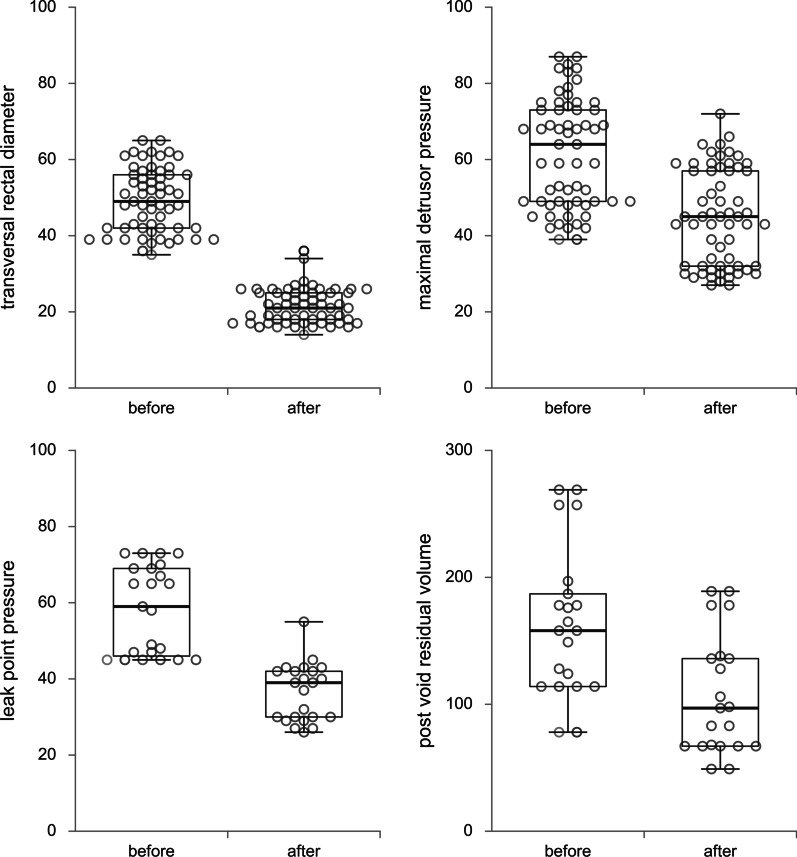
Bowel management caused an decrease in transverse rectal diameter by 56 ± 7.2% (p < 0.001). In addition, a decrease was observed for maximal detrusor pressure by 27.8 ± 7.8% (p < 0.001), leak point pressure by 37.2 ± 4.4% (p < 0.001), and PVR by 36.7 ± 8.0 (p < 0.001). Maximum bladder capacity was significantly increased after bowel management in both non-adjusted (36.4 ± 14.8%; p < 0.001) and adjusted analysis for age (39.4 ± 14.3%, p < 0.001). Detrusor compliance was also increased by 89.2 ± 24.8% (p < 0.001). Female gender and % change of maximal detrusor pressure were significant predictors of transversal rectal diameter change in univariate as well as in multivariate analysis (OR = 10.548, 95% CI 2.309-48.180; p = 0.002 and OR = 1.121, 95% CI 1.009-1.245; p = 0.034).
Decrease in transverse rectal diameter may be useful for bladder function and urodynamic findings in children with spinal dysraphism. Therefore, decrease in transverse rectal diameter should be a supplement to standard urotherapy.
研究脊髓脊膜膨出患儿直肠横径减小及其对膀胱动力学的影响。
我们前瞻性评估了 61 例连续脊髓脊膜膨出患儿,其中男 25 例(41%),女 36 例(59%),年龄 4 至 16 岁,平均年龄 9.3±3.8 岁,均接受肠道管理。所有患儿在开始肠道管理前后均行直肠横径超声测量。所有患儿在开始肠道管理前后均行尿动力学检查,且其泌尿系统治疗无变化。
肠道管理导致直肠横径减小 56±7.2%(p<0.001)。此外,最大逼尿肌压力降低 27.8±7.8%(p<0.001),漏点压力降低 37.2±4.4%(p<0.001),PVR 降低 36.7±8.0(p<0.001)。在非调整分析(36.4±14.8%;p<0.001)和调整年龄分析(39.4±14.3%,p<0.001)中,肠道管理后膀胱最大容量均显著增加。逼尿肌顺应性也增加了 89.2±24.8%(p<0.001)。在单变量和多变量分析中,女性和最大逼尿肌压力变化百分比均为直肠横径变化的显著预测因素(OR=10.548,95%CI 2.309-48.180;p=0.002 和 OR=1.121,95%CI 1.009-1.245;p=0.034)。
直肠横径减小可能对脊髓脊膜膨出患儿的膀胱功能和尿动力学发现有用。因此,直肠横径减小应作为标准尿路治疗的补充。