
经皮冠状动脉介入治疗后血流储备分数的预后意义:系统评价和荟萃分析。
Prognostic Implications of Fractional Flow Reserve After Coronary Stenting: A Systematic Review and Meta-analysis.
机构信息
Department of Internal Medicine and Cardiovascular Center, Seoul National University Hospital, Seoul, Korea.
Department of Cardiology, The Second Affiliated Hospital, School of Medicine, Zhejiang University, Hangzhou, China.
出版信息
JAMA Netw Open. 2022 Sep 1;5(9):e2232842. doi: 10.1001/jamanetworkopen.2022.32842.
IMPORTANCE
Fractional flow reserve (FFR) after percutaneous coronary intervention (PCI) is generally considered to reflect residual disease. Yet the clinical relevance of post-PCI FFR after drug-eluting stent (DES) implantation remains unclear.
OBJECTIVE
To evaluate the clinical relevance of post-PCI FFR measurement after DES implantation.
DATA SOURCES
MEDLINE, Embase, and the Cochrane Central Register of Controlled Trials were searched for relevant published articles from inception to June 18, 2022.
STUDY SELECTION
Published articles that reported post-PCI FFR after DES implantation and its association with clinical outcomes were included.
DATA EXTRACTION AND SYNTHESIS
Patient-level data were collected from the corresponding authors of 17 cohorts using a standardized spreadsheet. Meta-estimates for primary and secondary outcomes were analyzed per patient and using mixed-effects Cox proportional hazard regression with registry identifiers included as a random effect. All processes followed the Preferred Reporting Items for Systematic Review and Meta-analysis of Individual Participant Data.
MAIN OUTCOMES AND MEASURES
The primary outcome was target vessel failure (TVF) at 2 years, a composite of cardiac death, target vessel myocardial infarction (TVMI), and target vessel revascularization (TVR). The secondary outcome was a composite of cardiac death or TVMI at 2 years.
RESULTS
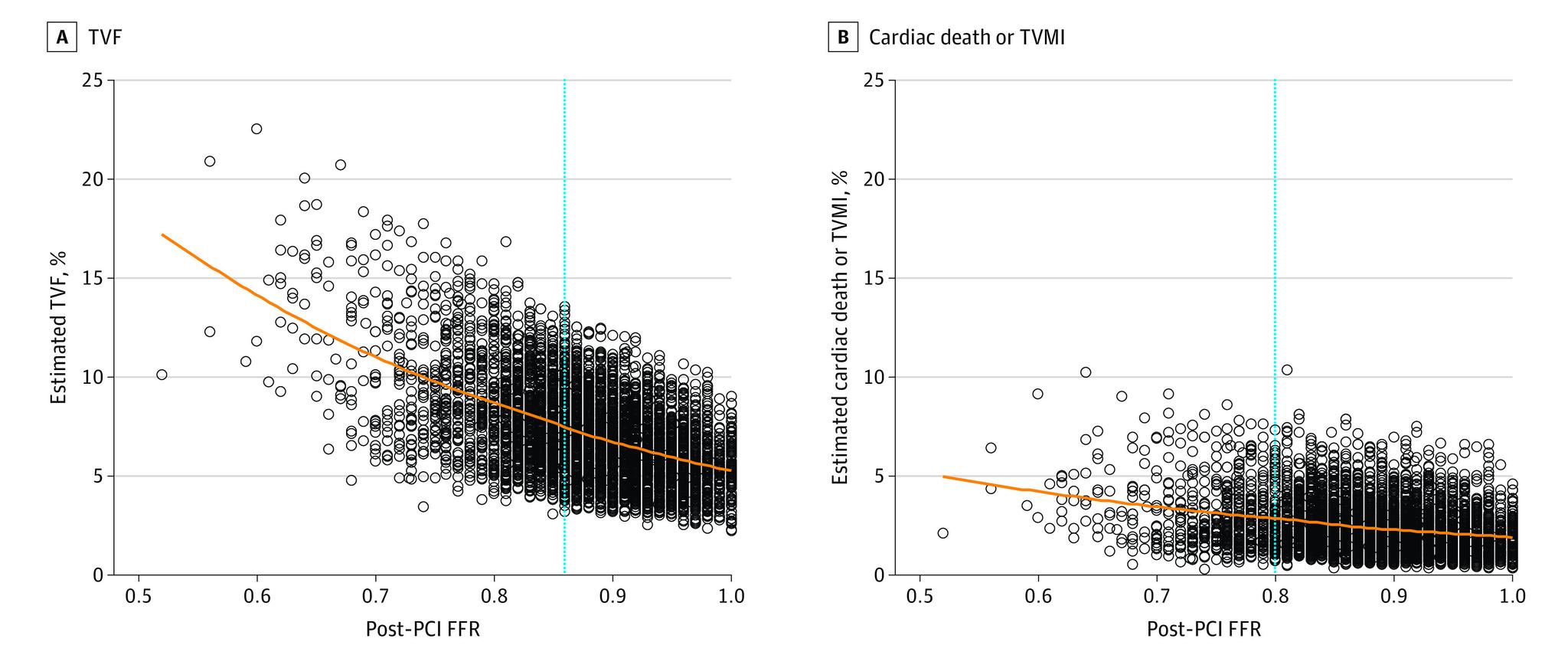
Of 2268 articles identified, 29 studies met selection criteria. Of these, 28 articles from 17 cohorts provided data, including a total of 5277 patients with 5869 vessels who underwent FFR measurement after DES implantation. Mean (SD) age was 64.4 (10.1) years and 4141 patients (78.5%) were men. Median (IQR) post-PCI FFR was 0.89 (0.84-0.94) and 690 vessels (11.8%) had a post-PCI FFR of 0.80 or below. The cumulative incidence of TVF was 340 patients (7.2%), with cardiac death or TVMI occurring in 111 patients (2.4%) at 2 years. Lower post-PCI FFR significantly increased the risk of TVF (adjusted hazard ratio [HR] per 0.01 FFR decrease, 1.04; 95% CI, 1.02-1.05; P < .001). The risk of cardiac death or MI also increased inversely with post-PCI FFR (adjusted HR, 1.03; 95% CI, 1.00-1.07, P = .049). These associations were consistent regardless of age, sex, the presence of hypertension or diabetes, and clinical diagnosis.
CONCLUSIONS AND RELEVANCE
Reduced FFR after DES implantation was common and associated with the risks of TVF and of cardiac death or TVMI. These results indicate the prognostic value of post-PCI physiologic assessment after DES implantation.
重要性
经皮冠状动脉介入治疗(PCI)后的分流量储备(FFR)通常被认为反映了残留的疾病。然而,药物洗脱支架(DES)植入后 PCI 后 FFR 的临床相关性仍不清楚。
目的
评估 DES 植入后 PCI 后 FFR 测量的临床相关性。
数据来源
从成立到 2022 年 6 月 18 日,在 MEDLINE、Embase 和 Cochrane 对照试验中心注册库中搜索了相关的已发表文章。
研究选择
纳入了报告 DES 植入后 PCI 后 FFR 及其与临床结局相关性的已发表文章。
数据提取和综合
使用标准化电子表格从 17 个队列的相应作者处收集患者水平数据。使用包含注册标识符的混合效应 Cox 比例风险回归分析,按患者对主要和次要结局进行了荟萃估计。所有过程均遵循个体参与者数据系统评价和荟萃分析的首选报告项目。
主要结局和测量
主要结局是 2 年时的靶血管失败(TVF),是心脏死亡、靶血管心肌梗死(TVMI)和靶血管血运重建(TVR)的综合结果。次要结局是 2 年时的心脏死亡或 TVMI 的综合结果。
结果
在 2268 篇文章中,有 29 篇符合选择标准。其中,28 篇来自 17 个队列的文章提供了数据,包括 5277 名患者的 5869 支血管,这些患者在 DES 植入后接受了 FFR 测量。平均(SD)年龄为 64.4(10.1)岁,4141 名患者(78.5%)为男性。中位数(IQR)PCI 后 FFR 为 0.89(0.84-0.94),690 支血管(11.8%)的 PCI 后 FFR 为 0.80 或更低。TVF 的累积发生率为 340 例(7.2%),2 年内发生心脏死亡或 TVMI 的患者为 111 例(2.4%)。较低的 PCI 后 FFR 显著增加了 TVF 的风险(每 0.01 FFR 降低的调整后的 HR,1.04;95%CI,1.02-1.05;P<0.001)。心脏死亡或 MI 的风险也随着 PCI 后 FFR 的降低而呈反比(调整后的 HR,1.03;95%CI,1.00-1.07,P=0.049)。这些关联在无论年龄、性别、是否存在高血压或糖尿病以及临床诊断如何,都是一致的。
结论和相关性
DES 植入后 FFR 降低较为常见,与 TVF 和心脏死亡或 TVMI 的风险相关。这些结果表明 DES 植入后 PCI 后的生理评估具有预后价值。


 Zotero 插件