Parment Renaud, Dubois Martine, Desrues Laurence, Mutel Alexandre, Dembélé Kléouforo-Paul, Belin Nicolas, Tron Laure, Guérin Charlène, Coëffier Moïse, Compère Vincent, Féger Céline, Joly Florence, Hilber Pascal, Ribet David, Castel Hélène
Normandie University, UNIROUEN, INSERM, U1245, Cancer and Brain Genomics, 76000 Rouen, France.
Institute for Research and Innovation in Biomedicine (IRIB), 76000 Rouen, France.
Cancers (Basel). 2022 Sep 10;14(18):4403. doi: 10.3390/cancers14184403.
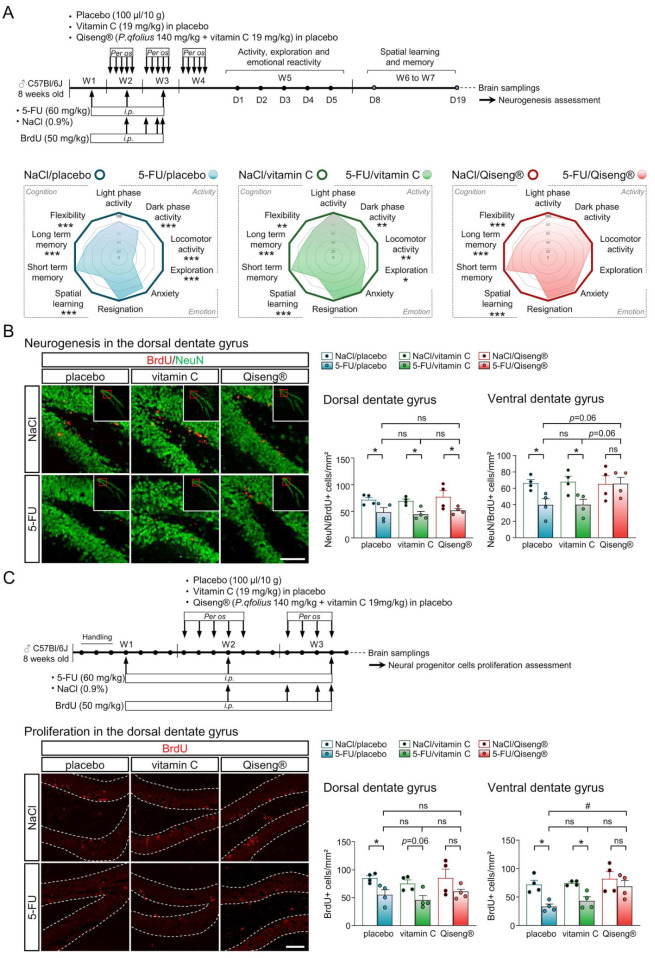
Chemotherapy-related cognitive impairment (CRCI) and fatigue constitute common complaints among cancer patient survivors. has been shown to be effective against fatigue in treated cancer patients. We developed a behavioral C57Bl/6j mouse model to study the role of a -based solution containing vitamin C (Qiseng) or vitamin C alone in activity/fatigue, emotional reactivity and cognitive functions impacted by 5-Fluorouracil (5-FU) chemotherapy. 5-FU significantly reduces the locomotor/exploration activity potentially associated with fatigue, evokes spatial cognitive impairments and leads to a decreased neurogenesis within the hippocampus (Hp). Qiseng fully prevents the impact of chemotherapy on activity/fatigue and on neurogenesis, specifically in the ventral Hp. We observed that the chemotherapy treatment induces intestinal damage and inflammation associated with increased levels of Lactobacilli in mouse gut microbiota and increased expression of plasma pro-inflammatory cytokines, notably IL-6 and MCP-1. We demonstrated that Qiseng prevents the 5-FU-induced increase in Lactobacilli levels and further compensates the 5-FU-induced cytokine release. Concomitantly, in the brains of 5-FU-treated mice, Qiseng partially attenuates the IL-6 receptor gp130 expression associated with a decreased proliferation of neural stem cells in the Hp. In conclusion, Qiseng prevents the symptoms of fatigue, reduced chemotherapy-induced neuroinflammation and altered neurogenesis, while regulating the mouse gut microbiota composition, thus protecting against intestinal and systemic inflammation.
化疗相关认知障碍(CRCI)和疲劳是癌症患者幸存者常见的主诉。已证明其对接受治疗的癌症患者的疲劳有效。我们开发了一种行为学C57Bl/6j小鼠模型,以研究含维生素C的溶液(奇森)或单独的维生素C在受5-氟尿嘧啶(5-FU)化疗影响的活动/疲劳、情绪反应和认知功能中的作用。5-FU显著降低可能与疲劳相关的运动/探索活动,引发空间认知障碍,并导致海马体(Hp)内神经发生减少。奇森完全预防了化疗对活动/疲劳和神经发生的影响,特别是在腹侧Hp。我们观察到化疗治疗会导致肠道损伤和炎症,这与小鼠肠道微生物群中乳酸杆菌水平升高以及血浆促炎细胞因子(尤其是IL-6和MCP-1)表达增加有关。我们证明奇森可预防5-FU诱导的乳酸杆菌水平升高,并进一步补偿5-FU诱导的细胞因子释放。同时,在5-FU处理的小鼠大脑中,奇森部分减弱了与Hp中神经干细胞增殖减少相关的IL-6受体gp130表达。总之,奇森可预防疲劳症状、减少化疗诱导的神经炎症并改变神经发生,同时调节小鼠肠道微生物群组成,从而预防肠道和全身炎症。