Department of Prosthodontics, Julius Maximilian University Würzburg, Pleicherwall 2, 97070 Würzburg, Germany.
Department of Behavioural Medicine and Principles of Human Biology for the Health Sciences, Trier University, Universitätsring 15, 54296 Trier, Germany.
Int J Environ Res Public Health. 2022 Sep 16;19(18):11709. doi: 10.3390/ijerph191811709.
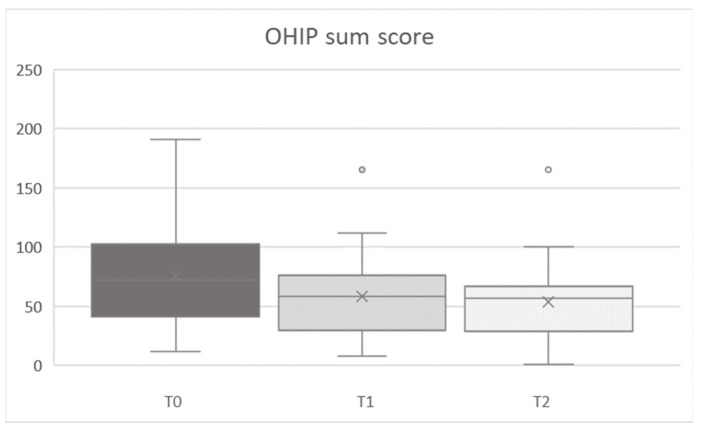
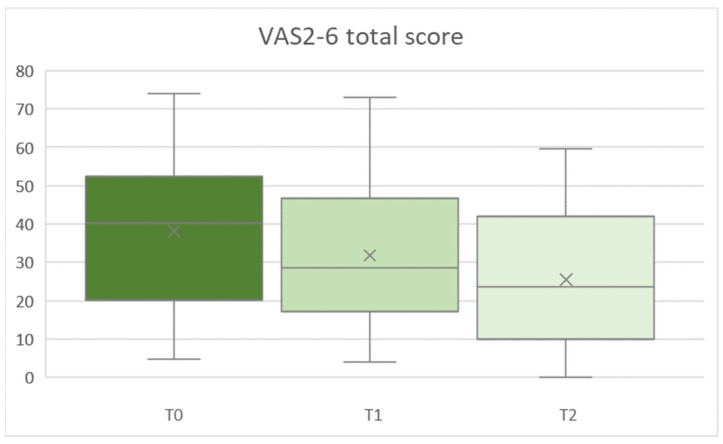
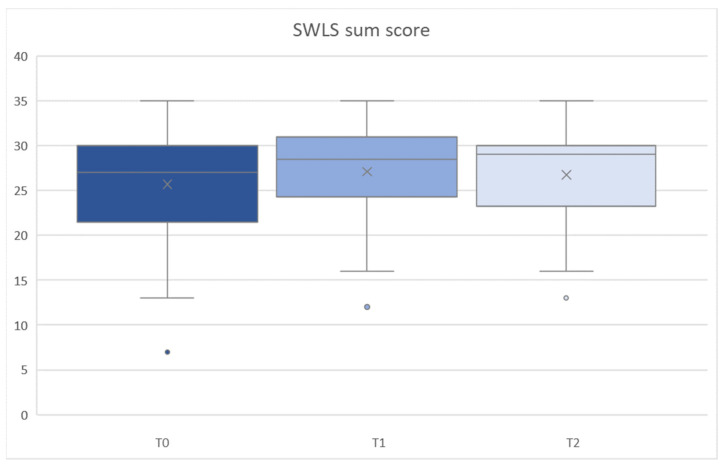
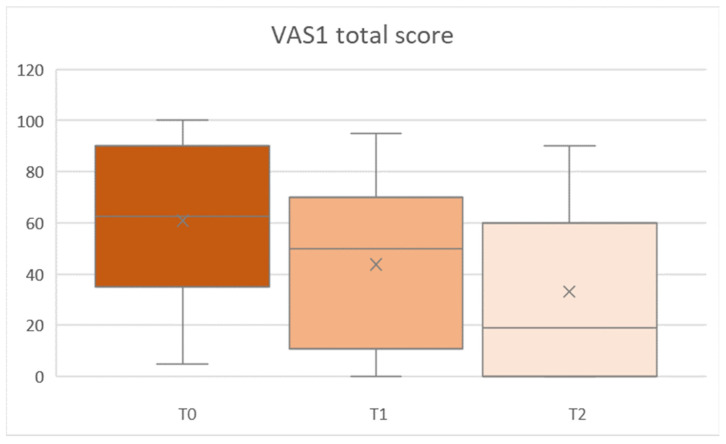
Medication-related osteonecrosis of the jaw (MRONJ) represents an adverse side effect of antiresorptive and antiangiogenic medications. It is associated with impaired quality of life, oral health, and oral function and can be classified into various stages. The purpose of this prospective clinical study is to evaluate the impact of stages I and II MRONJ on oral-health-related quality of life (OHRQoL) and related parameters. Patients' OHRQoL, satisfaction with life, oral discomfort, and oral health were assessed using the German version of the Oral Health Impact Profile (OHIP-G49), visual analog scales (VAS), and Satisfaction with Life Scale (SWLS) at baseline (T0), 10 days (T1), and 3 months after treatment (T2) in 36 patients. Data were analyzed using Kolmogorov-Smirnov test, two-way mixed ANOVAs, and follow-up Mann-Whitney U tests. The impact of treatment effects on the original seven OHIP domain structures and the recently introduced four-dimensional OHIP structure were evaluated using linear regression analysis. Thirty-six patients received surgical MRONJ treatment. Before treatment, patients' perceived OHRQoL, oral discomfort, oral health, and satisfaction with life were negatively affected by MRONJ. Surgical treatment significantly improved OHRQoL and related parameters (all ≤ 0.012). This improvement was greater in patients with higher impairment at T0. OHRQoL and oral restrictions were still impaired after treatment in patients who needed prosthetic treatment. The four-dimensional structure revealed valuable information beyond the standard seven OHIP domains. Increased awareness of MRONJ risks and an interdisciplinary treatment approach for MRONJ patients are needed.
药物相关性颌骨坏死(MRONJ)是抗吸收和抗血管生成药物的一种不良反应。它与生活质量、口腔健康和口腔功能受损有关,并可分为不同的阶段。本前瞻性临床研究的目的是评估 I 期和 II 期 MRONJ 对口腔健康相关生活质量(OHRQoL)和相关参数的影响。在 36 例患者中,使用德国版口腔健康影响简表(OHIP-G49)、视觉模拟量表(VAS)和生活满意度量表(SWLS),在基线(T0)、治疗后 10 天(T1)和 3 个月(T2)评估患者的 OHRQoL、生活满意度、口腔不适和口腔健康。使用 Kolmogorov-Smirnov 检验、双向混合方差分析和随访 Mann-Whitney U 检验分析数据。使用线性回归分析评估治疗效果对原始七个 OHIP 域结构和最近引入的四维度 OHIP 结构的影响。36 例患者接受了 MRONJ 的手术治疗。治疗前,患者的 OHRQoL、口腔不适、口腔健康和生活满意度受到 MRONJ 的负面影响。手术治疗显著改善了 OHRQoL 和相关参数(均 ≤ 0.012)。在 T0 损伤程度较高的患者中,这种改善更为显著。在需要进行修复治疗的患者中,治疗后 OHRQoL 和口腔限制仍然存在受损。四维度结构提供了标准的七个 OHIP 域之外的有价值信息。需要提高对 MRONJ 风险的认识,并对 MRONJ 患者采取跨学科治疗方法。