Department of Cranio- and Maxillofacial Surgery, Hospital of the University of Regensburg, Franz-Josef-Strauß-Allee 11, 93053, Regensburg, Germany.
Oral Maxillofac Surg. 2021 Sep;25(3):359-366. doi: 10.1007/s10006-020-00927-7. Epub 2020 Nov 23.
The treatment of advanced stages of medication-related osteonecrosis of the jaw (MRONJ) remains challenging. In order to improve decision making concerning the therapy, we examined the change of patients' quality of life (QoL) after surgical treatment of MRONJ stage III.
The primary outcome variable was patients' QoL. It was preoperative (T0), 6 weeks postoperative (T1) and 6 months postoperative (T2) assessed by the European Organisation for Research and Treatment of Cancer QoL-H&N35 (EORTC QoL-H&N35) and the Oral Health Impact Factor-G14 (OHIP-G14) questionnaire in a prospective cohort study. Other variables included location, age, sex, risk factors, and recurrence. Descriptive statistics and general multivariate regression models were calculated.
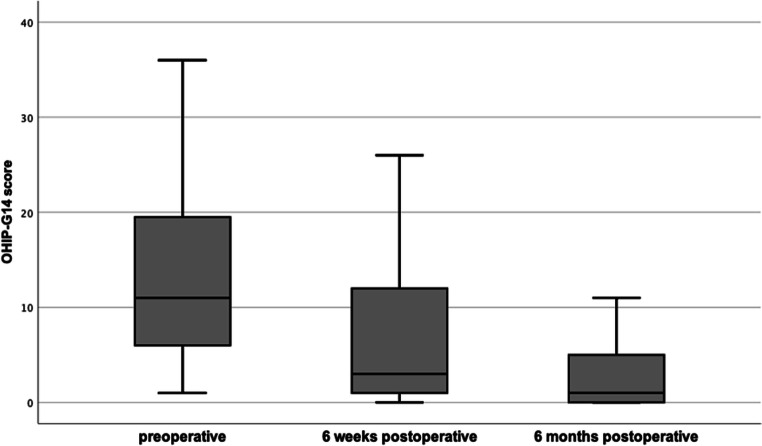
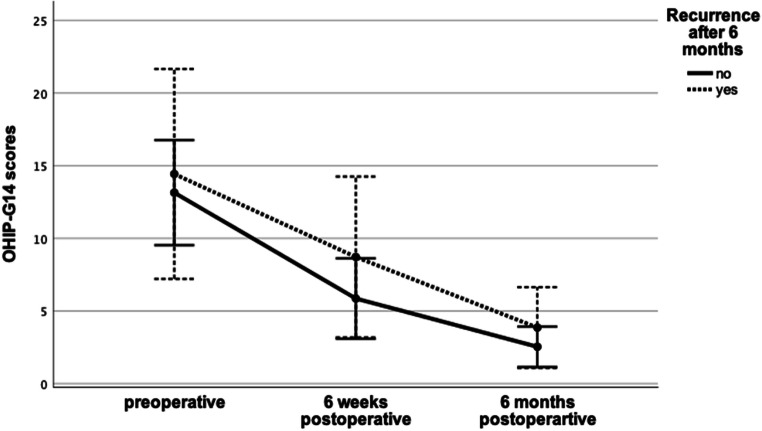
Forty-three patients with stage III MRONJ underwent surgery. OHIP-G14 scores decreased (improvement) statistically significant (p = .001) by 52.02% (T0-T1) and 56.45% (T1-T2). EORTC QoL-H&N35 showed statistical improvement for "swallowing" (p = .007), "opening mouth" (p = .045), "painkiller" (.005), "weight loss" (.004), "pain" (p = .001), "trouble with social eating" (p = .001), "trouble with social contact" (p = .001), and "teeth" (p = .001). Patients who developed a recurrence did not show any significant higher (worse) scores in OHIP G14 or EORTC QoL-H&N35 scores compared with patients without recurrence. Twenty-nine out of 36 patients showed full mucosal healing (T2). For patients with no full mucosal healing, a downgrade to stage I was achieved.
In terms of QoL patients with stage III MRONJ do benefit from surgical treatment. The incident of a recurrence seems to have no significant impact on patients QoL.
治疗药物相关性颌骨骨髓炎(MRONJ)的晚期阶段仍然具有挑战性。为了改善治疗决策,我们研究了手术治疗 MRONJ Ⅲ期后患者生活质量(QoL)的变化。
主要观察变量为患者的 QoL。在一项前瞻性队列研究中,采用欧洲癌症研究与治疗组织生活质量问卷头颈部模块 35 项(EORTC QoL-H&N35)和口腔健康影响因素问卷-14 项(OHIP-G14)在术前(T0)、术后 6 周(T1)和术后 6 个月(T2)评估患者的 QoL。其他变量包括位置、年龄、性别、危险因素和复发。计算了描述性统计和一般多元回归模型。
43 例 MRONJ Ⅲ期患者接受手术治疗。OHIP-G14 评分显著降低(改善)(p =.001),分别为 52.02%(T0-T1)和 56.45%(T1-T2)。EORTC QoL-H&N35 显示“吞咽”(p =.007)、“张口”(p =.045)、“止痛药”(p =.005)、“体重减轻”(p =.004)、“疼痛”(p =.001)、“社交进食困难”(p =.001)、“社交接触困难”(p =.001)和“牙齿”(p =.001)方面有统计学改善。与无复发患者相比,复发患者的 OHIP G14 或 EORTC QoL-H&N35 评分无明显升高(更差)。36 例患者中有 29 例(T2)完全黏膜愈合。对于未完全黏膜愈合的患者,降级至 I 期。
就 QoL 而言,MRONJ Ⅲ期患者从手术治疗中获益。复发的发生似乎对患者的 QoL 没有显著影响。