Key Laboratory of Exercise and Health Sciences (Ministry of Education), School of Kinesiology, Shanghai University of Sport, 399 Changhai Road, Shanghai 200438, China.
College of Physical Education and Training, Shanghai University of Sport, 399 Changhai Road, Shanghai 200438, China.
Int J Mol Sci. 2022 Sep 6;23(18):10264. doi: 10.3390/ijms231810264.
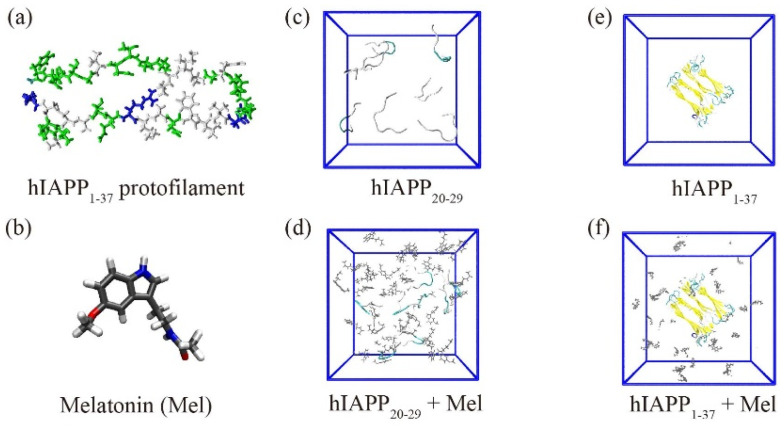
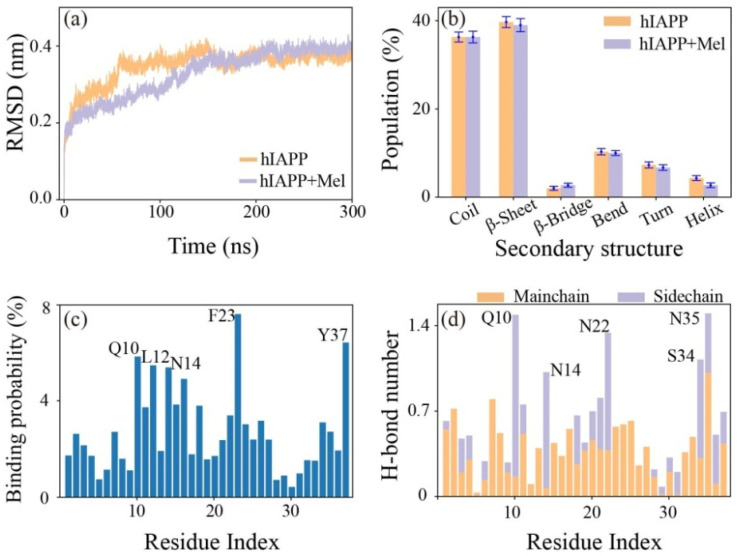
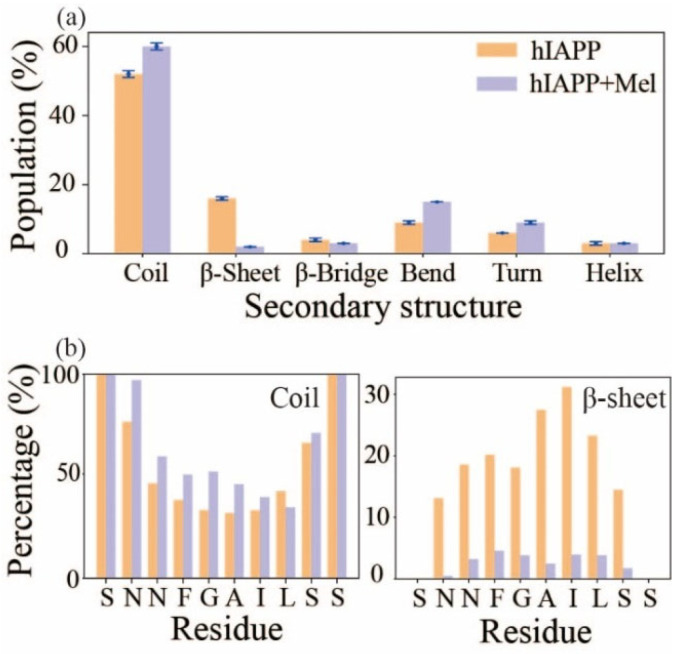
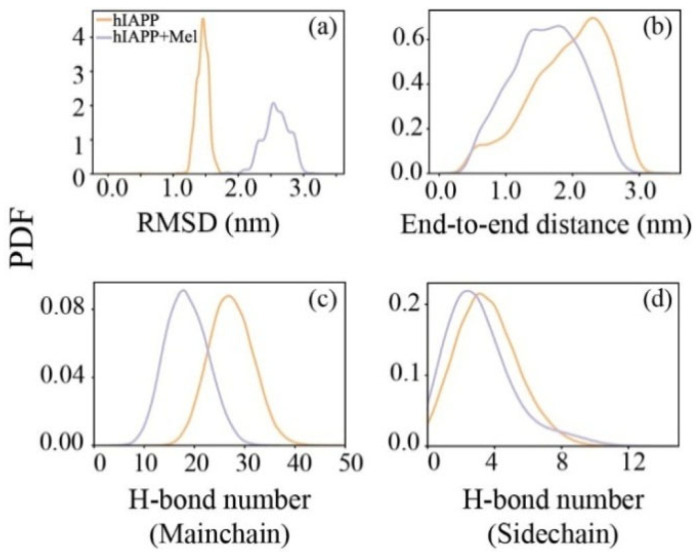
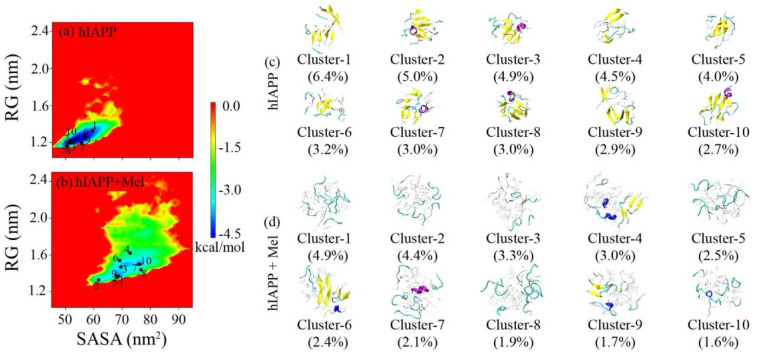
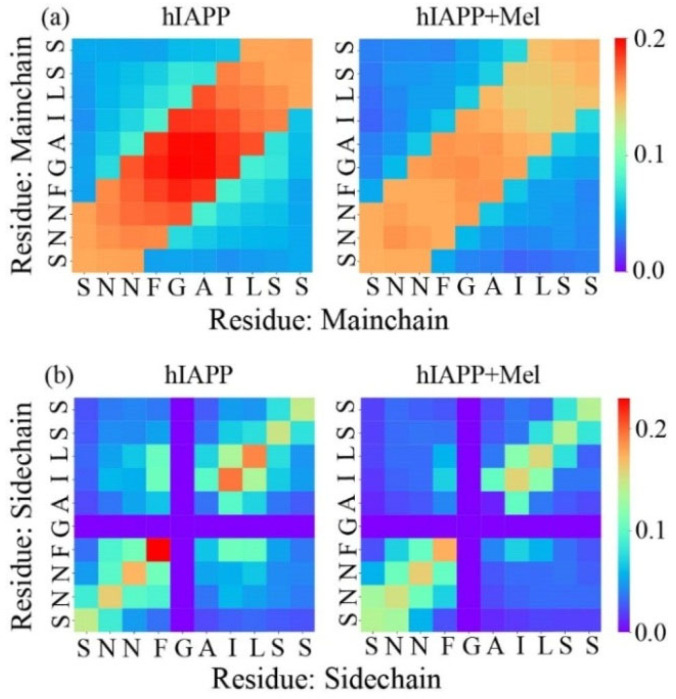
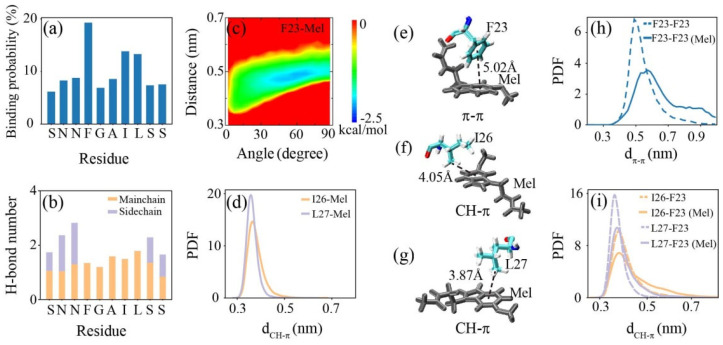
The pathogenesis of type 2 diabetes (T2D) is highly related to the abnormal self-assembly of the human islet amyloid polypeptide (hIAPP) into amyloid aggregates. To inhibit hIAPP aggregation is considered a promising therapeutic strategy for T2D treatment. Melatonin (Mel) was reported to effectively impede the accumulation of hIAPP aggregates and dissolve preformed fibrils. However, the underlying mechanism at the atomic level remains elusive. Here, we performed replica-exchange molecular dynamics (REMD) simulations to investigate the inhibitory effect of Mel on hIAPP oligomerization by using hIAPP octamer as templates. The conformational ensemble shows that Mel molecules can significantly prevent the β-sheet and backbone hydrogen bond formation of hIAPP octamer and remodel hIAPP oligomers and transform them into less compact conformations with more disordered contents. The interaction analysis shows that the binding behavior of Mel is dominated by hydrogen bonding with a peptide backbone and strengthened by aromatic stacking and CH-π interactions with peptide sidechains. The strong hIAPP-Mel interaction disrupts the hIAPP association, which is supposed to inhibit amyloid aggregation and cytotoxicity. We also performed conventional MD simulations to investigate the influence and binding affinity of Mel on the preformed hIAPP fibrillar octamer. Mel was found to preferentially bind to the amyloidogenic region hIAPP, whereas it has a slight influence on the structural stability of the preformed fibrils. Our findings illustrate a possible pathway by which Mel alleviates diabetes symptoms from the perspective of Mel inhibiting amyloid deposits. This work reveals the inhibitory mechanism of Mel against hIAPP oligomerization, which provides useful clues for the development of efficient anti-amyloid agents.
2 型糖尿病(T2D)的发病机制与人类胰岛淀粉样多肽(hIAPP)异常自组装成淀粉样聚集物高度相关。抑制 hIAPP 聚集被认为是治疗 T2D 的一种有前途的治疗策略。褪黑素(Mel)被报道可有效阻止 hIAPP 聚集物的积累和溶解原纤维。然而,其原子水平的潜在机制仍不清楚。在这里,我们使用 hIAPP 八聚体作为模板,通过复制交换分子动力学(REMD)模拟研究了 Mel 对 hIAPP 寡聚化的抑制作用。构象集合表明,Mel 分子可以显著阻止 hIAPP 八聚体的β-折叠和骨架氢键形成,并重塑 hIAPP 寡聚物,将其转化为更无序、更紧凑的构象。相互作用分析表明,Mel 的结合行为主要由与肽骨架的氢键主导,并通过与肽侧链的芳构堆积和 CH-π相互作用得到加强。强烈的 hIAPP-Mel 相互作用破坏了 hIAPP 的缔合,从而抑制了淀粉样聚集和细胞毒性。我们还进行了常规 MD 模拟,以研究 Mel 对预形成的 hIAPP 原纤维八聚体的影响和结合亲和力。发现 Mel 优先结合到淀粉样蛋白形成区域 hIAPP,而对预形成的原纤维的结构稳定性影响较小。我们的研究结果从 Mel 缓解糖尿病症状的角度阐明了 Mel 减轻淀粉样沉积的可能途径。这项工作揭示了 Mel 抑制 hIAPP 寡聚化的抑制机制,为开发有效的抗淀粉样蛋白药物提供了有用的线索。