
转录组分析揭示了外源油菜素内酯在半夏生物碱生物合成途径中的重要作用。
Transcriptome Analysis Reveals an Essential Role of Exogenous Brassinolide on the Alkaloid Biosynthesis Pathway in Pinellia Ternata.
机构信息
School of Life Sciences, Hebei University, Baoding 071002, China.
Institute of Life Sciences and Green Development, Hebei University, Baoding 071002, China.
出版信息
Int J Mol Sci. 2022 Sep 17;23(18):10898. doi: 10.3390/ijms231810898.
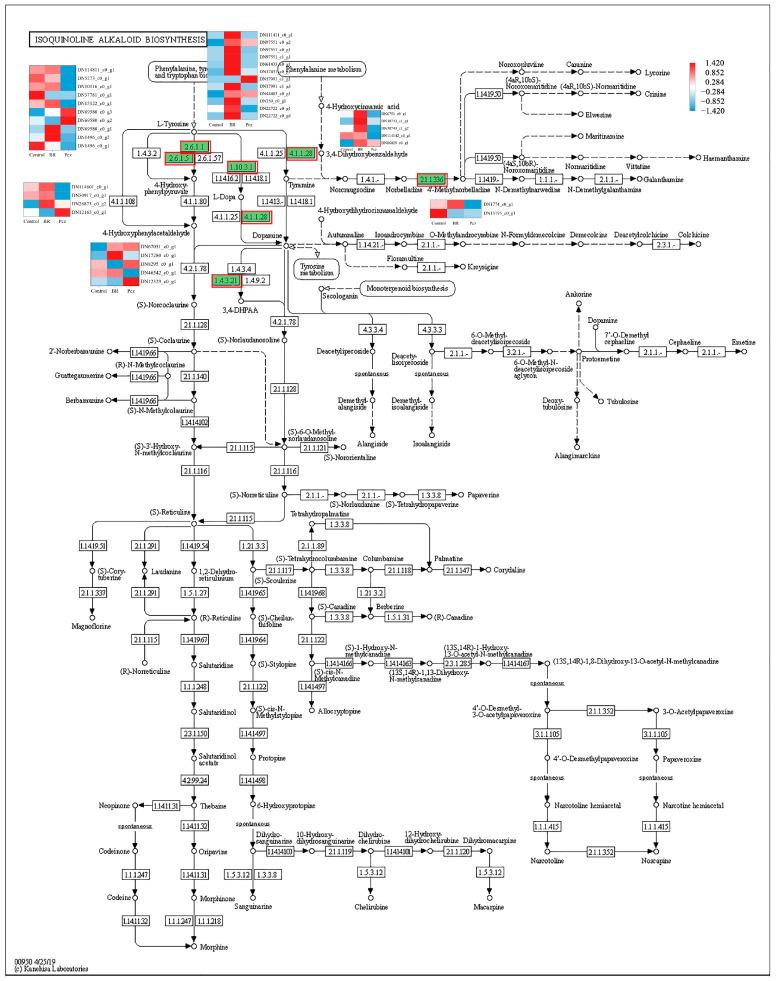
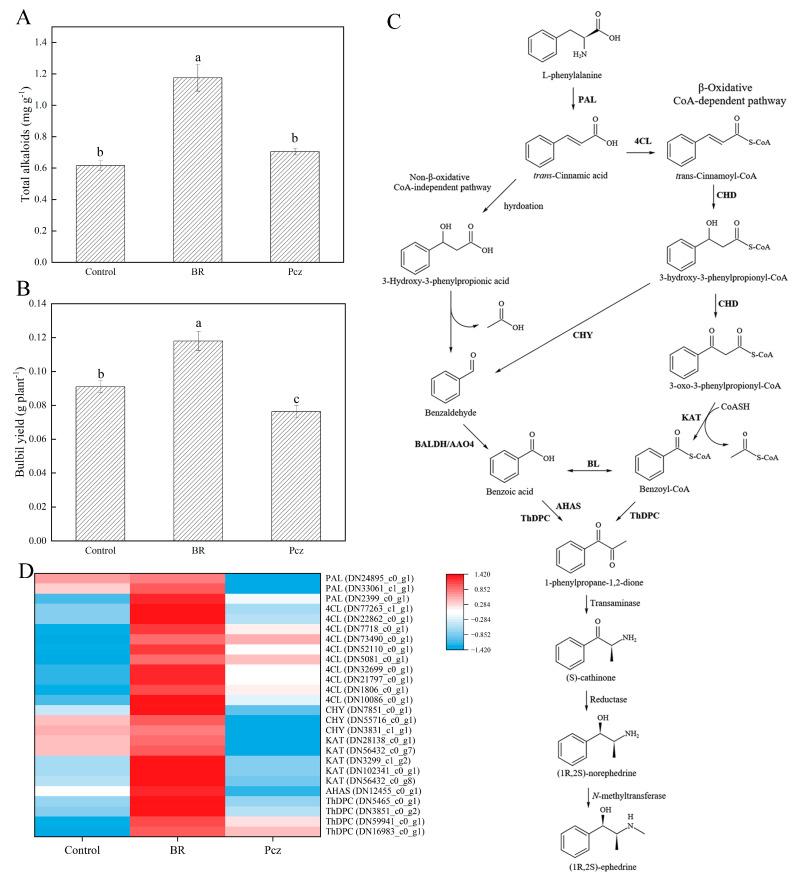
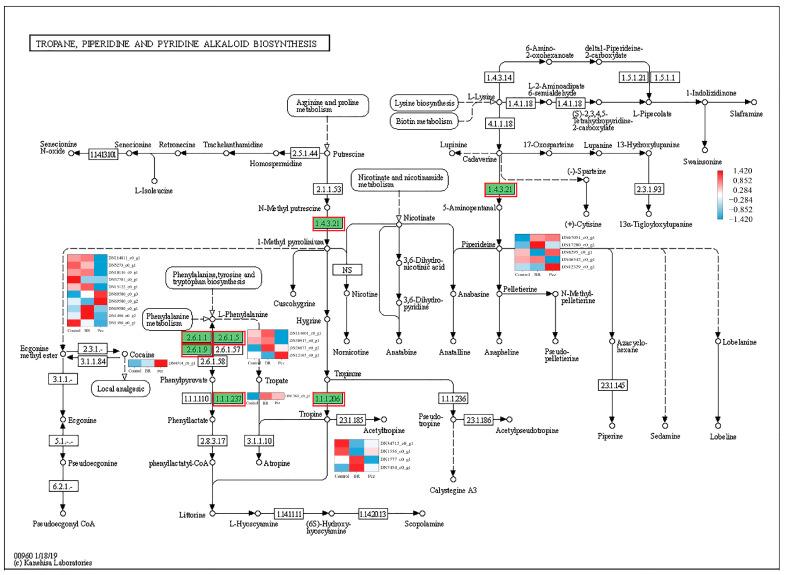
(Thunb.) Druce is a traditional medicinal plant containing a variety of alkaloids, which are important active ingredients. Brassinolide (BR) is a plant hormone that regulates plant response to environmental stress and promotes the accumulation of secondary metabolites in plants. However, the regulatory mechanism of BR-induced alkaloid accumulation in is not clear. In this study, we investigated the effects of BR and BR biosynthesis inhibitor (propiconazole, Pcz) treatments on alkaloid biosynthesis in the bulbil of . The results showed that total alkaloid content and bulbil yield was enhanced by 90.87% and 29.67% under BR treatment, respectively, compared to the control. We identified 818 (476 up-regulated and 342 down-regulated) and 697 (389 up-regulated and 308 down-regulated) DEGs in the BR-treated and Pcz-treated groups, respectively. Through this annotated data and the Kyoto encyclopedia of genes and genomes (KEGG), the expression patterns of unigenes involved in the ephedrine alkaloid, tropane, piperidine, pyridine alkaloid, indole alkaloid, and isoquinoline alkaloid biosynthesis were observed under BR and Pcz treatments. We identified 11, 8, 2, and 13 unigenes in the ephedrine alkaloid, tropane, piperidine, and pyridine alkaloid, indole alkaloid, and isoquinoline alkaloid biosynthesis, respectively. The expression levels of these unigenes were increased by BR treatment and were decreased by Pcz treatment, compared to the control. The results provided molecular insight into the study of the molecular mechanism of BR-promoted alkaloid biosynthesis.
(Thunb.) Druce 是一种传统的药用植物,含有多种生物碱,这些生物碱是重要的活性成分。油菜素内酯(BR)是一种植物激素,可调节植物对环境胁迫的反应,并促进植物中次生代谢物的积累。然而,BR 诱导 中生物碱积累的调控机制尚不清楚。在这项研究中,我们研究了 BR 和 BR 生物合成抑制剂(丙环唑,Pcz)处理对 珠芽生物碱生物合成的影响。结果表明,与对照相比,BR 处理分别使总生物碱含量和珠芽产量提高了 90.87%和 29.67%。我们分别在 BR 处理组和 Pcz 处理组中鉴定出 818 个(476 个上调和 342 个下调)和 697 个(389 个上调和 308 个下调)差异表达基因。通过注释数据和京都基因与基因组百科全书(KEGG),观察到 BR 和 Pcz 处理下参与麻黄碱、托烷、哌啶、吡啶生物碱、吲哚生物碱和异喹啉生物碱生物合成的基因表达模式。我们分别在麻黄碱、托烷、哌啶和吡啶生物碱、吲哚生物碱和异喹啉生物碱生物合成中鉴定出 11、8、2 和 13 个基因。与对照相比,这些基因的表达水平在 BR 处理下增加,而在 Pcz 处理下减少。结果为研究 BR 促进生物碱生物合成的分子机制提供了分子见解。



 Zotero 插件