
基于 EEG 的情绪识别中使用通道瓶颈模块加速 3D 卷积神经网络。
Accelerating 3D Convolutional Neural Network with Channel Bottleneck Module for EEG-Based Emotion Recognition.
机构信息
Department of Software Convergence, Kyung Hee University, Yongin 17104, Korea.
Department of Biomedical Engineering, Kyung Hee University, Yongin 17104, Korea.
出版信息
Sensors (Basel). 2022 Sep 8;22(18):6813. doi: 10.3390/s22186813.
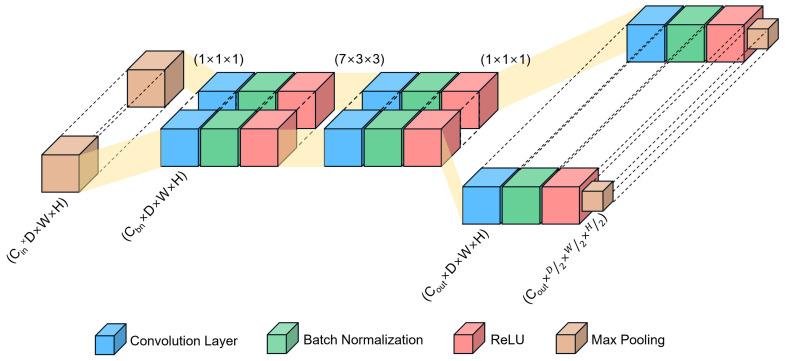
Deep learning-based emotion recognition using EEG has received increasing attention in recent years. The existing studies on emotion recognition show great variability in their employed methods including the choice of deep learning approaches and the type of input features. Although deep learning models for EEG-based emotion recognition can deliver superior accuracy, it comes at the cost of high computational complexity. Here, we propose a novel 3D convolutional neural network with a channel bottleneck module (CNN-BN) model for EEG-based emotion recognition, with the aim of accelerating the CNN computation without a significant loss in classification accuracy. To this end, we constructed a 3D spatiotemporal representation of EEG signals as the input of our proposed model. Our CNN-BN model extracts spatiotemporal EEG features, which effectively utilize the spatial and temporal information in EEG. We evaluated the performance of the CNN-BN model in the valence and arousal classification tasks. Our proposed CNN-BN model achieved an average accuracy of 99.1% and 99.5% for valence and arousal, respectively, on the DEAP dataset, while significantly reducing the number of parameters by 93.08% and FLOPs by 94.94%. The CNN-BN model with fewer parameters based on 3D EEG spatiotemporal representation outperforms the state-of-the-art models. Our proposed CNN-BN model with a better parameter efficiency has excellent potential for accelerating CNN-based emotion recognition without losing classification performance.
基于深度学习的 EEG 情绪识别近年来受到越来越多的关注。现有的情绪识别研究在其采用的方法上存在很大的可变性,包括深度学习方法的选择和输入特征的类型。虽然基于 EEG 的情绪识别的深度学习模型可以提供更高的准确性,但这是以高计算复杂度为代价的。在这里,我们提出了一种新的基于 3D 卷积神经网络和通道瓶颈模块(CNN-BN)的模型,用于 EEG 情绪识别,旨在在不显著损失分类准确性的情况下加速 CNN 计算。为此,我们构建了 EEG 信号的 3D 时空表示作为我们提出的模型的输入。我们的 CNN-BN 模型提取时空 EEG 特征,有效地利用 EEG 中的空间和时间信息。我们在 DEAP 数据集上评估了 CNN-BN 模型在效价和唤醒度分类任务中的性能。我们提出的 CNN-BN 模型在效价和唤醒度上的平均准确率分别为 99.1%和 99.5%,而参数数量和 FLOPs 分别减少了 93.08%和 94.94%。基于 3D EEG 时空表示的具有较少参数的 CNN-BN 模型优于最先进的模型。我们提出的具有更好参数效率的 CNN-BN 模型具有在不损失分类性能的情况下加速基于 CNN 的情绪识别的巨大潜力。




 Zotero 插件