Choi Min Joo, Yun Jae-Won, Song Joon Young, Ko Karam, Mould Joaquin F, Cheong Hee Jin
Department of Internal Medicine, International St. Mary's Hospital, Catholic Kwandong University College of Medicine, Incheon 22711, Korea.
Asia Pacific Influenza Institute, Korea University College of Medicine, Seoul 08308, Korea.
Vaccines (Basel). 2022 Aug 25;10(9):1387. doi: 10.3390/vaccines10091387.
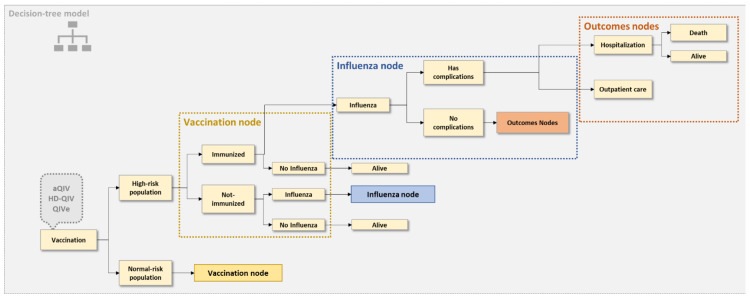
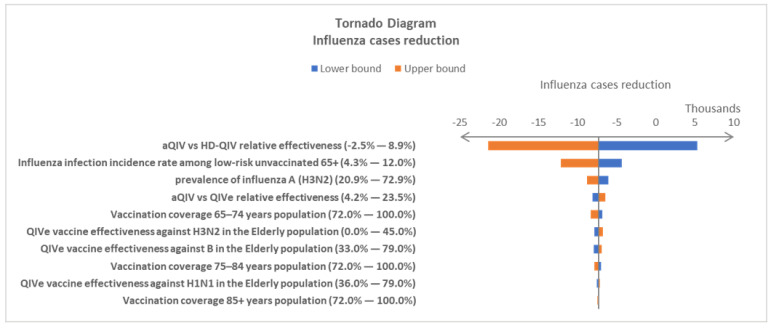
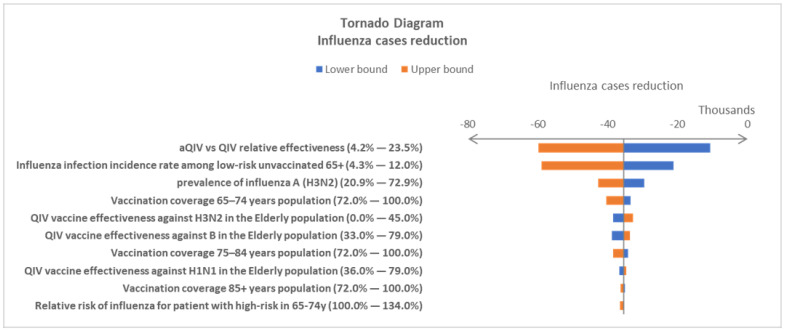
Influenza affects all age groups, but the risk of hospitalization and death due to influenza is strongly age-related and is at its highest among the elderly aged 65 years and older. The objective of this study is to compare the differences in influenza-associated disease burden under three different influenza vaccination strategies-the standard-dose quadrivalent influenza vaccine (QIV), high-dose QIV (HD-QIV), and MF59-adjuvanted QIV (aQIV)-for the elderly population aged 65 years and older in South Korea. A one-year decision-tree model was developed to compare influenza disease burdens. The input data for the model were obtained from published literature reviews and surveillance data from the Korea Disease Control and Prevention Agency (KDCA). The analysis indicated that aQIV is more effective than QIV, preventing 35,390 influenza cases, 1602 influenza-associated complications, 709 influenza-associated hospitalizations, and 145 influenza-associated deaths annually. Additionally, aQIV, when compared to HD-QIV, also reduced the influenza-associated burden of disease, preventing 7247 influenza cases, 328 influenza-associated complications, 145 influenza-associated hospitalizations, and 30 influenza-associated deaths annually. Switching the vaccination strategy from QIV to aQIV is predicted to reduce the influenza-associated disease burden for the elderly in South Korea. The public health gains from aQIV and HD-QIV are expected to be comparable. Future studies comparing the effectiveness of the vaccines will further inform future vaccination strategies for the elderly in South Korea.
流感影响所有年龄组,但因流感住院和死亡的风险与年龄密切相关,在65岁及以上的老年人中风险最高。本研究的目的是比较三种不同流感疫苗接种策略——标准剂量四价流感疫苗(QIV)、高剂量QIV(HD-QIV)和MF59佐剂四价流感疫苗(aQIV)——对韩国65岁及以上老年人群流感相关疾病负担的差异。开发了一个为期一年的决策树模型来比较流感疾病负担。该模型的输入数据来自已发表的文献综述和韩国疾病控制与预防机构(KDCA)的监测数据。分析表明,aQIV比QIV更有效,每年可预防35390例流感病例、1602例流感相关并发症、709例流感相关住院和145例流感相关死亡。此外,与HD-QIV相比,aQIV也降低了流感相关疾病负担,每年可预防7247例流感病例、328例流感相关并发症、145例流感相关住院和30例流感相关死亡。预计将疫苗接种策略从QIV改为aQIV可减轻韩国老年人的流感相关疾病负担。aQIV和HD-QIV的公共卫生效益预计相当。未来比较这些疫苗有效性的研究将为韩国老年人未来的疫苗接种策略提供更多信息。