Partanen Juha, Achim Kaia
Molecular and Integrative Biosciences Research Programme, Faculty of Biological and Environmental Sciences, University of Helsinki, Helsinki, Finland.
Front Neurosci. 2022 Sep 6;16:976209. doi: 10.3389/fnins.2022.976209. eCollection 2022.
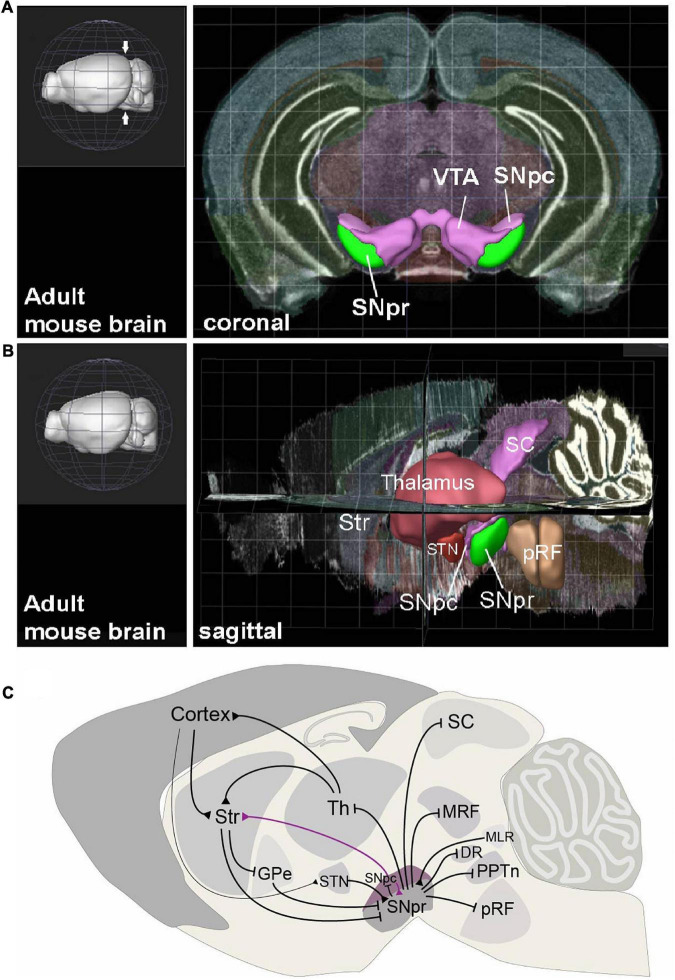
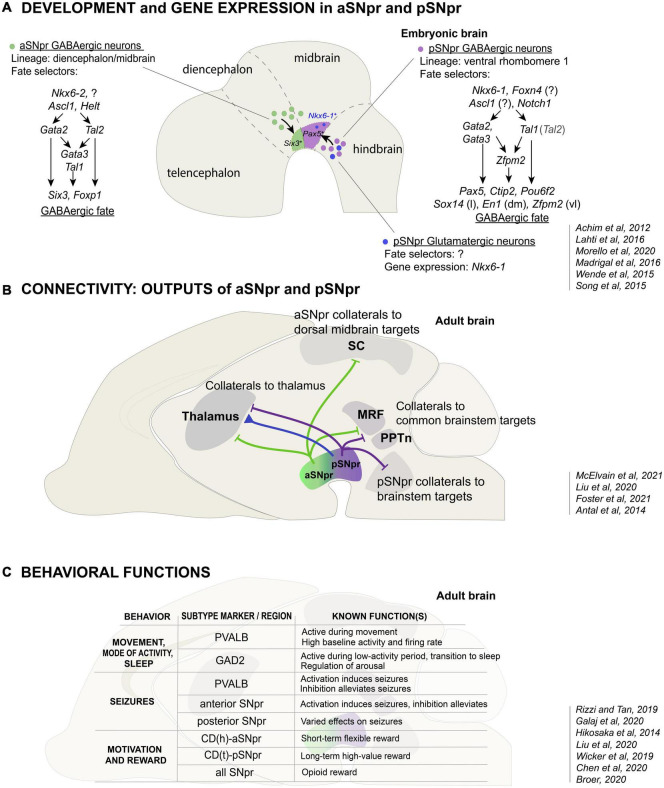
The Substantia Nigra pars reticulata (SNpr) is the major information output site of the basal ganglia network and instrumental for the activation and adjustment of movement, regulation of the behavioral state and response to reward. Due to both overlapping and unique input and output connections, the SNpr might also have signal integration capacity and contribute to action selection. How the SNpr regulates these multiple functions remains incompletely understood. The SNpr is located in the ventral midbrain and is composed primarily of inhibitory GABAergic projection neurons that are heterogeneous in their properties. In addition, the SNpr contains smaller populations of other neurons, including glutamatergic neurons. Here, we discuss regionalization of the SNpr, in particular the division of the SNpr neurons to anterior (aSNpr) and posterior (pSNpr) subtypes, which display differences in many of their features. We hypothesize that unique developmental and molecular characteristics of the SNpr neuron subtypes correlate with both region-specific connections and notable functional specializations of the SNpr. Variation in both the genetic control of the SNpr neuron development as well as signals regulating cell migration and axon guidance may contribute to the functional diversity of the SNpr neurons. Therefore, insights into the various aspects of differentiation of the SNpr neurons can increase our understanding of fundamental brain functions and their defects in neurological and psychiatric disorders, including movement and mood disorders, as well as epilepsy.
黑质网状部(SNpr)是基底神经节网络的主要信息输出位点,对运动的激活与调节、行为状态的调控以及对奖励的反应起着重要作用。由于其输入和输出连接既有重叠又有独特之处,SNpr可能还具备信号整合能力并有助于动作选择。SNpr如何调节这些多种功能仍未完全明确。SNpr位于腹侧中脑,主要由性质各异的抑制性γ-氨基丁酸能投射神经元组成。此外,SNpr还包含数量较少的其他神经元群体,包括谷氨酸能神经元。在此,我们讨论SNpr的区域划分,特别是将SNpr神经元分为前侧(aSNpr)和后侧(pSNpr)亚型,它们在许多特征上存在差异。我们推测,SNpr神经元亚型独特的发育和分子特征与SNpr的区域特异性连接以及显著的功能特化相关。SNpr神经元发育的遗传控制以及调节细胞迁移和轴突导向的信号变化可能导致SNpr神经元的功能多样性。因此,深入了解SNpr神经元分化的各个方面能够增进我们对基本脑功能及其在神经和精神疾病(包括运动和情绪障碍以及癫痫)中的缺陷的理解。