Howard Hughes Medical Institute, Department of Neurobiology, Harvard Medical School, Boston, MA, USA.
Nat Neurosci. 2020 Nov;23(11):1388-1398. doi: 10.1038/s41593-020-00712-5. Epub 2020 Sep 28.
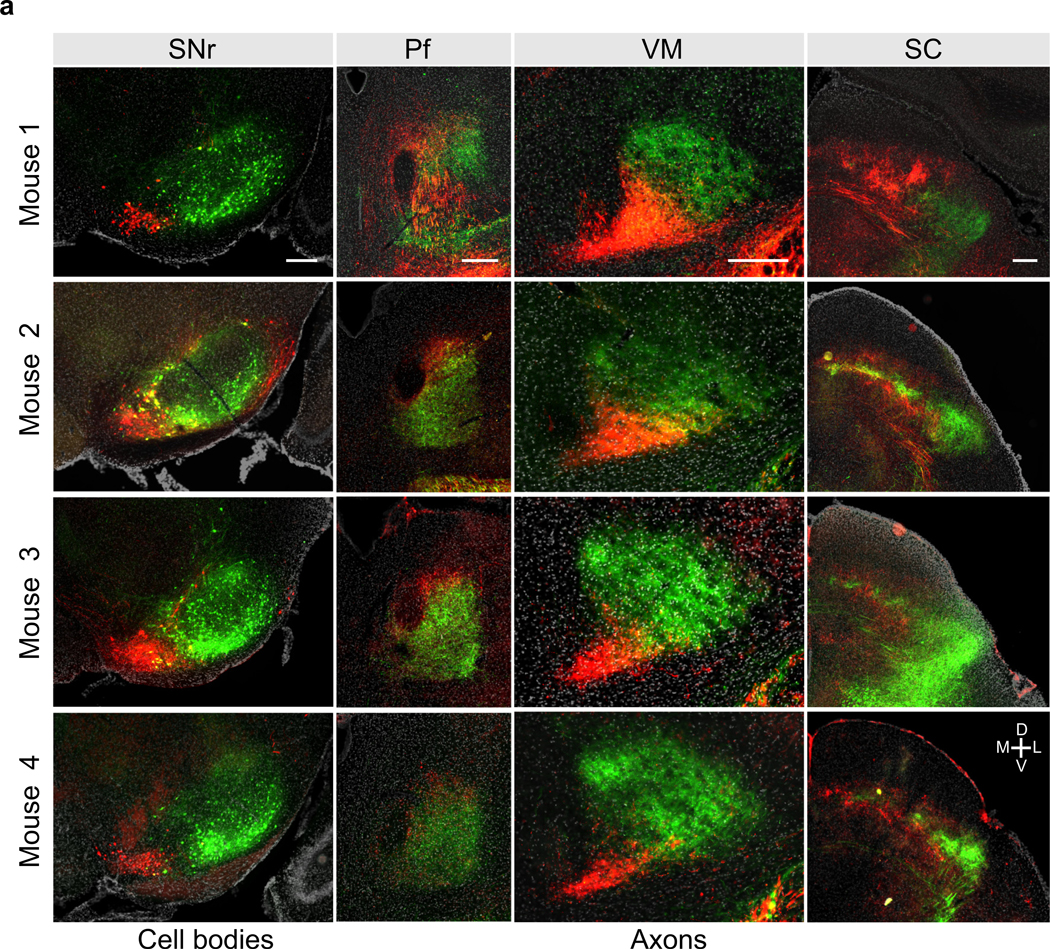
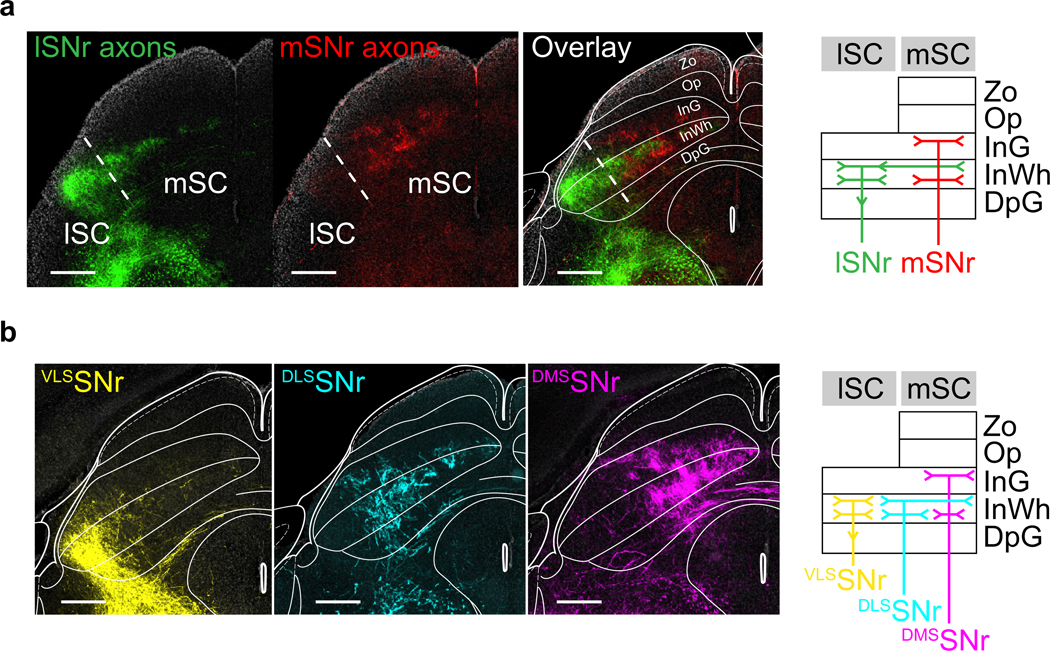
In the basal ganglia (BG), anatomically segregated and topographically organized feedforward circuits are thought to modulate multiple behaviors in parallel. Although topographically arranged BG circuits have been described, the extent to which these relationships are maintained across the BG output nuclei and in downstream targets is unclear. Here, using focal trans-synaptic anterograde tracing, we show that the motor-action-related topographical organization of the striatum is preserved in all BG output nuclei. The topography is also maintained downstream of the BG and in multiple parallel closed loops that provide striatal input. Furthermore, focal activation of two distinct striatal regions induces either licking or turning, consistent with their respective anatomical targets of projection outside of the BG. Our results confirm the parallel model of BG function and suggest that the integration and competition of information relating to different behavior occur largely outside of the BG.
在基底神经节(BG)中,解剖上分离且拓扑组织的前馈回路被认为可并行调节多种行为。尽管已经描述了拓扑排列的 BG 回路,但这些关系在 BG 输出核和下游靶标中保持的程度尚不清楚。在这里,我们使用焦点跨突触顺行示踪技术显示,纹状体与运动行为相关的拓扑组织在所有 BG 输出核中都得到了保留。这种拓扑结构在 BG 下游和多个提供纹状体输入的平行闭环中也得到了维持。此外,对两个不同纹状体区域的焦点激活会引起舔舐或转向,这与它们在 BG 之外的各自解剖学目标投射一致。我们的结果证实了 BG 功能的并行模型,并表明与不同行为相关的信息的整合和竞争主要发生在 BG 之外。