Instituto Gulbenkian de Ciência, Oeiras, Portugal.
CE3C - Center for Ecology, Evolution and Environmental Changes, Faculdade de Ciências da Universidade de Lisboa. Campo Grande, Lisboa, Portugal.
Nat Commun. 2022 Sep 24;13(1):5604. doi: 10.1038/s41467-022-33412-8.
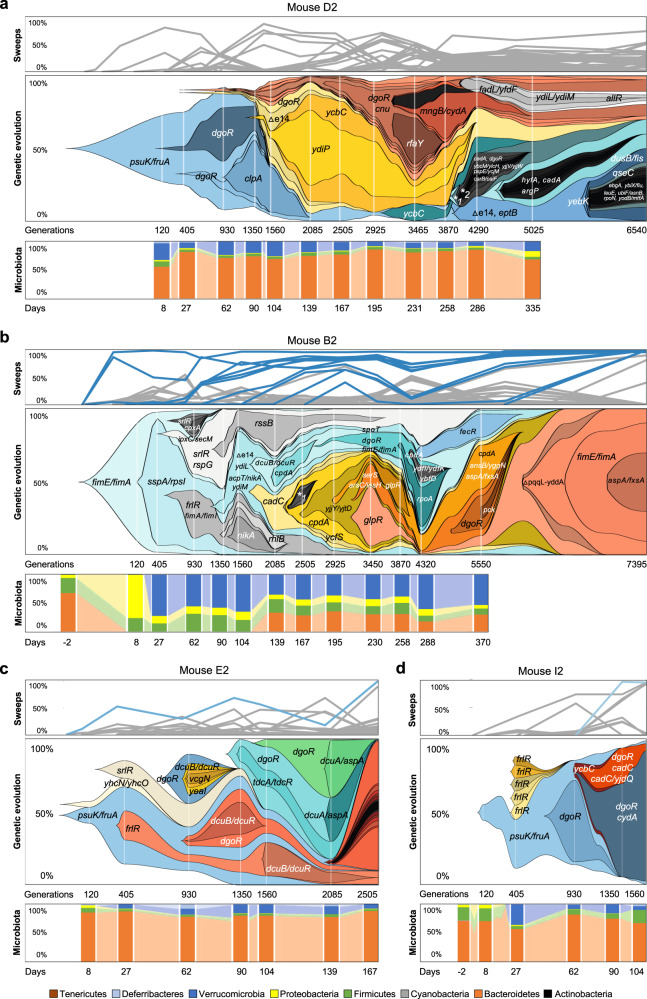
How and at what pace bacteria evolve when colonizing healthy hosts remains unclear. Here, by monitoring evolution for more than six thousand generations in the mouse gut, we show that the successful colonization of an invader Escherichia coli depends on the diversity of the existing microbiota and the presence of a closely related strain. Following colonization, two modes of evolution were observed: one in which diversifying selection leads to long-term coexistence of ecotypes and a second in which directional selection propels selective sweeps. These modes can be quantitatively distinguished by the statistics of mutation trajectories. In our experiments, diversifying selection was marked by the emergence of metabolic mutations, and directional selection by acquisition of prophages, which bring their own benefits and costs. In both modes, we observed parallel evolution, with mutation accumulation rates comparable to those typically observed in vitro on similar time scales. Our results show how rapid ecotype formation and phage domestication can be in the mammalian gut.
当细菌在健康宿主中定植时,它们是如何以及以何种速度进化的尚不清楚。在这里,我们通过在小鼠肠道中监测超过六千代的进化,表明入侵性大肠杆菌成功定植取决于现有微生物组的多样性和密切相关菌株的存在。定植后,观察到两种进化模式:一种是多样化选择导致生态型长期共存,另一种是定向选择推动选择清除。通过突变轨迹的统计数据可以定量地区分这些模式。在我们的实验中,多样化选择的标志是代谢突变的出现,而定向选择则是通过获得噬菌体来实现的,噬菌体带来了自身的好处和成本。在这两种模式中,我们观察到了平行进化,突变积累率与在类似时间尺度上在体外通常观察到的水平相当。我们的研究结果表明,在哺乳动物肠道中,生态型的快速形成和噬菌体驯化是多么容易。