Department of Biochemistry, Simmons Comprehensive Cancer Center, The University of Texas Southwestern Medical Center, Dallas 75390, Texas, United States.
Children's Research Institute, Departments of Pediatrics and Internal Medicine, Center for Regenerative Science and Medicine, Children's Research Institute Mouse Genome Engineering Core, The University of Texas Southwestern Medical Center, Dallas 75390, Texas, United States.
Mol Pharm. 2022 Nov 7;19(11):3973-3986. doi: 10.1021/acs.molpharmaceut.2c00442. Epub 2022 Sep 26.
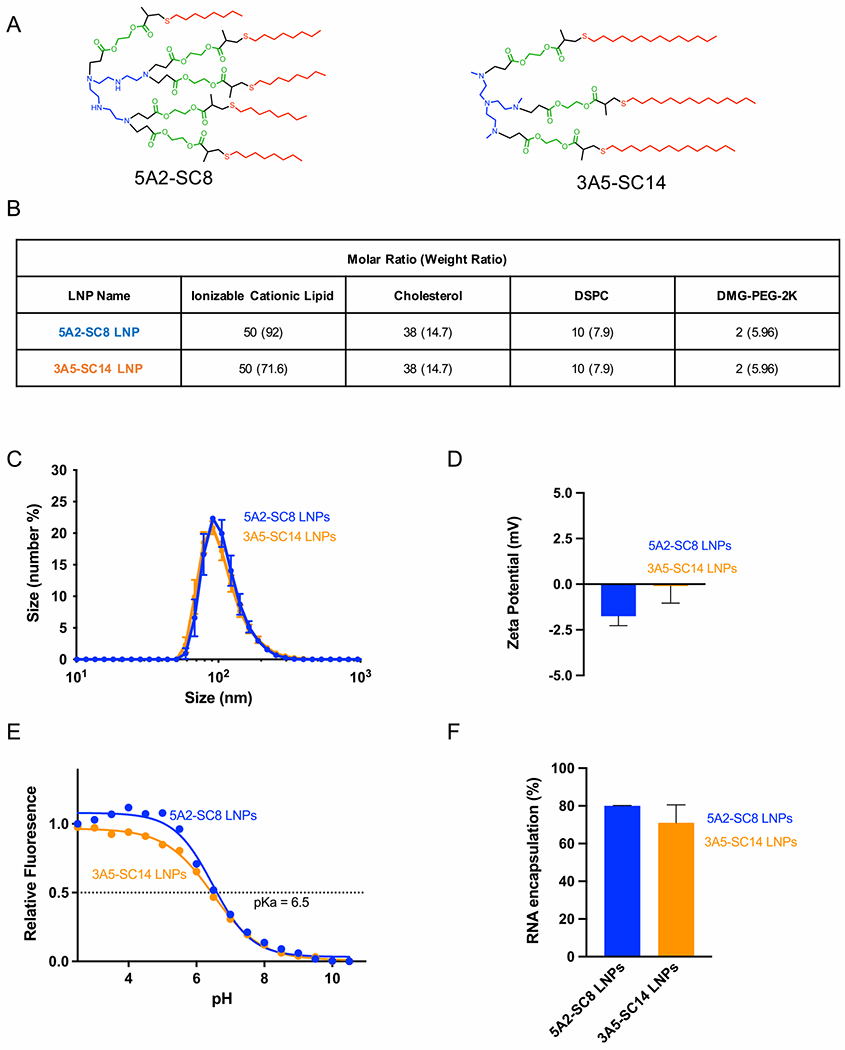
Within the field of lipid nanoparticles (LNPs) for RNA delivery, the focus has been mainly placed on organ level delivery, which can mask cellular level effects consequential to therapeutic applications. Here, we studied a pair of LNPs with similar physical properties and discovered how the chemistry of the ionizable amino lipid can control the endogenous LNP identity, affecting cellular uptake in the liver and altering therapeutic outcomes in a model of liver cancer. Although most LNPs accumulate in the liver after intravenous administration (suggesting that liver delivery is straightforward), we observed an unexpected behavior when comparing two similar LNP formulations (5A2-SC8 and 3A5-SC14 LNPs) that resulted in distinct RNA delivery within the organ. Despite both LNPs possessing similar physical properties, ability to silence gene expression , strong accumulation within the liver, and a shared p of 6.5, only 5A2-SC8 LNPs were able to functionally deliver RNA to hepatocytes. Factor VII (FVII) activity was reduced by 87%, with 5A2-SC8 LNPs carrying FVII siRNA (siFVII), while 3A5-SC14 LNPs carrying siFVII produced baseline FVII activity levels comparable to the nontreatment control at a dosage of 0.5 mg/kg. Protein corona analysis indicated that 5A2-SC8 LNPs bind apolipoprotein E (ApoE), which can drive LDL-R receptor-mediated endocytosis in hepatocytes. In contrast, the surface of 3A5-SC14 LNPs was enriched in albumin but depleted in ApoE, which likely led to Kupffer cell delivery and detargeting of hepatocytes. In an aggressive MYC-driven liver cancer model relevant to hepatocytes, 5A2-SC8 LNPs carrying let-7g miRNA were able to significantly extend survival up to 121 days. Since disease targets exist in an organ- and cell-specific manner, the clinical development of RNA LNP therapeutics will require an improved understanding of LNP cellular tropism within organs. The results from our work illustrate the importance of understanding the cellular localization of RNA delivery and incorporating further checkpoints when choosing nanoparticles beyond biochemical and physical characterization, as small changes in the chemical composition of LNPs can have an impact on both the biofate of LNPs and therapeutic outcomes.
在用于 RNA 递送的脂质纳米颗粒 (LNPs) 领域,研究重点主要集中在器官水平的递送,这可能掩盖了治疗应用中与细胞水平相关的效应。在这里,我们研究了一对具有相似物理性质的 LNPs,并发现可离子化氨基酸脂质的化学性质如何控制内源性 LNP 特性,从而影响肝脏中的细胞摄取,并改变肝癌模型中的治疗效果。尽管大多数 LNPs 在静脉给药后积聚在肝脏中(表明肝脏递送很简单),但当比较两种相似的 LNP 制剂(5A2-SC8 和 3A5-SC14 LNPs)时,我们观察到一种意想不到的行为,导致器官内 RNA 递送的明显差异。尽管这两种 LNP 都具有相似的物理性质、沉默基因表达的能力、在肝脏中的强烈积累以及共同的 p 值为 6.5,但只有 5A2-SC8 LNPs 能够将 RNA 有效地递送到肝细胞中。用 5A2-SC8 LNP 携带 FVII siRNA (siFVII) 可使因子 VII (FVII) 活性降低 87%,而用 3A5-SC14 LNP 携带 siFVII 则可在 0.5mg/kg 的剂量下产生与未治疗对照相当的基线 FVII 活性水平。蛋白质冠分析表明,5A2-SC8 LNPs 与载脂蛋白 E (ApoE) 结合,这可以驱动肝细胞中的 LDL-R 受体介导的内吞作用。相比之下,3A5-SC14 LNP 的表面富含白蛋白而缺乏 ApoE,这可能导致库普弗细胞的递送和对肝细胞的脱靶作用。在与肝细胞相关的侵袭性 MYC 驱动的肝癌模型中,携带 let-7g miRNA 的 5A2-SC8 LNP 能够显著延长生存时间,达到 121 天。由于疾病靶点在器官和细胞特异性方式中存在,因此 RNA LNP 治疗的临床开发将需要更好地了解 LNP 在器官中的细胞趋向性。我们的工作结果说明了了解 RNA 递送的细胞定位的重要性,并在选择纳米颗粒时纳入进一步的检查点,超越生物化学和物理特性,因为 LNPs 的化学成分的微小变化会对 LNPs 的生物命运和治疗结果产生影响。