Center for Microbial Ecology and Technology (CMET), Ghent Universitygrid.5342.0, Gent, Belgium.
Microbiol Spectr. 2022 Oct 26;10(5):e0268922. doi: 10.1128/spectrum.02689-22. Epub 2022 Sep 26.
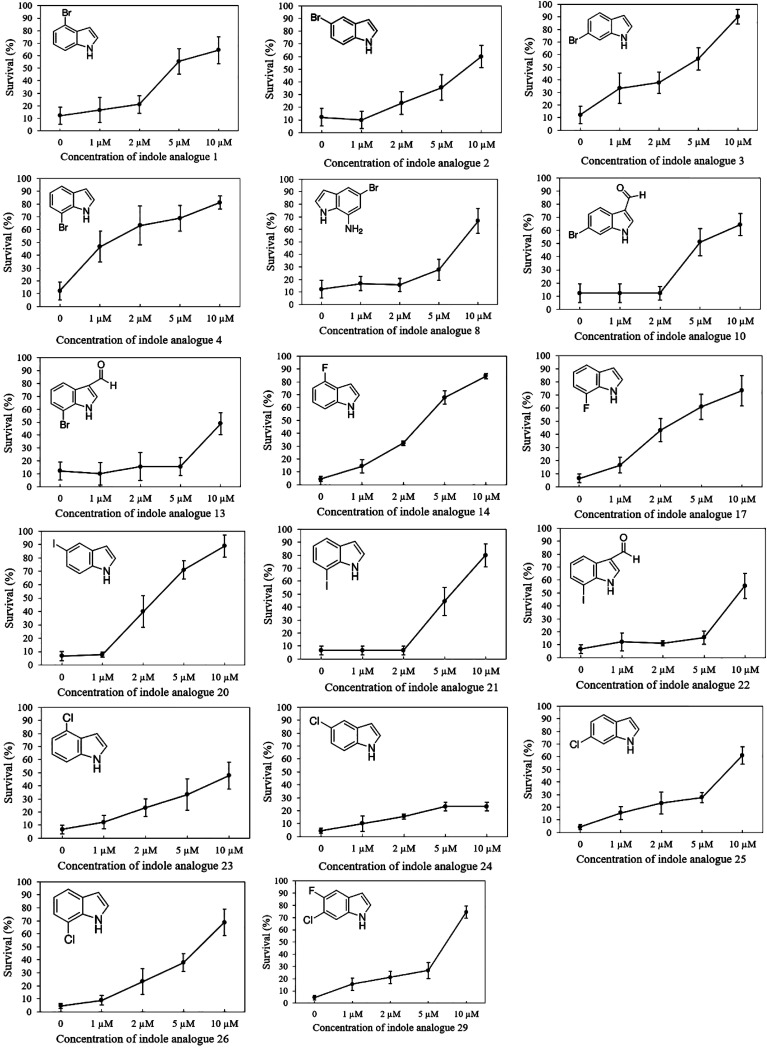
Indole signaling is viewed as a potential target for antivirulence therapy against antibiotic-resistant pathogens because of its link with the production of virulence factors. This study examined the antimicrobial and antivirulence properties of 44 indoles toward Vibrio campbellii. Based on the results, 17 halogenated indole analogues were selected, as they significantly improved the survival of brine shrimp larvae challenged with . Specifically, 6-bromoindole, 7-bromoindole, 4-fluoroindole, 5-iodoindole, and 7-iodoindole showed a high protective effect, improving the survival of brine shrimp to over 80% even at a low concentration of 10 μM. To explore the impact of selected indole analogues on bacterial virulence phenotypes, swimming motility, biofilm formation, protease activity, and hemolytic activity of were determined. The results showed that all of the 17 selected indole analogues decreased swimming motility at both 10 μM and 100 μM. Most of the indole analogues decreased biofilm formation at a concentration of 100 μM. In contrast, only a slightly decreased protease activity and no effect on hemolytic activity were observed at both concentrations. To our knowledge, this is the first study of the structure-activity relation of halogenated indole analogues with respect to virulence inhibition of a pathogenic bacterium in an host model system, and the results demonstrate the potential of these compounds in applications aiming at the protection of shrimp from vibriosis, a major disease in aquaculture. Bacterial diseases are a major problem in the aquaculture industry. In order to counter this problem, farmers have been using antibiotics, and this has led to the evolution and spread of antibiotic resistance. In order for the aquaculture industry to further grow in a sustainable way, novel and sustainable methods to control diseases are needed. We previously reported that indole signaling is a valid target for the development of novel therapies to control disease caused by Vibrio campbellii and related bacteria, which are among the major bacterial pathogens in aquaculture. In the present study, we identified indole analogues that are more potent in protecting brine shrimp (a model organism for shrimp) from . To our knowledge, this is the first study of the structure-activity relation of halogenated indole analogues with respect to virulence inhibition of a pathogenic bacterium in an host model system.
吲哚信号被认为是一种针对抗生素耐药性病原体的抗毒力治疗的潜在靶点,因为它与毒力因子的产生有关。本研究检测了 44 种吲哚类化合物对鳗弧菌的抗菌和抗毒力特性。根据结果,选择了 17 种卤代吲哚类似物,因为它们显著提高了 challenged with 的盐水虾幼虫的存活率。具体来说,6-溴吲哚、7-溴吲哚、4-氟吲哚、5-碘吲哚和 7-碘吲哚表现出高保护作用,即使在低浓度 10μM 时,也能将盐水虾的存活率提高到 80%以上。为了探究所选吲哚类似物对细菌毒力表型的影响,测定了 的泳动运动、生物膜形成、蛋白酶活性和溶血活性。结果表明,17 种所选吲哚类似物在 10μM 和 100μM 时均降低了泳动运动。大多数吲哚类似物在 100μM 时降低了生物膜形成。相比之下,在两个浓度下,仅观察到蛋白酶活性略有降低,溶血活性没有影响。据我们所知,这是首次研究卤代吲哚类似物的结构-活性关系,以抑制病原细菌在丰年虾宿主模型系统中的毒力,结果表明这些化合物在应用于保护虾免受弧菌病方面具有潜力,弧菌病是水产养殖中的一种主要疾病。细菌疾病是水产养殖业的一个主要问题。为了解决这个问题,农民一直在使用抗生素,这导致了抗生素耐药性的进化和传播。为了使水产养殖业以可持续的方式进一步发展,需要新的和可持续的方法来控制疾病。我们之前报道过,吲哚信号是开发新型疗法来控制由鳗弧菌和相关细菌引起的疾病的有效靶点,这些细菌是水产养殖中主要的细菌病原体之一。在本研究中,我们鉴定出了更有效地保护丰年虾(虾的模型生物)免受 的吲哚类似物。据我们所知,这是首次研究卤代吲哚类似物的结构-活性关系,以抑制病原细菌在丰年虾宿主模型系统中的毒力。