
既往乙型肝炎病毒感染——被低估的胰腺癌致病因素。
Previous hepatitis B viral infection-an underestimated cause of pancreatic cancer.
机构信息
Department of Hepatology, Moscow Clinical Scientific Center N.A. A.S. Loginov, Moscow 111123, Russia.
Department of Gastroenterology, Hepatology and Nutrition, Federal Research Center of Nutrition, Biotechnology and Food Safety, Moscow 115446, Russia.
出版信息
World J Gastroenterol. 2022 Sep 7;28(33):4812-4822. doi: 10.3748/wjg.v28.i33.4812.
BACKGROUND
The etiology of pancreatic cancer remains unclear. This limits the possibility of prevention and effective treatment. Hepatitis B virus (HBV) is responsible for the development of different types of cancer, but its role in pancreatic cancer is still being discussed.
AIM
To assess the prevalence of previous HBV infection and to identify viral biomarkers in patients with pancreatic ductal adenocarcinoma (PDAC) to support the role of the virus in etiology of this cancer.
METHODS
The data of 130 hepatitis B surface antigen-negative subjects were available for the final analysis, including 60 patients with PDAC confirmed by cytology or histology and 70 sex- and age-matched controls. All the participants were tested for HBV biomarkers in blood [antibody to hepatitis B core antigen (anti-HBc), antibody to hepatitis B surface antigen (anti-HBs) and HBV DNA], and for those with PDAC, biomarkers in resected pancreatic tissues were tested (HBV DNA, HBV pregenomic RNA and covalently closed circular DNA). We performed immunohistochemistry staining of pancreatic tissues for hepatitis B virus X antigen and Ki-67 protein. Non-parametric statistics were used for the analysis.
RESULTS
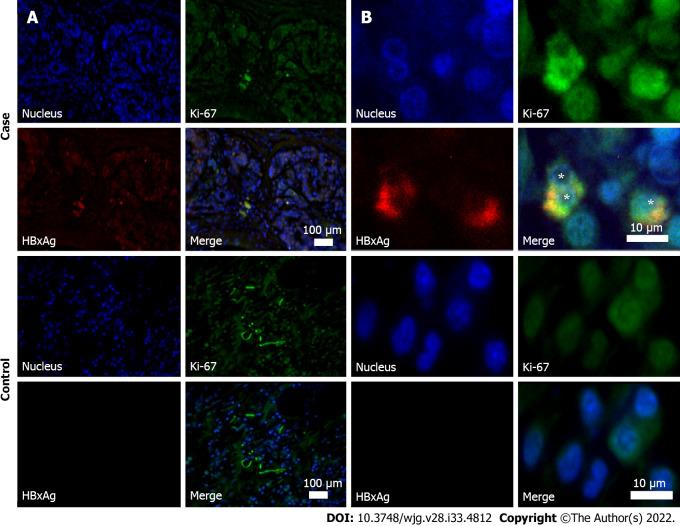
Anti-HBc was detected in 18/60 (30%) patients with PDAC and in 9/70 (13%) participants in the control group ( = 0.029). Accordingly, the odds of PDAC in anti-HBc-positive subjects were higher compared to those with no previous HBV infection (odds ratio: 2.905, 95% confidence interval: 1.191-7.084, standard error 0.455). HBV DNA was detected in 8 cases of PDAC and in 6 of them in the pancreatic tumor tissue samples only (all patients were anti-HBc positive). Blood HBV DNA was negative in all subjects of the control group with positive results of the serum anti-HBc test. Among 9 patients with PDAC, 5 revealed signs of replicative competence of the virus (covalently closed circular DNA with or without pregenomic RNA) in the pancreatic tumor tissue samples. Hepatitis B virus X antigen expression and active cell proliferation was revealed by immunohistochemistry in 4 patients with PDAC in the pancreatic tumor tissue samples.
CONCLUSION
We found significantly higher risks of PDAC in anti-HBc-positive patients. Detection of viral replication and hepatitis B virus X protein expression in the tumor tissue prove involvement of HBV infection in pancreatic cancer development.
背景
胰腺癌的病因仍不清楚。这限制了预防和有效治疗的可能性。乙型肝炎病毒(HBV)可导致多种类型的癌症,但它在胰腺癌中的作用仍存在争议。
目的
评估乙型肝炎表面抗原阴性的患者中既往 HBV 感染的流行情况,并鉴定胰腺导管腺癌(PDAC)患者中的病毒标志物,以支持病毒在这种癌症发病机制中的作用。
方法
最终纳入 130 例乙型肝炎表面抗原阴性患者进行分析,包括 60 例经细胞学或组织学证实的 PDAC 患者和 70 例性别和年龄匹配的对照者。所有参与者均进行血液 HBV 标志物检测[乙型肝炎核心抗体(抗-HBc)、乙型肝炎表面抗原抗体(抗-HBs)和 HBV DNA],PDAC 患者还检测胰腺组织中的标志物[HBV DNA、HBV 前基因组 RNA 和共价闭合环状 DNA]。对乙型肝炎病毒 X 抗原和 Ki-67 蛋白进行胰腺组织免疫组化染色。采用非参数统计方法进行分析。
结果
60 例 PDAC 患者中有 18 例(30%)和 70 例对照者中有 9 例(13%)检测到抗-HBc(=0.029)。因此,与无既往 HBV 感染的患者相比,抗-HBc 阳性患者 PDAC 的发生几率更高(比值比:2.905,95%置信区间:1.191-7.084,标准误 0.455)。8 例 PDAC 患者中检测到 HBV DNA,其中 6 例仅在胰腺肿瘤组织样本中检出(所有患者均为抗-HBc 阳性)。所有抗-HBc 阳性且血清抗-HBc 检测结果阳性的对照组患者血液 HBV DNA 均为阴性。9 例 PDAC 患者中,5 例胰腺肿瘤组织样本中存在病毒复制能力的证据(存在或不存在前基因组 RNA 的共价闭合环状 DNA)。4 例 PDAC 患者的胰腺肿瘤组织样本中通过免疫组化检测到乙型肝炎病毒 X 抗原表达和活跃的细胞增殖。
结论
我们发现抗-HBc 阳性患者 PDAC 的发生风险显著增加。在肿瘤组织中检测到病毒复制和乙型肝炎病毒 X 蛋白表达证明 HBV 感染参与了胰腺癌的发生发展。

 Zotero 插件