Kurdi Maher, Moshref Rana H, Katib Yousef, Faizo Eyad, Najjar Ahmed A, Bahakeem Basem, Bamaga Ahmed K
Department of Pathology, Faculty of Medicine, King Abdulaziz University, Jeddah 213733, Saudi Arabia.
Department of Neurosciences, King Faisal Specialist Hospital and Research Center, Jeddah 213733, Saudi Arabia.
World J Clin Oncol. 2022 Jul 24;13(7):567-576. doi: 10.5306/wjco.v13.i7.567.
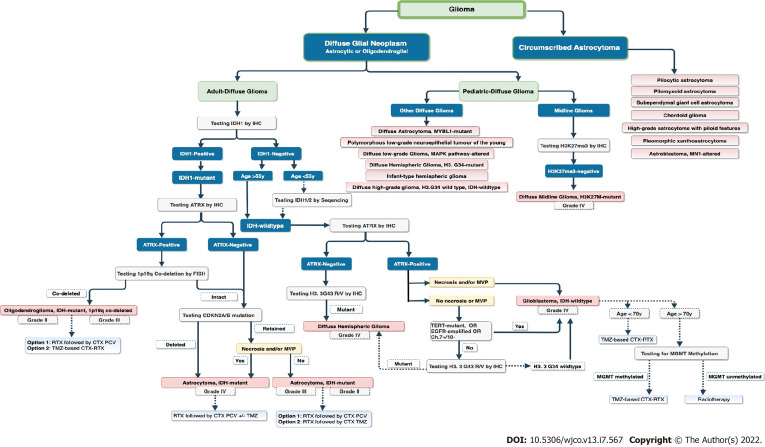
The classification of central nervous system (CNS) glioma went through a sequence of developments, between 2006 and 2021, started with only histological approach then has been aided with a major emphasis on molecular signatures in the 4th and 5th editions of the World Health Organization (WHO). The recent reformation in the 5th edition of the WHO classification has focused more on the molecularly defined entities with better characterized natural histories as well as new tumor types and subtypes in the adult and pediatric populations. These new subclassified entities have been incorporated in the 5 edition after the continuous exploration of new genomic, epigenomic and transcriptomic discovery. Indeed, the current guidelines of 2021 WHO classification of CNS tumors and European Association of Neuro-Oncology (EANO) exploited the molecular signatures in the diagnostic approach of CNS gliomas. Our current review presents a practical diagnostic approach for diffuse CNS gliomas and circumscribed astrocytomas using histomolecular criteria adopted by the recent WHO classification. We also describe the treatment strategies for these tumors based on EANO guidelines.
2006年至2021年间,中枢神经系统(CNS)胶质瘤的分类经历了一系列发展,最初仅采用组织学方法,随后在世界卫生组织(WHO)第4版和第5版分类中,重点转向分子特征。WHO第5版分类的最新改革更多地关注分子定义的实体,这些实体具有更明确的自然史,以及成人和儿童人群中的新肿瘤类型和亚型。经过对新的基因组、表观基因组和转录组发现的不断探索,这些新的亚分类实体已被纳入第5版。事实上,2021年WHO中枢神经系统肿瘤分类指南和欧洲神经肿瘤协会(EANO)在中枢神经系统胶质瘤的诊断方法中采用了分子特征。我们目前的综述提出了一种使用WHO最新分类所采用的组织分子标准对弥漫性中枢神经系统胶质瘤和局限性星形细胞瘤进行实际诊断的方法。我们还根据EANO指南描述了这些肿瘤的治疗策略。