Belliere Julie, Sprangers Ben
Department of Nephrology and Organ Transplantation, Referral Centre for Rare Kidney Diseases, French National of Health and Medical Research, U1297 (Institute of Metabolic and Cardiovascular Diseases), University Paul Sabatier, University Hospital of Toulouse, Toulouse, France.
Department of Microbiology, Immunology and Transplantation, Laboratory of Molecular Immunology, Rega Institute, KU Leuven, Leuven Belgium and Division of Nephrology, University Hospitals Leuven, Leuven, Belgium.
Clin Kidney J. 2022 Jun 22;15(10):1803-1806. doi: 10.1093/ckj/sfac161. eCollection 2022 Oct.
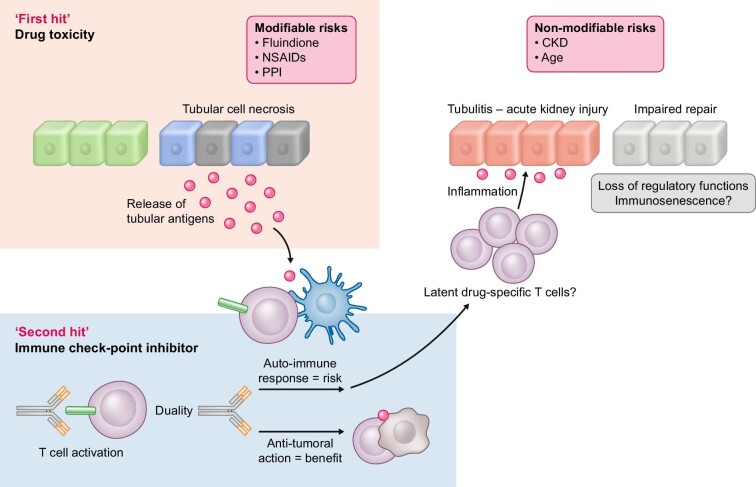
The introduction of immune checkpoint inhibitors (ICI) has resulted in significant improvement in cancer care, but has been accompanied by the occurrence of immune-related adverse events (irAEs). Also, kidney irAEs have been reported, and the most frequent one is acute tubulointerstitial disease which impacts renal and overall prognosis. There is an unmet need to stratify renal risk in oncologic patients, to allow individualized monitoring and therefore, early detection of ICI-related acute kidney injury (ICI-AKI). Although risk factors for ICI-AKI have been described in previous case-control studies, where 'cases' were ICI-AKI patients and 'controls' ICI-treated patients without AKI, there is limited epidemiologic knowledge concerning patients developing different irAEs. In this issue of the , Gerard describe five factors that were associated with the development of ICI-AKI: older age, previous chronic kidney disease, and concomitant use of fluindione, non-steroidal anti-inflammatory drugs and proton pump inhibitors. These findings suggest that ICI may be a 'second hit' that precipitates AKI caused by a concomitant drug. These results urge an increased focus to prevent the prescription of potential nephrotoxic drugs in ICI-treated patients, avoiding iatrogenic events.
免疫检查点抑制剂(ICI)的引入显著改善了癌症治疗,但同时也伴随着免疫相关不良事件(irAE)的发生。此外,肾脏irAE也有报道,其中最常见的是急性肾小管间质性疾病,这会影响肾脏及整体预后。对肿瘤患者的肾脏风险进行分层,以实现个体化监测,从而早期发现ICI相关急性肾损伤(ICI-AKI),这一需求尚未得到满足。尽管在先前的病例对照研究中已经描述了ICI-AKI的危险因素,其中“病例”为ICI-AKI患者,“对照”为接受ICI治疗但未发生AKI的患者,但关于发生不同irAE的患者的流行病学知识仍然有限。在本期杂志中,杰拉德等人描述了与ICI-AKI发生相关的五个因素:老年、既往慢性肾脏病以及同时使用氟茚二酮、非甾体抗炎药和质子泵抑制剂。这些发现表明,ICI可能是引发由伴随药物导致的AKI的“二次打击”。这些结果促使人们更加关注在接受ICI治疗的患者中预防潜在肾毒性药物的处方,避免医源性事件。