World Health Organization, WHO Country Office, Juba, South Sudan.
World Health Organization, East and South Africa, Sub-Regional Office, Nairobi, Kenya.
Pan Afr Med J. 2022 Jun 9;42(Suppl 1):7. doi: 10.11604/pamj.supp.2022.42.1.33842. eCollection 2022.
joint external evaluation is a voluntary and collaborative process to assess a country´s capacity under International Health Regulations (2005) to prevent, detect, and respond to public health threats. The main objective is to measure a country´s status in building the necessary capacities to prevent, detect, and respond to infectious disease threats and establish a baseline measurement of capacities and capabilities. The Republic of South Sudan conducted the Joint External Evaluation from 16-20 October 2017, where its capacities were assessed to public health threats per the International Health Regulation (2005).
cross-sectional descriptive study of the Joint External Evaluation process and the findings are described along with major findings and recommendations for the country.
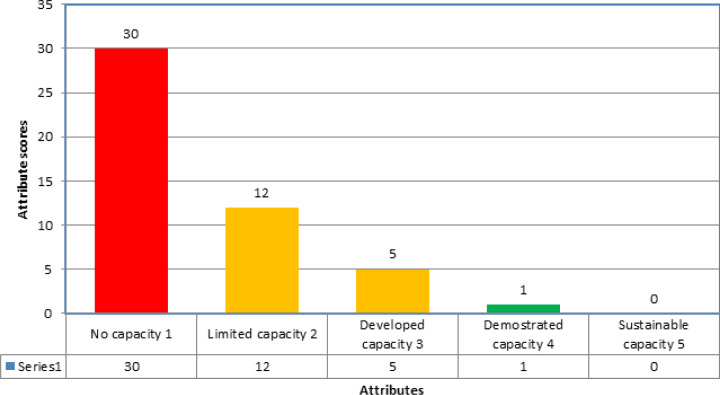
South Sudan's overall mean score across 48 indicators was 1.5 (min= 1, max= 4) and 42/48 indicators (87.5%) scored < 2 on a 1 to 5 scale. Technical areas in the prevent category with the lowest score were antimicrobial resistance, biosafety and biosecurity, and National legislation, policy, and financing. In the detect category, the mean score was 2. Technical areas with the lowest mean scores were workforce development and the National Laboratory System. Preparedness, medical countermeasures, personnel deployment, linking public health, and security authorities had the lowest scores in the respond category. Chemical events, radiation emergencies, and points of entry had a score of 1 in the other IHR-related hazards and points of entry category.
South Sudan's mean score of 1.5 can be attributed to several civil conflicts experienced, which have impacted negatively on the health system. Recommendations from the Joint External Evaluation need to be implemented and these must be aligned with the costed National Action Plan for Health Security.
联合外部评估是一项自愿和协作的过程,旨在评估一个国家根据《国际卫生条例(2005)》预防、发现和应对公共卫生威胁的能力。主要目标是衡量一个国家在建立预防、发现和应对传染病威胁的必要能力方面的状况,并建立能力和能力的基线衡量标准。南苏丹共和国于 2017 年 10 月 16 日至 20 日进行了联合外部评估,根据《国际卫生条例(2005)》评估了其应对公共卫生威胁的能力。
对联合外部评估过程进行横断面描述性研究,并描述了评估结果以及该国的主要发现和建议。
南苏丹在 48 项指标中的总平均得分为 1.5(最低= 1,最高= 4),42/48 项指标(87.5%)在 1 到 5 的评分范围内得分为<2。预防类别中技术领域得分最低的是抗菌素耐药性、生物安全和生物安保以及国家立法、政策和融资。在发现类别中,平均得分为 2。技术领域中得分最低的是劳动力发展和国家实验室系统。准备、医疗对策、人员部署、公共卫生和安全当局之间的联系以及应对类别中的得分最低。化学事件、辐射紧急情况和入境点在其他与《国际卫生条例》相关的危害和入境点类别中的得分为 1。
南苏丹 1.5 的平均得分可归因于其经历的几次内战,这些冲突对卫生系统产生了负面影响。联合外部评估的建议需要得到执行,这些建议必须与已定价的《国家卫生安全行动计划》保持一致。