The Key Laboratory of Aquaculture Nutrition and Feed (Ministry of Agriculture) and the Key Laboratory of Mariculture (Ministry of Education), Ocean University of China, Qingdao, China.
Fish Innate Immune System Group, Department of Cell Biology and Histology, Faculty of Biology, University of Murcia, Murcia, Spain.
Front Immunol. 2022 Sep 8;13:986593. doi: 10.3389/fimmu.2022.986593. eCollection 2022.
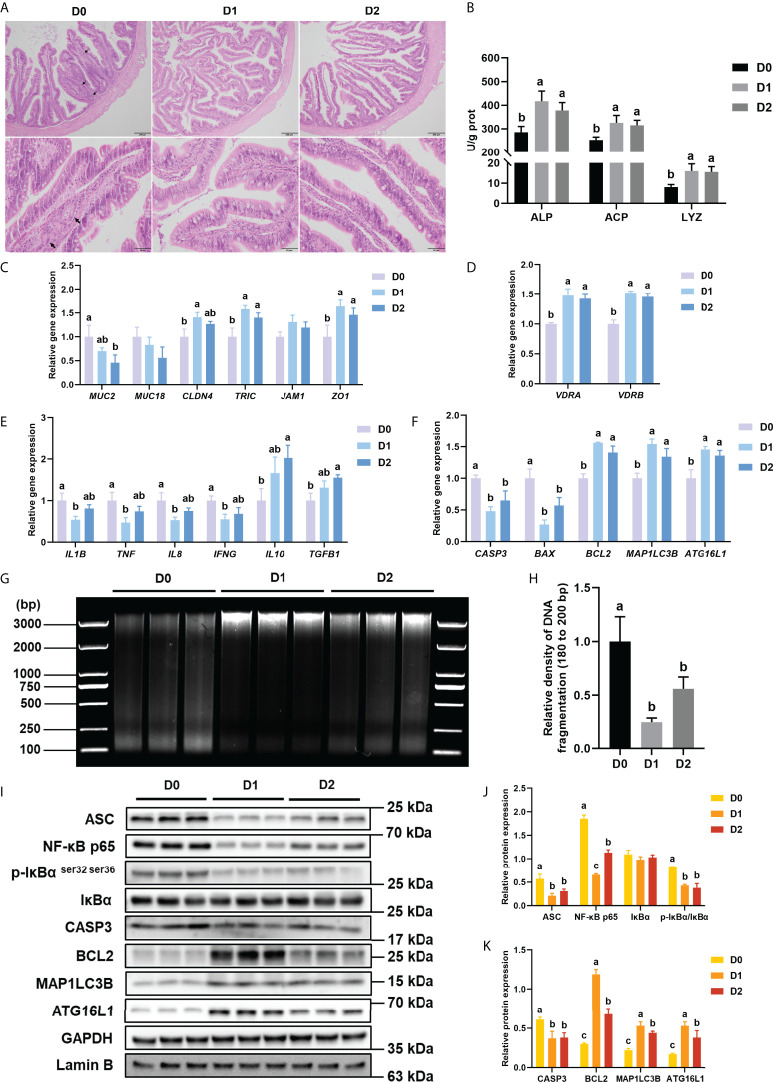
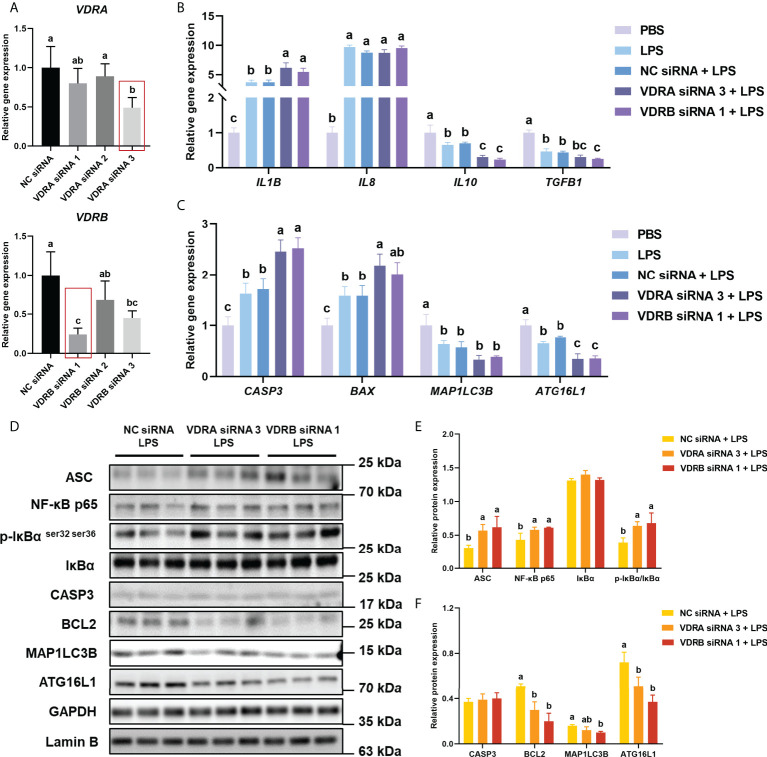
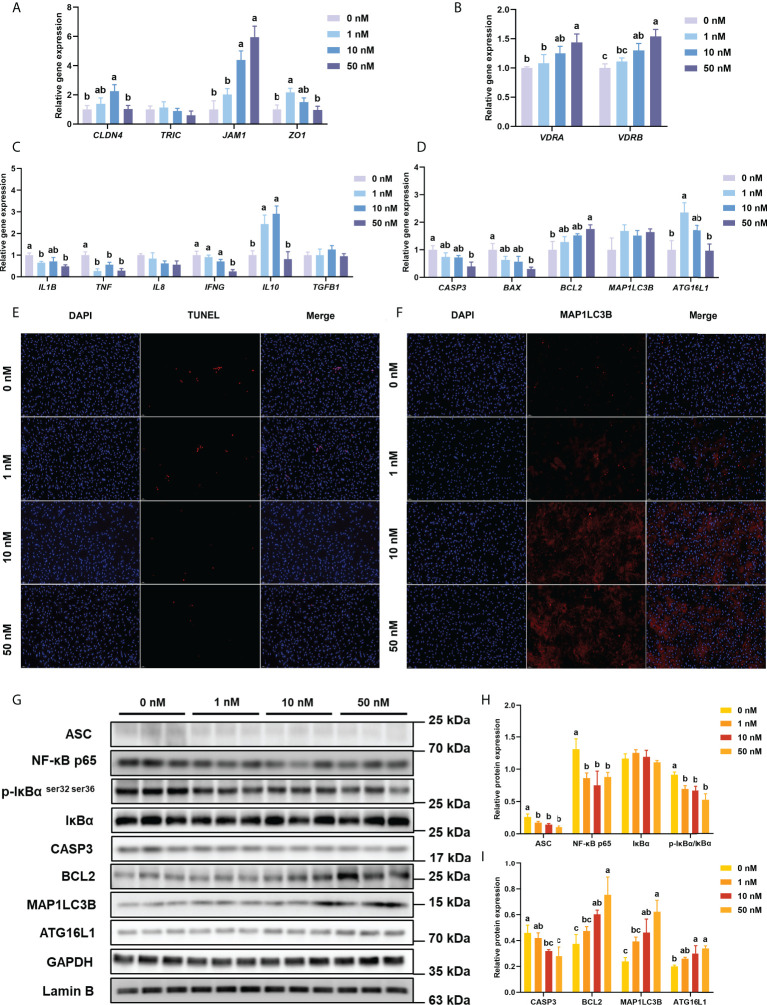
Vitamin D (VD) participated widely in the nuclear factor-κB (NF-κB)-mediated inflammation, apoptosis, and autophagy through the vitamin D receptor (VDR). However, the molecular mechanisms remain not understood in teleost. The present study investigated the functions of VD/VDR on intestinal inflammation, autophagy, and apoptosis of turbot and . Triple replicates of 30 fish were fed with each of three diets with graded levels of 32.0 (D), 1012.6 (D), and 3978.2 (D) IU/kg VD. Obvious intestinal enteritis was observed in the D group and followed with dysfunction of intestinal mucosal barriers. The intestinal inflammatory response induced by VD deficiency was regulated by the NF-κB/inflammasome signalling. The promotion of intestinal apoptosis and suppression of intestinal autophagy were also observed in the D group. Similarly, VD deficiency induced more intense inflammation regulated by NF-κB/inflammasome signalling. The mutually exclusive apoptosis and autophagy were also observed in the group without 1,25(OH)D , accompanied by similar changes in apoptosis and autophagy increased apoptosis. The gene expression of VDRs was significantly increased with the increasing VD supplementation both and . Moreover, VDR knockdown in turbot resulted in intestinal inflammation, and this process relied on the activation of inflammasome mediated by NF-κB signalling. Simultaneously, intestinal apoptosis was promoted, whereas intestinal autophagy was inhibited. In conclusion, VD deficiency could induce intestinal inflammation activation of the NF-κB/inflammasome pathway, intestinal apoptosis, and autophagy formed a mutually exclusive relation in teleost. And VDR is the critical molecule in those processes.
维生素 D(VD)通过维生素 D 受体(VDR)广泛参与核因子-κB(NF-κB)介导的炎症、凋亡和自噬。然而,在鱼类中,其分子机制尚不清楚。本研究探讨了维生素 D/VDR 对大菱鲆和牙鲆肠道炎症、自噬和凋亡的作用。将 30 条鱼分为 3 组,每组 3 个重复,分别投喂 3 种等氮等能但维生素 D 水平不同的饲料:32.0(D)、1012.6(D)和 3978.2(D)IU/kg。结果发现,D 组鱼出现明显的肠炎,肠黏膜屏障功能受损。VD 缺乏诱导的肠道炎症反应受 NF-κB/炎症小体信号通路调控。同时,D 组鱼还出现了肠道细胞凋亡增加和自噬受抑制的现象。同样,缺乏 1,25(OH)2D 也诱导了更强烈的 NF-κB/炎症小体信号通路调控的炎症反应,并且观察到凋亡和自噬互斥的现象,同时伴随着凋亡增加和自噬减少。随着 VD 补充量的增加, 和 鱼的 VDRs 基因表达均显著增加。此外,在大菱鲆中敲低 VDR 导致肠道炎症,这一过程依赖于 NF-κB 信号通路激活的炎症小体。同时,促进了肠道细胞凋亡,抑制了肠道自噬。综上所述,VD 缺乏可诱导鱼类肠道炎症,激活 NF-κB/炎症小体通路,促进肠道细胞凋亡,抑制自噬,并且这种互斥关系在鱼类中普遍存在。VDR 是这些过程中的关键分子。