Lv Gang, Wang Xiaoxia, Jiang Xiangxiang, Li Minghui, Lu Kevin
Department of General Surgery, The First Medical Center of Chinese PLA General Hospital, Beijing, China.
College of Pharmacy, University of South Carolina, Columbia, SC, United States.
Front Pharmacol. 2022 Sep 7;13:872702. doi: 10.3389/fphar.2022.872702. eCollection 2022.
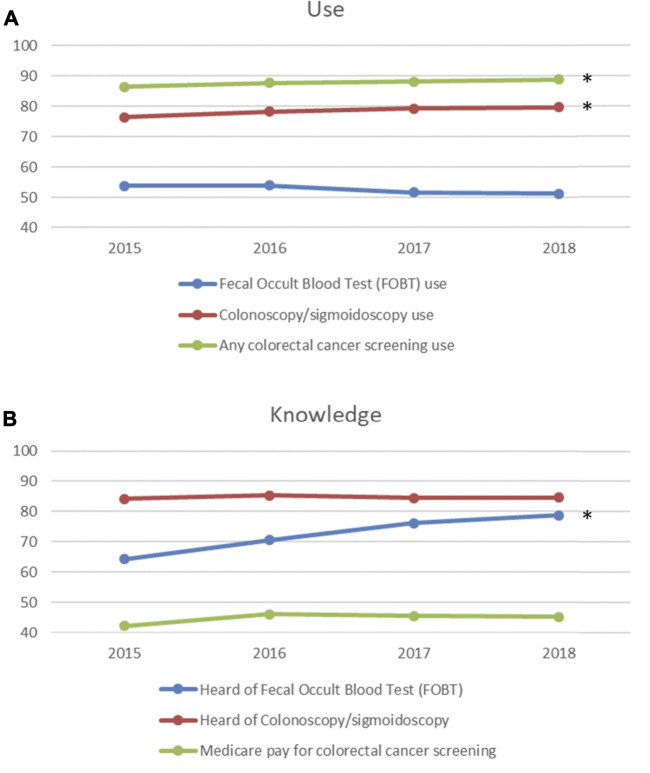
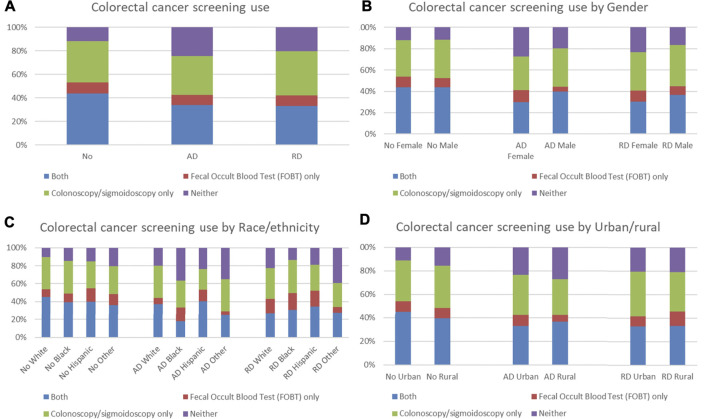
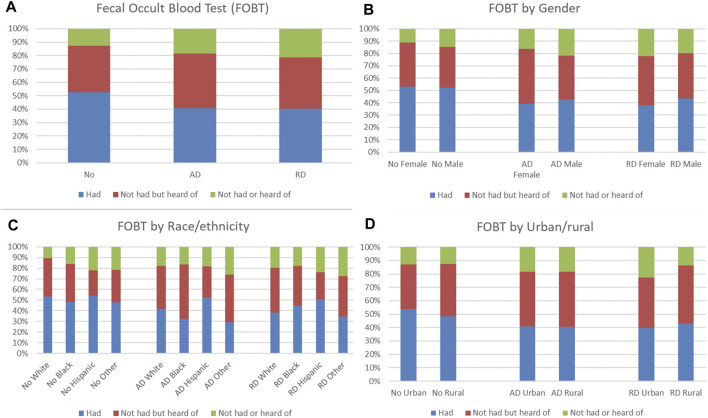
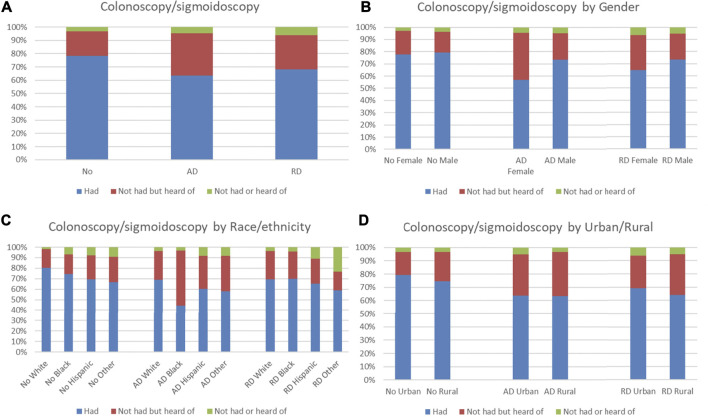
Colorectal cancer screening can detect colorectal cancer at an early stage and reduce mortality. None of the existing clinical practice guidelines provide specific recommendations for colorectal cancer screening in patients with Alzheimer's disease and related dementias (ADRD). Limited studies have assessed the impacts of ADRD on colorectal cancer screening use and knowledge, and no studies have focused on the associated health disparities. To examine the utilization, knowledge, and associated health disparities of colorectal cancer screening in older adults with ADRD. This study used the Medicare Current Beneficiary Survey from 2015 to 2018. Two types of colorectal cancer screening, including fecal occult blood test (FOBT) and colonoscopy/sigmoidoscopy, were measured. The colorectal cancer screening knowledge was evaluated by asking if the participants have heard of two screening methods and whether they knew Medicare pays for colorectal cancer screenings. Logistic regression models were used to examine the impact of ADRD diagnosis on the utilization and knowledge of colorectal cancer screening. The overall colorectal cancer screening rate in older adults increased from 86.4% to 88.96% from 2015 to 2018. Patients with AD were 39% (OR: 0.61; 95% CI: 0.50-0.76) less likely and those with RD were 25% (OR: 0.75; 95% CI: 0.62-0.91) less likely to use any colorectal cancer screening when compared to older adults without ADRD. The rate of knowledge of colonoscopy/sigmoidoscopy remained high between 84.23% and 84.57% while the knowledge of FOBT increased from 64.32% to 78.69% during the study period. Compared to older adults without ADRD, those with AD were 77% (OR: 1.77; 95% CI: 1.12-2.81) more likely to hear of colonoscopy/sigmoidoscopy. The rate of knowledge of Medicare pay for colorectal cancer screening increased from 42.19% to 45.27% during the study period. Compared to older adults without ADRD, those with AD were 19% (OR: 0.81; 95% CI: 0.70-0.94) less likely to know that Medicare pays for colorectal cancer screening. ADRD was significantly associated with colorectal cancer screening utilization and knowledge. In addition, this study identified health disparities in race/ethnicity, gender, and urban/rural residence in colorectal cancer screening use and knowledge.
结直肠癌筛查可在早期检测出结直肠癌并降低死亡率。现有的临床实践指南均未针对阿尔茨海默病及相关痴呆症(ADRD)患者的结直肠癌筛查提供具体建议。有限的研究评估了ADRD对结直肠癌筛查应用和认知的影响,且尚无研究关注相关的健康差异。为了研究患有ADRD的老年人在结直肠癌筛查方面的应用情况、认知水平及相关的健康差异。本研究使用了2015年至2018年的医疗保险当前受益人调查数据。测量了两种类型的结直肠癌筛查,包括粪便潜血试验(FOBT)和结肠镜检查/乙状结肠镜检查。通过询问参与者是否听说过这两种筛查方法以及他们是否知道医疗保险支付结直肠癌筛查费用来评估结直肠癌筛查知识。使用逻辑回归模型来研究ADRD诊断对结直肠癌筛查应用和认知的影响。2015年至2018年期间,老年人的总体结直肠癌筛查率从86.4%提高到了88.96%。与没有ADRD的老年人相比,患有阿尔茨海默病(AD)的患者使用任何结直肠癌筛查的可能性降低了39%(比值比:0.61;95%置信区间:0.50 - 0.76),患有其他痴呆症(RD)的患者降低了25%(比值比:0.75;95%置信区间:0.62 - 0.91)。在研究期间,结肠镜检查/乙状结肠镜检查的知晓率保持在较高水平,在84.23%至84.57%之间,而粪便潜血试验的知晓率从64.32%提高到了78.69%。与没有ADRD的老年人相比,患有AD的患者听说过结肠镜检查/乙状结肠镜检查的可能性高77%(比值比:1.77;95%置信区间:1.12 - 2.81)。在研究期间,知道医疗保险支付结直肠癌筛查费用的知晓率从42.19%提高到了45.27%。与没有ADRD的老年人相比,患有AD的患者知道医疗保险支付结直肠癌筛查费用的可能性降低了19%(比值比:0.81;95%置信区间:0.70 - 0.94)。ADRD与结直肠癌筛查的应用和认知显著相关。此外,本研究还发现了在结直肠癌筛查应用和认知方面,不同种族/民族、性别以及城乡居住情况存在健康差异。