Lin Huijia, Chen Xuefeng, Ge Jiajing, Shi Liping, Du Lizhong, Ma Xiaolu
Department of NICU, The Children's Hospital, Zhejiang University School of Medicine, National Clinical Research Center for Child Health, Hangzhou, China.
Department of Endocrinology, The Children's Hospital, Zhejiang University School of Medicine, National Clinical Research Center for Child Health, Hangzhou, China.
Front Pediatr. 2022 Sep 9;10:978743. doi: 10.3389/fped.2022.978743. eCollection 2022.
This study aims to compare the clinical characteristics and 1-year outcomes of preterm infants with bronchopulmonary dysplasia (BPD) who were discharged on supplemental oxygen or room air.
The preterm infants (born <32 weeks' gestation, birth weight ≤1,250 g) diagnosed with BPD and admitted between January 2020 and December 2020 were enrolled. The clinical data during hospitalization were collected through the hospital's electronic record system. The outcomes after discharge were acquired from the outpatient system and through telephonic interviews.
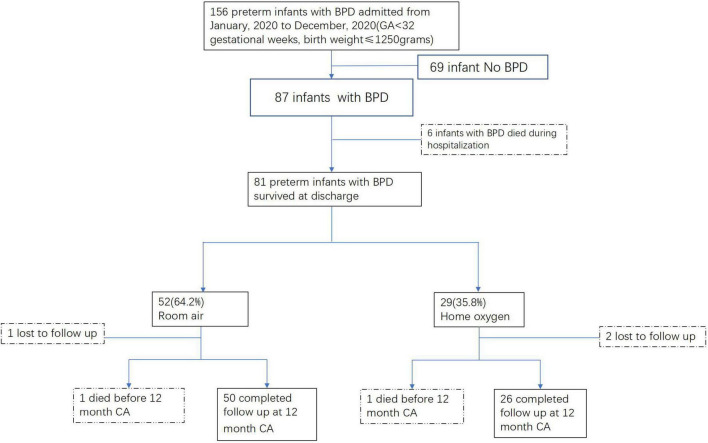
Of the 87 preterm infants diagnosed with BPD, 81 infants survived until discharge. The 81 infants were divided into the home oxygen group ( = 29) and room air group ( = 52) according to supplemental oxygen or not at discharge. Infants in the home oxygen group were more likely to receive postnatal systemic steroids and higher ventilation settings at 36 weeks' PMA. There was one patient in each group who died before 1 year corrected age, respectively. All the infants had successfully weaned off oxygen eventually during the first year. The median duration of home oxygen therapy was 25 (7,42) days. Readmission occurred in 49 (64.5%) infants. Readmissions for infants with home oxygen were more often related to respiratory disease. In addition, wheezing disorders and home inhalation occurred more frequently in the home oxygen group ( = 0.022, = 0.004). Although the incidence of underweight at 1 year corrected age was higher in the room air group (10.0 vs. 3.8%), there was no significant difference ( = 0.620). The rate of neurodevelopmental impairment was similar between these two groups (26.0 vs. 30.8%, = 0.659).
It was the first study focused on preterm infants with BPD receiving home oxygen in China. Infants with home oxygen were more likely to have respiratory problems after discharge from NICU. Home oxygen use was not associated with more readmission for infants with BPD, and no difference was found in neurodevelopmental impairment and growth outcome.
本研究旨在比较出院时接受补充氧气或呼吸空气的支气管肺发育不良(BPD)早产儿的临床特征和1年预后。
纳入2020年1月至2020年12月期间诊断为BPD并入院的早产儿(孕周<32周,出生体重≤1250g)。通过医院电子记录系统收集住院期间的临床资料。出院后的结局通过门诊系统和电话访谈获得。
在87例诊断为BPD的早产儿中,81例存活至出院。根据出院时是否接受补充氧气,将81例婴儿分为家庭氧疗组(n=29)和呼吸空气组(n=52)。家庭氧疗组婴儿在出生后36周时更有可能接受全身类固醇治疗和更高的通气设置。每组各有1例患者在1岁矫正年龄前死亡。所有婴儿在第一年最终均成功脱氧。家庭氧疗的中位持续时间为25(7,42)天。49例(64.5%)婴儿再次入院。家庭氧疗组婴儿再次入院更常与呼吸系统疾病有关。此外,家庭氧疗组喘息性疾病和家庭吸入更为频繁(P=0.022,P=0.004)。虽然呼吸空气组1岁矫正年龄时体重不足的发生率较高(10.0%对3.8%),但差异无统计学意义(P=0.620)。两组神经发育障碍发生率相似(26.0%对30.8%,P=0.659)。
这是中国第一项关注接受家庭氧疗的BPD早产儿的研究。家庭氧疗组婴儿从新生儿重症监护病房出院后更易出现呼吸问题。家庭氧疗与BPD婴儿再次入院增多无关,且在神经发育障碍和生长结局方面未发现差异。