Madonna Megan C, Duer Joy E, McKinney Brock J, Sunassee Enakshi D, Crouch Brian T, Ilkayeva Olga, Hirschey Matthew D, Alvarez James V, Ramanujam Nirmala
Department of Biomedical Engineering, Duke University, Durham, NC, USA.
Duke University Trinity College of Arts and Sciences, Durham, NC, USA.
NPJ Breast Cancer. 2022 Sep 26;8(1):111. doi: 10.1038/s41523-022-00481-3.
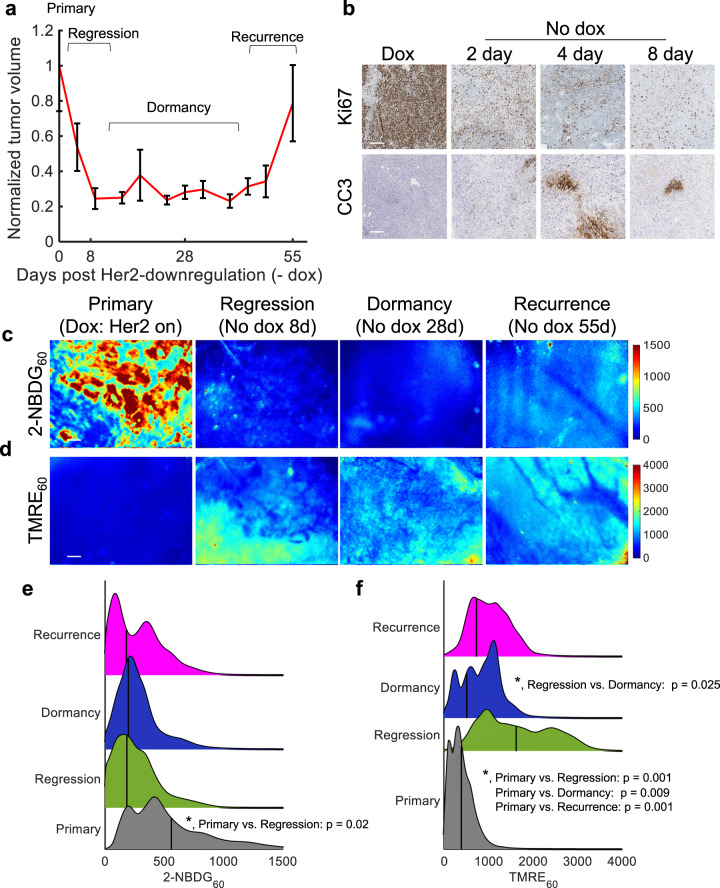
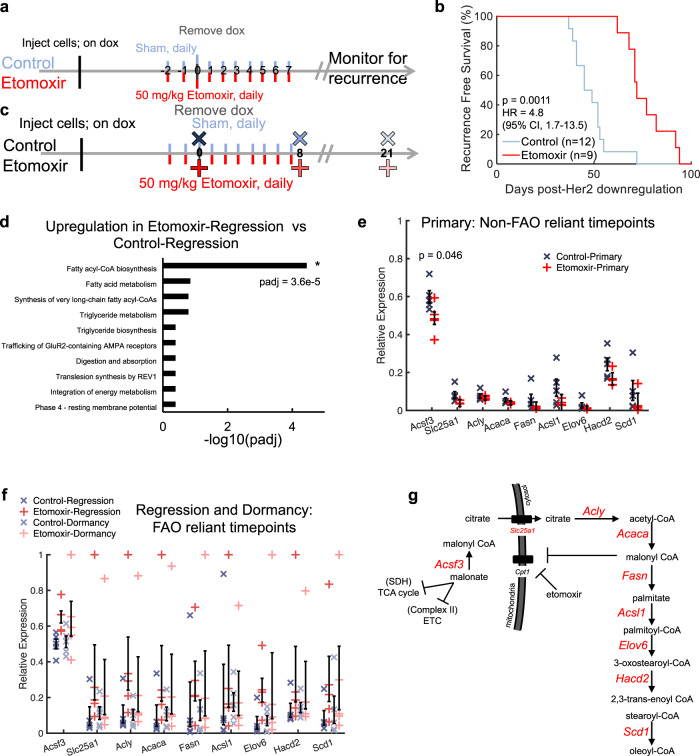
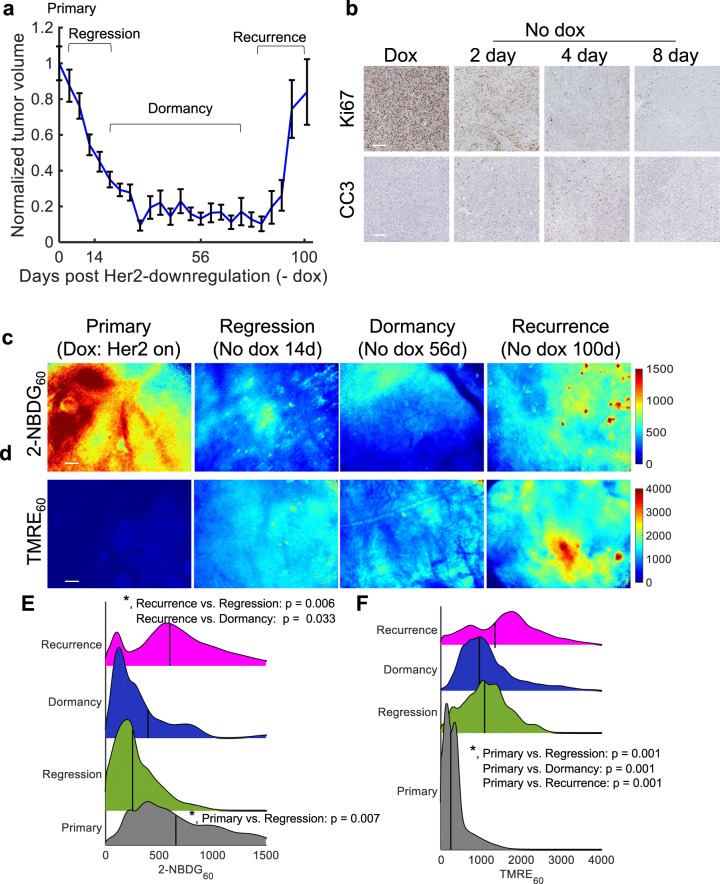
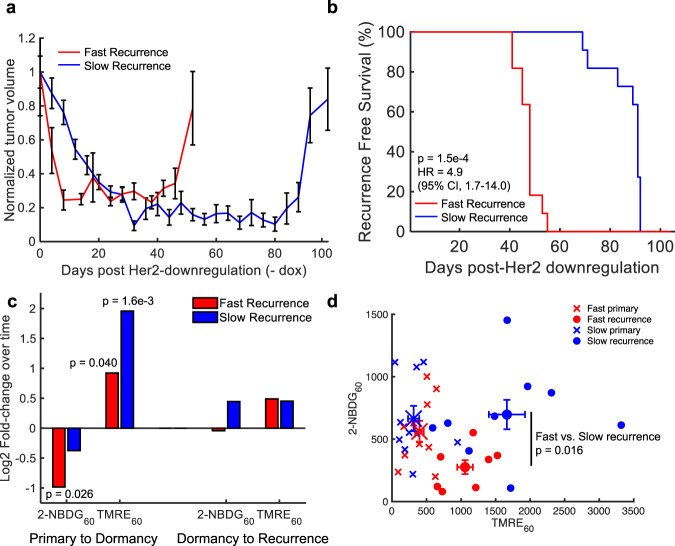
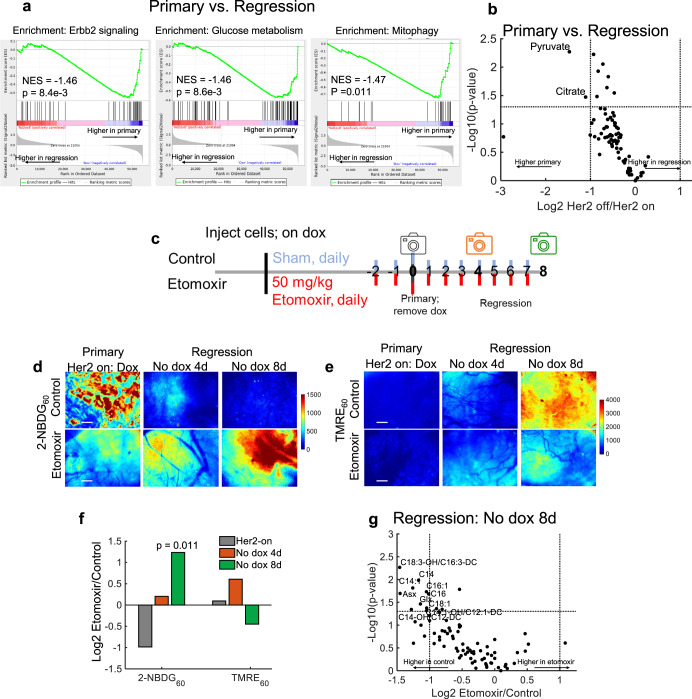
Recurrent cancer cells that evade therapy is a leading cause of death in breast cancer patients. This risk is high for women showing an overexpression of human epidermal growth factor receptor 2 (Her2). Cells that persist can rely on different substrates for energy production relative to their primary tumor counterpart. Here, we characterize metabolic reprogramming related to tumor dormancy and recurrence in a doxycycline-induced Her2+/Neu model of breast cancer with varying times to recurrence using longitudinal fluorescence microscopy. Glucose uptake (2-NBDG) and mitochondrial membrane potential (TMRE) imaging metabolically phenotype mammary tumors as they transition to regression, dormancy, and recurrence. "Fast-recurrence" tumors (time to recurrence ~55 days), transition from glycolysis to mitochondrial metabolism during regression and this persists upon recurrence. "Slow-recurrence" tumors (time to recurrence ~100 days) rely on both glycolysis and mitochondrial metabolism during recurrence. The increase in mitochondrial activity in fast-recurrence tumors is attributed to a switch from glucose to fatty acids as the primary energy source for mitochondrial metabolism. Consequently, when fast-recurrence tumors receive treatment with a fatty acid inhibitor, Etomoxir, tumors report an increase in glucose uptake and lipid synthesis during regression. Treatment with Etomoxir ultimately prolongs survival. We show that metabolic reprogramming reports on tumor recurrence characteristics, particularly at time points that are essential for actionable targets. The temporal characteristics of metabolic reprogramming will be critical in determining the use of an appropriate timing for potential therapies; namely, the notion that metabolic-targeted inhibition during regression reports long-term therapeutic benefit.
逃避治疗的复发性癌细胞是乳腺癌患者死亡的主要原因。对于人类表皮生长因子受体2(Her2)过表达的女性来说,这种风险很高。相对于其原发肿瘤对应物,持续存在的细胞可以依赖不同的底物进行能量产生。在这里,我们使用纵向荧光显微镜,在多西环素诱导的乳腺癌Her2+/Neu模型中,对与肿瘤休眠和复发相关的代谢重编程进行了表征,该模型具有不同的复发时间。葡萄糖摄取(2-NBDG)和线粒体膜电位(TMRE)成像在乳腺肿瘤向消退、休眠和复发转变过程中对其进行代谢表型分析。“快速复发”肿瘤(复发时间约55天)在消退过程中从糖酵解转变为线粒体代谢,并且在复发时持续存在。“缓慢复发”肿瘤(复发时间约100天)在复发过程中依赖糖酵解和线粒体代谢。快速复发肿瘤中线粒体活性的增加归因于从葡萄糖到脂肪酸的转变,脂肪酸成为线粒体代谢的主要能量来源。因此,当快速复发肿瘤接受脂肪酸抑制剂依托莫西治疗时,肿瘤在消退过程中葡萄糖摄取和脂质合成增加。依托莫西治疗最终延长了生存期。我们表明,代谢重编程反映了肿瘤复发特征,特别是在对于可操作靶点至关重要的时间点。代谢重编程的时间特征对于确定潜在治疗的合适时机至关重要;也就是说,在消退过程中进行代谢靶向抑制可带来长期治疗益处的观点。