Cain Wesley V, Sill Anne M, Solipuram Vinod, Weiss John J, Miller Carole B, Jelsma Peter F
The Department of Medicine, University of Tennessee Health Science Center, Ascension Saint Thomas Hospital Midtown, Nashville, TN, USA.
Ascension Saint Agnes, Baltimore, MD, USA.
Adv Hematol. 2022 Sep 17;2022:7992927. doi: 10.1155/2022/7992927. eCollection 2022.
Convalescent plasma obtained from individuals who have recovered from severe acute respiratory syndrome coronavirus 2 (SARS-CoV-2) contains neutralizing antibodies to the virus and has been frequently used as a treatment in hospitalized patients with severe COVID-19.
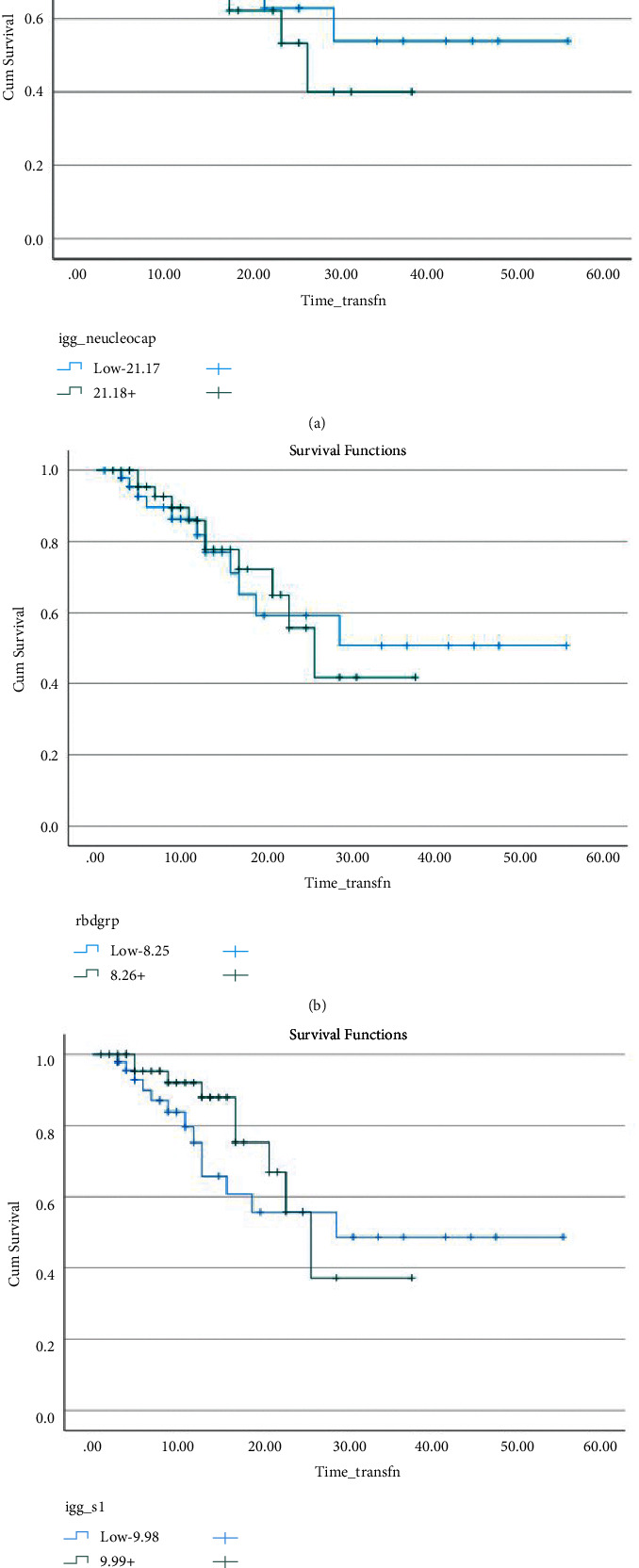
We conducted a retrospective, observational cohort study involving 96 hospitalized patients with severe COVID-19 who were allocated in a 1 : 1 ratio to having received either high antibody concentration convalescent plasma or low antibody concentration convalescent plasma. Quantitative measurements of IgG to the receptor-binding domain (RBD), the S1 subunit of the spike protein, and the SARS-CoV-2 nucleocapsid (N) protein were determined from donor plasma samples. The primary outcome was all-cause mortality within 30 days following convalescent plasma administration in regard to each of the three antibody domains.
Within the nucleocapsid antibody domain, death occurred in 22.2% of patients in the low antibody concentration group versus 23.5% in the high antibody concentration group (=0.88). Within the RBD antibody domain, death occurred in 22.9% of patients in both the low and the high antibody concentration groups (=1.0). Within the S1 subunit antibody domain, death occurred in 27.1% of patients in the low antibody concentration group versus 18.8% in the high antibody concentration group (=0.33).
No significant differences were observed between low and high concentration convalescent plasma in regard to overall mortality at 30 days, hospital length of stay, number of ventilator days, and subsequent receipt of invasive mechanical ventilation in patients who were previously not receiving mechanical ventilation. . This study was not associated with a clinical trial due to the retrospective nature of study design.
从感染严重急性呼吸综合征冠状病毒2(SARS-CoV-2)后康复的个体中获得的康复期血浆含有针对该病毒的中和抗体,并经常被用作治疗重症新型冠状病毒肺炎(COVID-19)住院患者的方法。
我们进行了一项回顾性观察队列研究,纳入96例重症COVID-19住院患者,这些患者按1∶1比例分为接受高抗体浓度康复期血浆组或低抗体浓度康复期血浆组。从供体血浆样本中定量测定针对受体结合域(RBD)、刺突蛋白S1亚基和SARS-CoV-2核衣壳(N)蛋白的IgG。主要结局是在康复期血浆输注后30天内,针对三个抗体域中每一个域的全因死亡率。
在核衣壳抗体域,低抗体浓度组22.2%的患者死亡,高抗体浓度组为23.5%(P=0.88)。在RBD抗体域,低抗体浓度组和高抗体浓度组均有22.9%的患者死亡(P=1.0)。在S1亚基抗体域,低抗体浓度组27.1%的患者死亡,高抗体浓度组为18.8%(P=0.33)。
对于30天的总体死亡率、住院时间、机械通气天数以及先前未接受机械通气的患者随后接受有创机械通气的情况,低浓度和高浓度康复期血浆之间未观察到显著差异。由于研究设计的回顾性,本研究未与临床试验相关联。