Department of Medicine, Graduate School of Medical Science, Brain Korea 21 Project, Yonsei University College of Medicine, Seoul, Korea.
Department of Internal Medicine and Institute of Gastroenterology, Graduate School of Medical Science, Brain Korea 21 Project, Yonsei University College of Medicine, Seoul, Korea.
Gut Liver. 2023 Sep 15;17(5):766-776. doi: 10.5009/gnl220159. Epub 2022 Sep 27.
BACKGROUND/AIMS: The purpose of the current study was to examine the anti-inflammatory effects of CKD-506, a novel histone deacetylase 6 inhibitor, on human peripheral blood mononuclear cells (PBMCs) and CD4+ T cells and to explore the relationship between CKD-506 and gut epithelial barrier function.
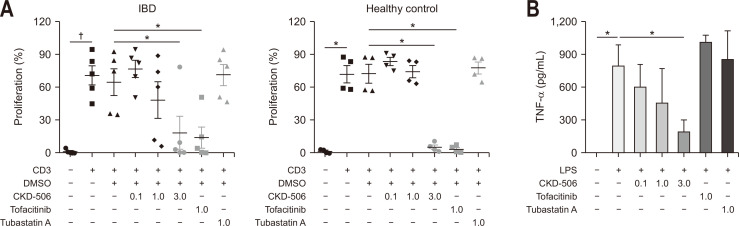
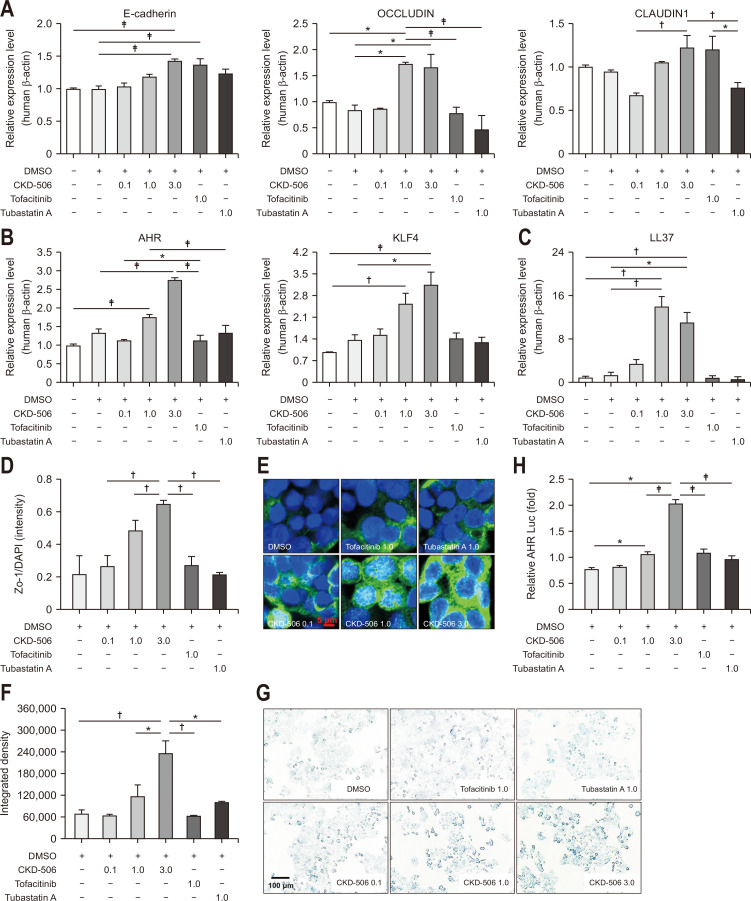
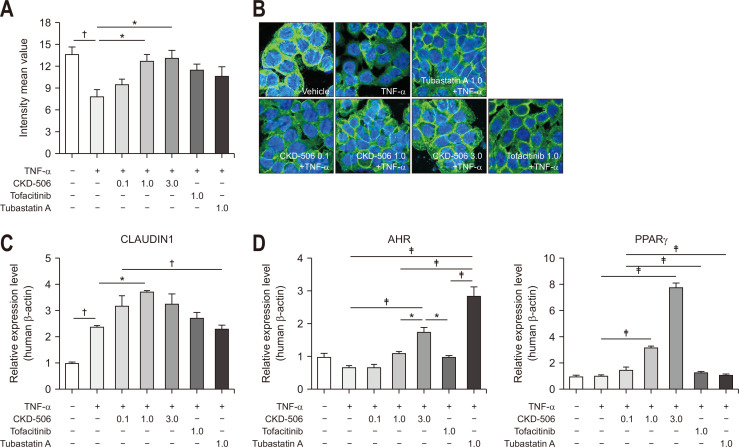
Lipopolysaccharide-stimulated human PBMCs from inflammatory bowel disease (IBD) patients were treated with CKD-506, and tumor necrosis factor (TNF)-α expression was measured using an enzyme-linked immunosorbent assay. The proliferation of CD4+ T cells from IBD patients was evaluated using flow cytometric analysis. The effects of CKD-506 on gut barrier function in a cell line and colon organoids, based on examinations of mRNA production, goblet cell differentiation, and E-cadherin recovery, were investigated using quantitative reverse transcription polymerase chain reaction, immunofluorescence, and a fluorescein isothiocyanate-dextran permeability assay.
Secretion of TNF-α, a pivotal pro-inflammatory mediator in IBD, by lipopolysaccharide-triggered PBMCs was markedly decreased by CKD-506 treatment in a dose-dependent manner and to a greater extent than by tofacitinib or tubastatin A treatment. E-cadherin mRNA expression and goblet cell differentiation increased significantly and dose-dependently in HT-29 cells in response to CKD-506, and inhibition of E-cadherin loss after TNF-α stimulation was significantly reduced both in HT-29 cells and gut organoids. Caco-2 cells treated with CKD-506 showed a significant reduction in barrier permeability in a dose-dependent manner.
The present study demonstrated that CKD-506 has anti-inflammatory effects on PBMCs and CD4 T cells and improves gut barrier function, suggesting its potential as a small-molecule therapeutic option for IBD.
背景/目的:本研究旨在探讨新型组蛋白去乙酰化酶 6 抑制剂 CKD-506 对人外周血单个核细胞(PBMC)和 CD4+T 细胞的抗炎作用,并探讨 CKD-506 与肠道上皮屏障功能的关系。
用 CKD-506 处理脂多糖刺激的炎症性肠病(IBD)患者的 PBMC,用酶联免疫吸附试验测定肿瘤坏死因子(TNF)-α的表达。用流式细胞术分析 IBD 患者 CD4+T 细胞的增殖。用定量逆转录聚合酶链反应、免疫荧光和荧光素异硫氰酸酯-葡聚糖通透性测定法,研究 CKD-506 对细胞系和结肠类器官中肠道屏障功能的影响,检测 mRNA 产物、杯状细胞分化和 E-钙黏蛋白恢复情况。
脂多糖触发的 PBMC 分泌 TNF-α,这是 IBD 中的关键促炎介质,CKD-506 以剂量依赖性方式显著降低,比托法替尼或曲古抑菌素 A 治疗的效果更显著。CKD-506 可显著增加 HT-29 细胞中 E-钙黏蛋白 mRNA 表达和杯状细胞分化,并呈剂量依赖性,且可显著减少 TNF-α刺激后 HT-29 细胞和肠道类器官中 E-钙黏蛋白的丢失。CKD-506 处理的 Caco-2 细胞的屏障通透性呈剂量依赖性显著降低。
本研究表明,CKD-506 对 PBMC 和 CD4+T 细胞具有抗炎作用,并改善肠道屏障功能,提示其作为 IBD 小分子治疗选择的潜力。