Department of Internal Medicine and Institute of Gastroenterology, Yonsei University College of Medicine, Seoul, Korea.
Gut Liver. 2021 Mar 15;15(2):232-242. doi: 10.5009/gnl19433.
BACKGROUND/AIMS: The tumor necrosis factor-α inhibitors infliximab and adalimumab are standard treatments for moderate to severe ulcerative colitis (UC). However, there has been no headto- head comparison of treatment efficacy and outcomes between the two agents. The aim of this study was to compare the efficacy and long-term outcomes of infliximab versus adalimumab treatment in biologic-naïve patients with UC.
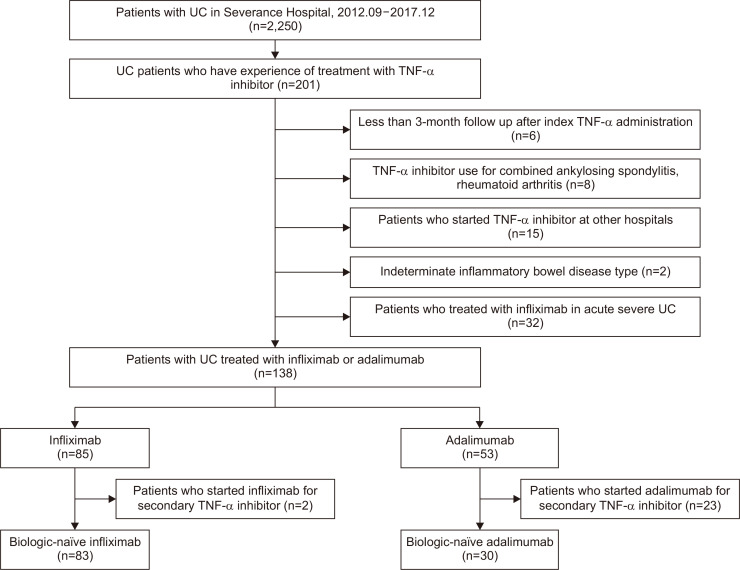
We retrospectively analyzed the records of 113 biologic-naïve patients with UC who were treated between September 2012 and December 2017 (the infliximab group [n=83] and the adalimumab group [n=30]). We compared remission and response rates between these groups at 8 and 52 weeks. We used Kaplan-Meier curves to compare long-term outcomes, and logistic regression analysis and Cox-proportional hazard regression models to assess factors affecting outcomes.
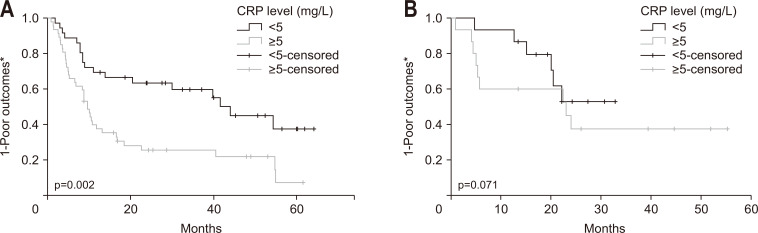
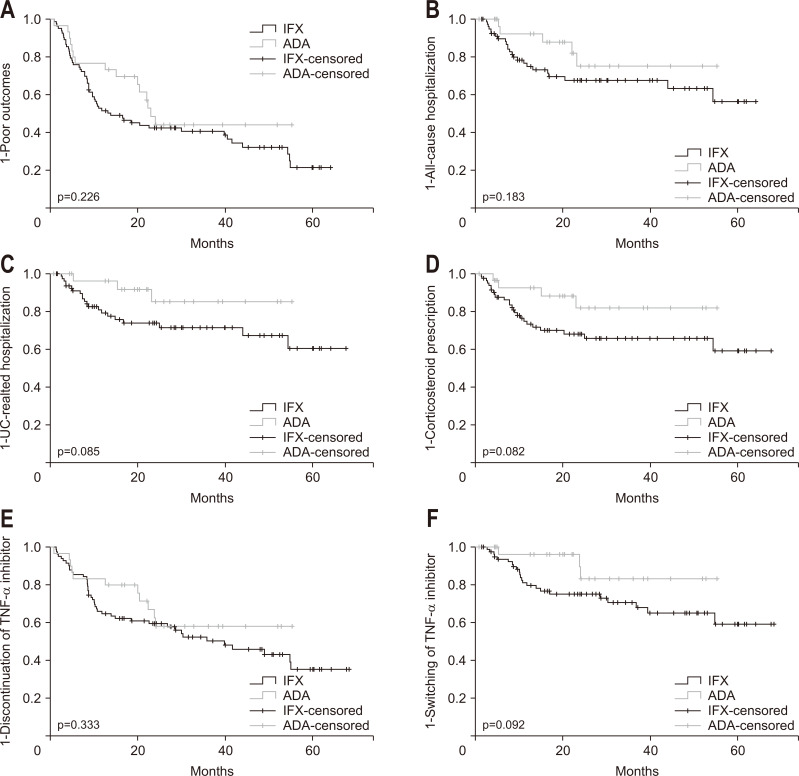
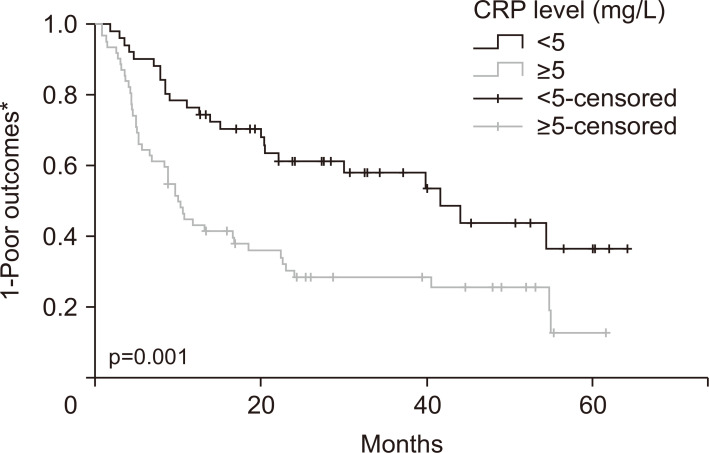
The median follow-up duration was 25.8 months. Baseline clinical characteristics were similar between groups. There were no significant differences between the two groups in the rate of clinical remission or clinical response at 8 or 52 weeks. Multivariate analyses also showed that long-term outcomes were not significantly different (adjusted hazard ratio [HR], 1.45; 95% confidence interval [CI], 0.81 to 2.56; p=0.208). An elevated C-reactive protein level (greater than 5 mg/L) was a significant predictive factor for poor outcomes (adjusted HR, 2.25; 95% CI, 1.37 to 3.70; p=0.001). During the follow-up period, the rates of adverse event were not significantly different between the two groups (p=0.441).
In our study, infliximab and adalimumab had similar treatment efficacy and longterm outcomes in biologic-naïve patients with moderate to severe UC.
背景/目的:肿瘤坏死因子-α抑制剂英夫利昔单抗和阿达木单抗是中重度溃疡性结肠炎(UC)的标准治疗方法。然而,这两种药物在疗效和结局方面还没有进行过直接比较。本研究旨在比较英夫利昔单抗与阿达木单抗治疗生物初治 UC 患者的疗效和长期结局。
我们回顾性分析了 2012 年 9 月至 2017 年 12 月期间收治的 113 例生物初治 UC 患者的病历(英夫利昔单抗组[n=83]和阿达木单抗组[n=30])。我们比较了两组患者在 8 周和 52 周时的缓解率和应答率。我们使用 Kaplan-Meier 曲线比较长期结局,并使用逻辑回归分析和 Cox 比例风险回归模型评估影响结局的因素。
中位随访时间为 25.8 个月。两组患者的基线临床特征相似。两组患者在 8 周和 52 周时的临床缓解率或临床应答率无显著差异。多变量分析也表明,长期结局无显著差异(调整后的危险比[HR],1.45;95%置信区间[CI],0.81 至 2.56;p=0.208)。C 反应蛋白水平升高(大于 5 mg/L)是结局不良的显著预测因素(调整后的 HR,2.25;95%CI,1.37 至 3.70;p=0.001)。在随访期间,两组患者的不良事件发生率无显著差异(p=0.441)。
在本研究中,英夫利昔单抗和阿达木单抗在生物初治中重度 UC 患者中的疗效和长期结局相似。