Department of Human Evolutionary Biology, Harvard University, Cambridge, MA, 02138, USA.
Department of Immunology & Infectious Diseases, Harvard T. H. Chan School of Public Health, Boston, MA, 02115, USA.
Commun Biol. 2022 Sep 27;5(1):1020. doi: 10.1038/s42003-022-03962-0.
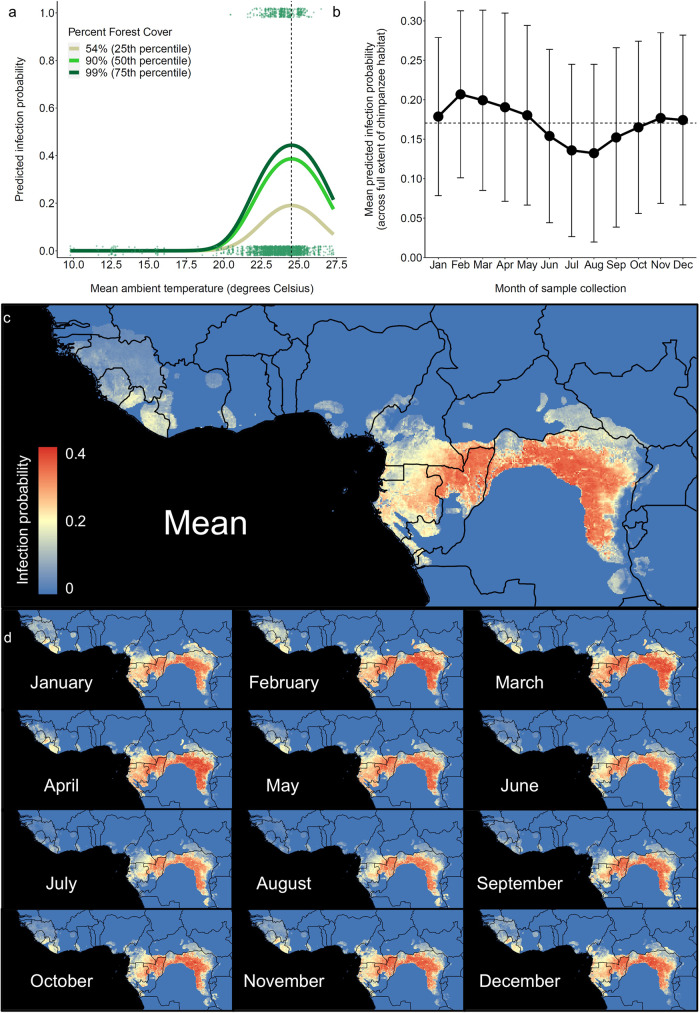
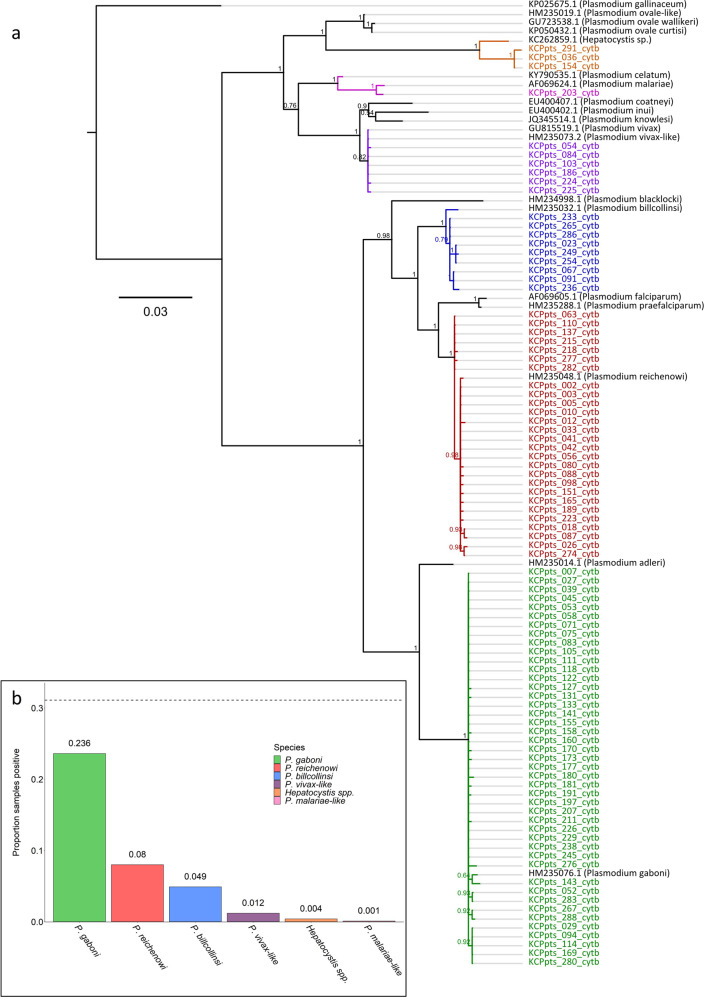
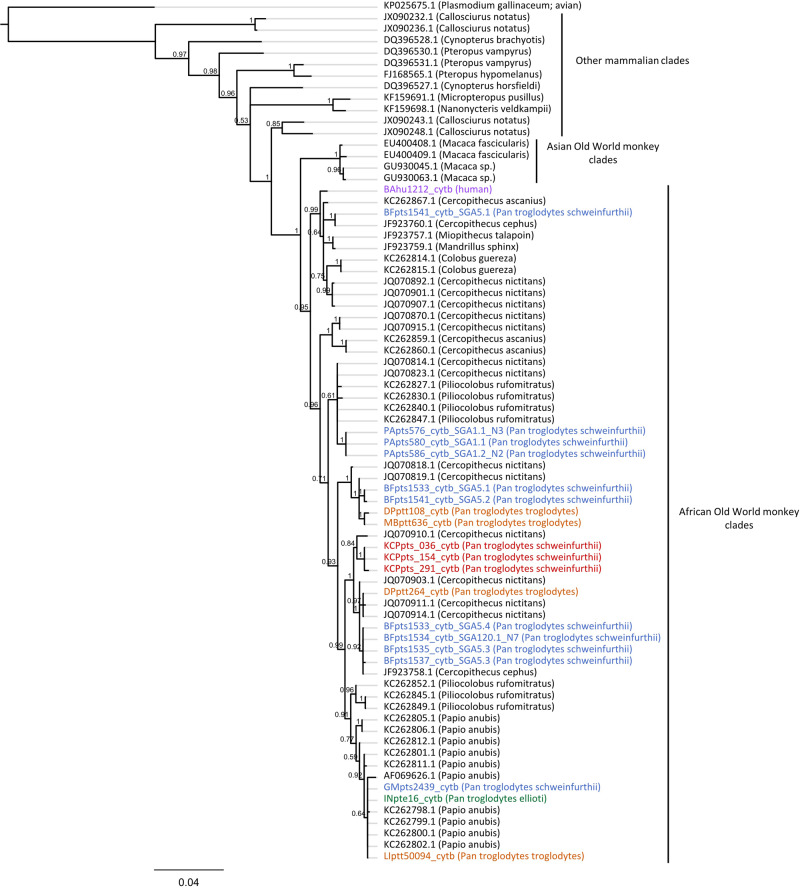
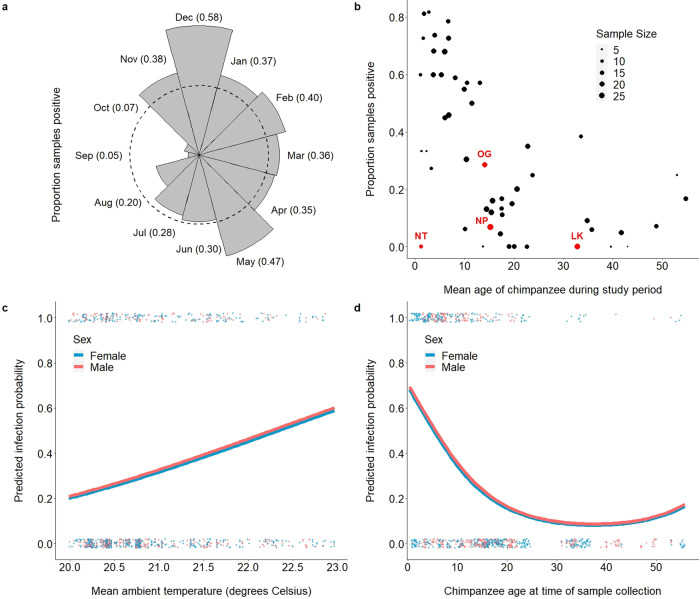
Chimpanzees (Pan troglodytes) harbor rich assemblages of malaria parasites, including three species closely related to P. falciparum (sub-genus Laverania), the most malignant human malaria parasite. Here, we characterize the ecology and epidemiology of malaria infection in wild chimpanzee reservoirs. We used molecular assays to screen chimpanzee fecal samples, collected longitudinally and cross-sectionally from wild populations, for malaria parasite mitochondrial DNA. We found that chimpanzee malaria parasitism has an early age of onset and varies seasonally in prevalence. A subset of samples revealed Hepatocystis mitochondrial DNA, with phylogenetic analyses suggesting that Hepatocystis appears to cross species barriers more easily than Laverania. Longitudinal and cross-sectional sampling independently support the hypothesis that mean ambient temperature drives spatiotemporal variation in chimpanzee Laverania infection. Infection probability peaked at ~24.5 °C, consistent with the empirical transmission optimum of P. falciparum in humans. Forest cover was also positively correlated with spatial variation in Laverania prevalence, consistent with the observation that forest-dwelling Anophelines are the primary vectors. Extrapolating these relationships across equatorial Africa, we map spatiotemporal variation in the suitability of chimpanzee habitat for Laverania transmission, offering a hypothetical baseline indicator of human exposure risk.
黑猩猩(Pan troglodytes)携带丰富的疟疾寄生虫群,包括三种与恶性疟原虫(疟原虫属 Laverania)密切相关的寄生虫。在这里,我们描述了野生黑猩猩储库中疟疾感染的生态学和流行病学。我们使用分子检测方法对来自野生种群的纵向和横向采集的黑猩猩粪便样本进行疟疾寄生虫线粒体 DNA 的检测。我们发现,黑猩猩疟疾寄生虫病的发病年龄较早,且在流行率方面存在季节性变化。部分样本显示出肝胞体线粒体 DNA,系统发育分析表明肝胞体比 Laverania 更容易跨越物种障碍。纵向和横向采样独立地支持了这样一种假设,即平均环境温度驱动着黑猩猩 Laverania 感染的时空变化。感染概率在约 24.5°C 时达到峰值,这与人类中疟原虫的经验传播最佳温度一致。森林覆盖率也与 Laverania 流行率的空间变化呈正相关,这与居住在森林中的按蚊是主要传播媒介的观察结果一致。将这些关系推广到赤道非洲,我们绘制了黑猩猩栖息地中 Laverania 传播适宜性的时空变化图,为人类接触风险提供了一个假设的基线指标。