Department of Medicine, Surgery and Neurosciences, University of Siena, Siena, Italy.
Department of Health Sciences, University of Genoa and Ospedale Policlinico San Martino IRCCS, Genoa, Italy.
Eur J Neurol. 2023 Jan;30(1):179-186. doi: 10.1111/ene.15579. Epub 2022 Oct 11.
Measures of atrophy in the whole brain can be used to reliably assess treatment effect in clinical trials of patients with multiple sclerosis (MS). Trials assessing the effect of treatment on grey matter (GM) and white matter (WM) atrophy are very informative, but hindered by technical limitations. This study aimed to measure GM and WM volume changes, using a robust longitudinal method, in patients with relapsing MS randomized to cladribine tablets 3.5 mg/kg or placebo in the CLARITY study.
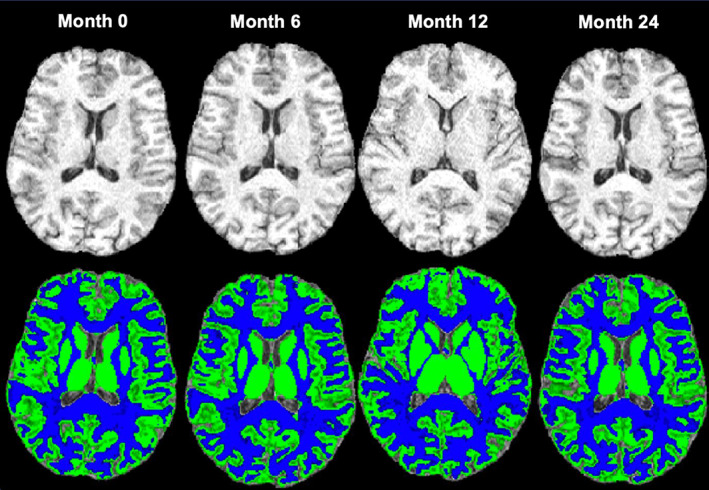
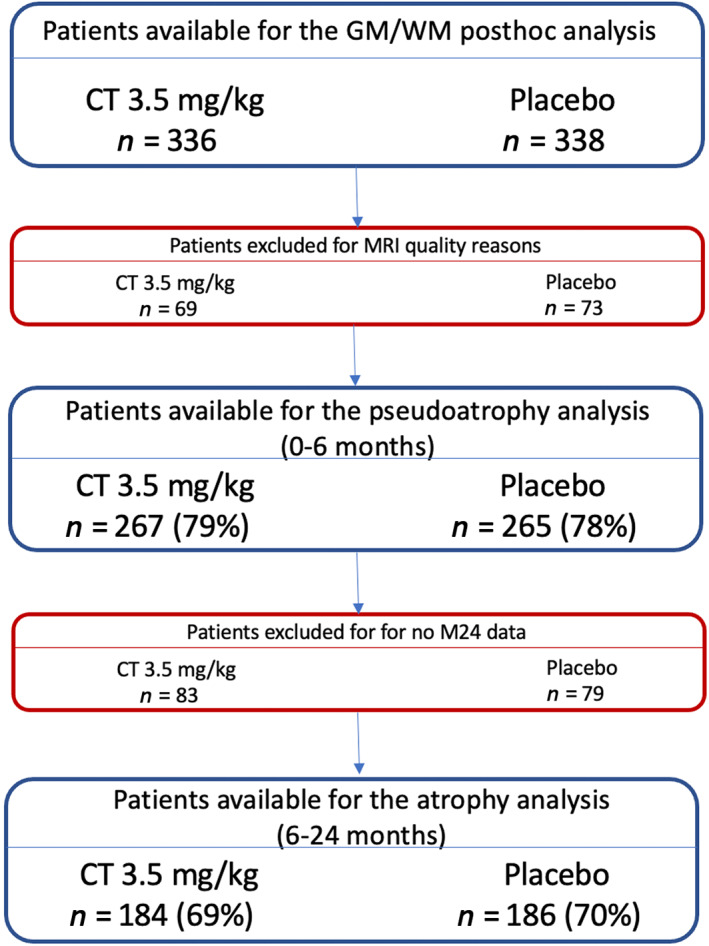
We analysed T1-weighted magnetic resonance sequences using SIENA-XL, from 0 to 6 months (cladribine, n = 267; placebo, n = 265) and 6 to 24 months (cladribine, n = 184; placebo, n = 186). Mean percentage GM and WM volume changes (PGMVC and PWMVC) were compared using a mixed-effect model.
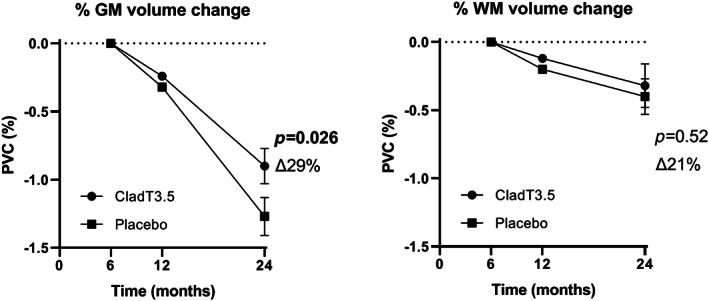
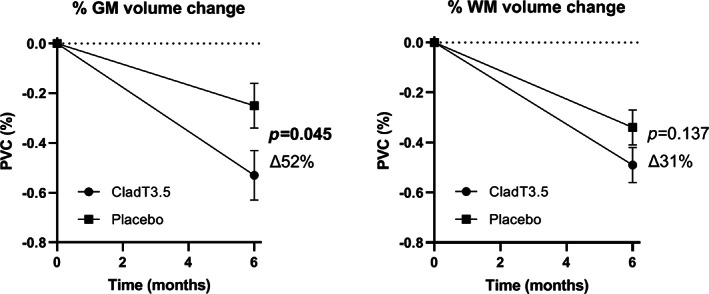
More GM and WM volume loss was found in patients taking cladribine versus those taking placebo in the first 6 months of treatment (PGMVC: cladribine: -0.53 vs. placebo: -0.25 [p = 0.045]; PWMVC: cladribine: -0.49 vs. placebo: -0.34 [p = 0.137]), probably due to pseudoatrophy. However, over the period 6 to 24 months, GM volume loss was significantly lower in patients on cladribine than in those on placebo (PGMVC: cladribine: -0.90 vs. placebo: -1.27 [p = 0.026]). In this period, volume changes in WM were similar in the two treatment arms (p = 0.52).
After a short period of pseudoatrophy, treatment with cladribine 3.5 mg/kg significantly reduced GM atrophy in comparison with placebo. This supports the relevance of GM damage in MS and may have important implications for physical and cognitive disability progression.
在多发性硬化症(MS)患者的临床试验中,全脑萎缩测量可用于可靠地评估治疗效果。评估治疗对灰质(GM)和白质(WM)萎缩影响的试验非常有意义,但受到技术限制。本研究旨在使用稳健的纵向方法,测量 CLARITY 研究中接受氯法拉滨片 3.5mg/kg 或安慰剂治疗的复发型 MS 患者的 GM 和 WM 体积变化。
我们使用 SIENA-XL 分析了 0 至 6 个月(氯法拉滨组 n=267,安慰剂组 n=265)和 6 至 24 个月(氯法拉滨组 n=184,安慰剂组 n=186)的 T1 加权磁共振序列。使用混合效应模型比较 GM 和 WM 体积变化的平均百分比(PGMVC 和 PWMVC)。
与服用安慰剂的患者相比,服用氯法拉滨的患者在前 6 个月的治疗中发现 GM 和 WM 体积丢失更多(PGMVC:氯法拉滨:-0.53%vs.安慰剂:-0.25%[p=0.045];PWMVC:氯法拉滨:-0.49%vs.安慰剂:-0.34%[p=0.137]),可能是由于假性萎缩。然而,在 6 至 24 个月期间,服用氯法拉滨的患者 GM 体积丢失明显低于服用安慰剂的患者(PGMVC:氯法拉滨:-0.90%vs.安慰剂:-1.27%[p=0.026])。在此期间,两种治疗组 WM 体积变化相似(p=0.52)。
在短暂的假性萎缩期后,与安慰剂相比,氯法拉滨 3.5mg/kg 治疗显著减少 GM 萎缩。这支持 GM 损伤在 MS 中的相关性,可能对身体和认知残疾进展有重要意义。