
动态转录组和基于网络的分析银杏黄叶突变体。
Dynamic transcriptome and network-based analysis of yellow leaf mutant Ginkgo biloba.
机构信息
Systematic & Evolutionary Botany and Biodiversity Group, MOE Key Laboratory of Biosystem Homeostasis and Protection, College of Life Sciences, Zhejiang University, Hangzhou, 310058, China.
Zhejiang Academy of Forestry, Hangzhou, 310023, China.
出版信息
BMC Plant Biol. 2022 Sep 29;22(1):465. doi: 10.1186/s12870-022-03854-9.
BACKGROUND
Golden leaf in autumn is a prominent feature of deciduous tree species like Ginkgo biloba L., a landscape tree widely cultivated worldwide. However, little was known about the molecular mechanisms of leaf yellowing, especially its dynamic regulatory network. Here, we performed a suite of comparative physiological and dynamic transcriptional analyses on the golden-leaf cultivar and the wild type (WT) ginkgo to investigate the underlying mechanisms of leaf yellowing across different seasons.
RESULTS
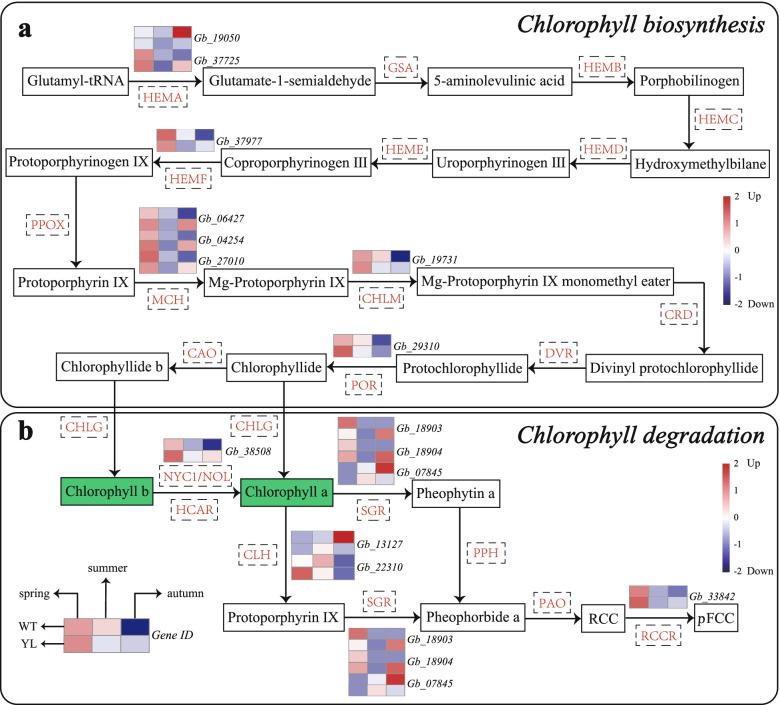
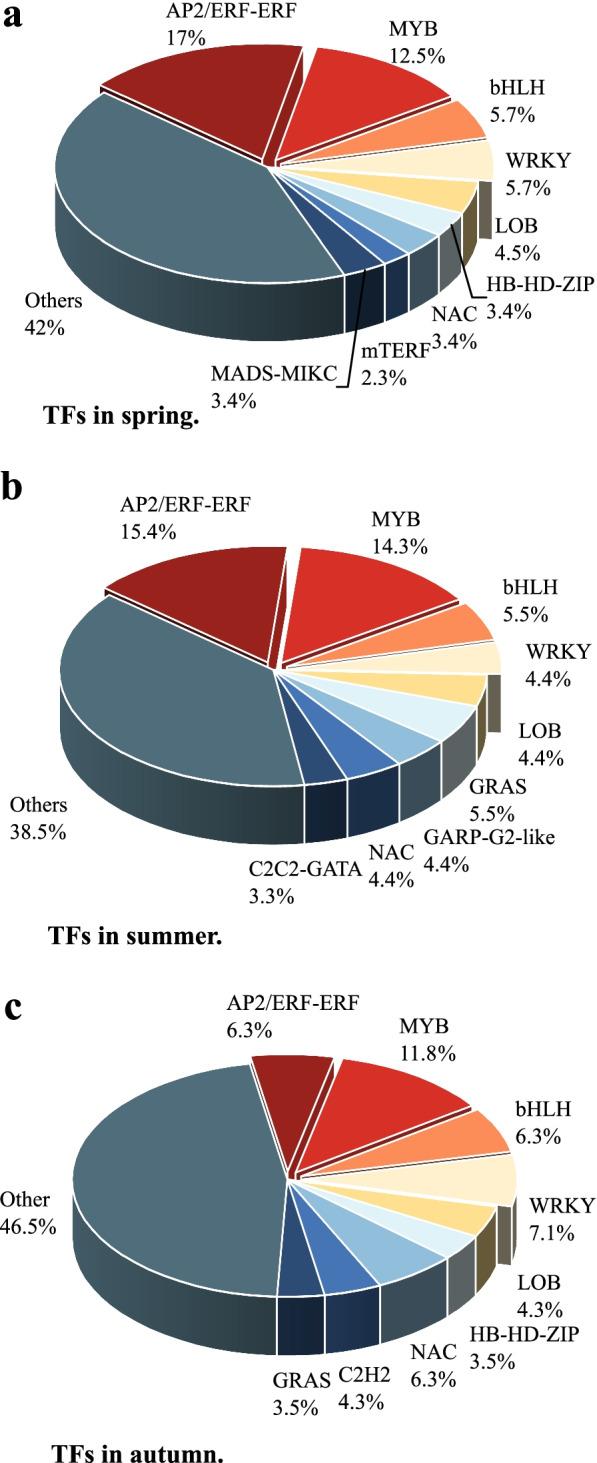
In the present study, we used the natural bud mutant cultivar with yellow leaves "Wannianjin" (YL) as materials. Physiological analysis revealed that higher ratios of chlorophyll a to chlorophyll b and carotenoid to chlorophyll b caused the leaf yellowing of YL. On the other hand, dynamic transcriptome analyses showed that genes related to chlorophyll metabolism played key a role in leaf coloration. Genes encoding non-yellow coloring 1 (NYC1), NYC1-like (NOL), and chlorophyllase (CLH) involved in the degradation of chlorophyll were up-regulated in spring. At the summer stage, down-regulated HEMA encoding glutamyl-tRNA reductase functioned in chlorophyll biosynthesis, while CLH involved in chlorophyll degradation was up-regulated, causing a lower chlorophyll accumulation. In carotenoid metabolism, genes encoding zeaxanthin epoxidase (ZEP) and 9-cis-epoxy carotenoid dioxygenase (NCED) showed significantly different expression levels in the WT and YL. Moreover, the weighted gene co-expression network analysis (WGCNA) suggested that the most associated transcriptional factor, which belongs to the AP2/ERF-ERF family, was engaged in regulating pigment metabolism. Furthermore, quantitative experiments validated the above results.
CONCLUSIONS
By comparing the golden-leaf cultivar and the wide type of ginkgo across three seasons, this study not only confirm the vital role of chlorophyll in leaf coloration of YL but also provided new insights into the seasonal transcriptome landscape and co-expression network. Our novel results pinpoint candidate genes for further wet-bench experiments in tree species.
背景
金秋时节,银杏等落叶树种的叶片呈现金黄色,是一道亮丽的风景线,这些树种在全球范围内被广泛种植。然而,人们对叶片变黄的分子机制知之甚少,特别是其动态调控网络。在这里,我们对金黄色叶片品种和野生型银杏进行了一系列比较生理和动态转录组分析,以研究不同季节叶片变黄的潜在机制。
结果
本研究以自然芽变的黄叶品种“万年金”(YL)为材料。生理分析表明,较高的叶绿素 a 与叶绿素 b 比值和类胡萝卜素与叶绿素 b 比值导致了 YL 的叶片变黄。另一方面,动态转录组分析表明,与叶绿素代谢相关的基因在叶片颜色形成中起着关键作用。编码非黄色素 1(NYC1)、NYC1 样(NOL)和叶绿素酶(CLH)的基因在春季上调,参与叶绿素降解。在夏季阶段,下调的谷氨酸-tRNA 还原酶编码基因 HEMA 参与叶绿素的生物合成,而参与叶绿素降解的 CLH 上调,导致叶绿素积累减少。在类胡萝卜素代谢中,编码玉米黄质环氧化酶(ZEP)和 9-顺式环氧类胡萝卜素双加氧酶(NCED)的基因在 WT 和 YL 中表现出明显不同的表达水平。此外,加权基因共表达网络分析(WGCNA)表明,与色素代谢相关的最主要转录因子属于 AP2/ERF-ERF 家族,参与调控色素代谢。此外,定量实验验证了上述结果。
结论
通过比较金黄色叶片品种和银杏野生型在三个季节的表现,本研究不仅证实了叶绿素在 YL 叶片变黄中的重要作用,还提供了关于季节性转录组景观和共表达网络的新见解。我们的新结果确定了候选基因,可供进一步在树种中进行湿实验研究。





 Zotero 插件