Main Sasha C, Cescon David W, Bratman Scott V
Princess Margaret Cancer Centre, University Health Network, Toronto M5G 2C1, Ontario, Canada.
Department of Medical Biophysics, University of Toronto, Toronto M5G 1L7, Ontario, Canada.
Cancer Drug Resist. 2022 Jun 22;5(3):727-748. doi: 10.20517/cdr.2022.37. eCollection 2022.
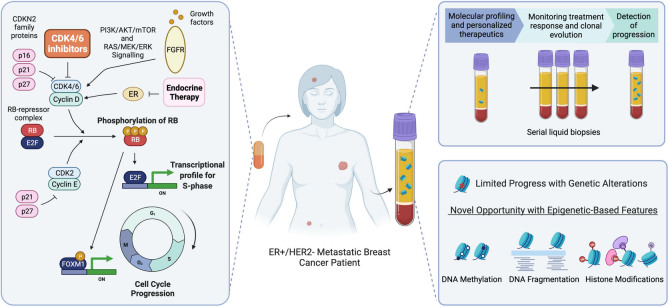
Cyclin-dependent kinase 4 and 6 (CDK4/6) inhibitors combined with endocrine therapy have transformed the treatment of estrogen receptor-positive (ER+) and human epidermal growth factor receptor 2 negative (HER2-) metastatic breast cancer. However, some patients do not respond to this treatment, and patients inevitably develop resistance, such that novel biomarkers are needed to predict primary resistance, monitor treatment response for acquired resistance, and personalize treatment strategies. Circumventing the spatial and temporal limitations of tissue biopsy, newly developed liquid biopsy approaches have the potential to uncover biomarkers that can predict CDK4/6 inhibitor efficacy and resistance in breast cancer patients through a simple blood test. Studies on circulating tumor DNA (ctDNA)-based liquid biopsy biomarkers of CDK4/6 inhibitor resistance have focused primarily on genomic alterations and have failed thus far to identify clear and clinically validated predictive biomarkers, but emerging epigenetic ctDNA methodologies hold promise for further discovery. The present review outlines recent advances and future directions in ctDNA-based biomarkers of CDK4/6 inhibitor treatment response.
细胞周期蛋白依赖性激酶4和6(CDK4/6)抑制剂与内分泌治疗联合应用,已经改变了雌激素受体阳性(ER+)和人表皮生长因子受体2阴性(HER2-)转移性乳腺癌的治疗方式。然而,一些患者对此治疗无反应,并且患者不可避免地会产生耐药性,因此需要新的生物标志物来预测原发性耐药、监测获得性耐药的治疗反应以及个性化治疗策略。新开发的液体活检方法克服了组织活检的时空限制,有可能通过简单的血液检测发现能够预测乳腺癌患者CDK4/6抑制剂疗效和耐药性的生物标志物。基于循环肿瘤DNA(ctDNA)的CDK4/6抑制剂耐药性液体活检生物标志物的研究主要集中在基因组改变上,到目前为止尚未确定明确的、经过临床验证的预测性生物标志物,但新兴的表观遗传ctDNA方法有望实现进一步发现。本综述概述了基于ctDNA的CDK4/6抑制剂治疗反应生物标志物的最新进展和未来方向。