Bernardi Ophélie, Reverchon Maxime, Estienne Anthony, Baumard Yannick, Ramé Christelle, Brossaud Adeline, Combarnous Yves, Froment Pascal, Dupont Joëlle
Centre National de la Recherche Scientifique, Institut Français du Cheval et de l'Equitation, Institut National de Recherche pour l'Agriculture, l'Alimentation et l'Environnement (INRAE), Université de Tours, Physiologie de la Reproduction et des Comportements, UMR85, Paris, France.
SYSAAF-Syndicat des Sélectionneurs Avicoles et Aquacoles Français, Centre INRA Val de Loire, France.
Front Physiol. 2022 Sep 13;13:1012212. doi: 10.3389/fphys.2022.1012212. eCollection 2022.
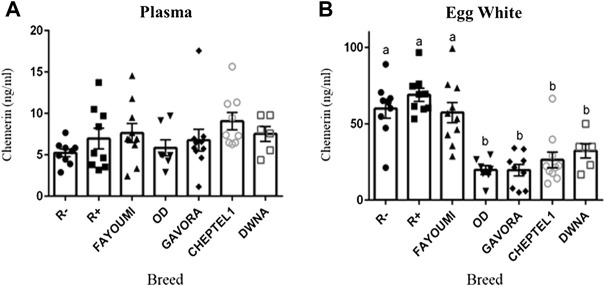
Embryo mortality rate, which can reach up to 40% in avian species, is a major issue for breeding. It is therefore important to identify new embryo development biomarkers for genetic selection to improve reproductive performances. We have recently shown that chemerin is expressed in the oviductal hen magnum, accumulates in egg white, is correlated with embryo survival and could thus be used as a molecular marker of embryo development. Eggs from seven hen breeds ( = 70) were collected during five successive days at the end of the laying period. After weighing eggs, yolk and albumen, an egg white sample from each egg was collected and a blood sample was taken from each hen. Chemerin concentrations in albumen and blood samples were measured by a specific home made ELISA assay. Hen's plasma and egg's albumen chemerin levels were found to be correlated with reproductive parameters such as fecundity, fertility, embryo mortality, hatchability and laying rates. The inter-hen chemerin level variability in albumen was higher than intra-hen except for one breed (R+). We observed significantly different levels of chemerin in egg white between breeds. However, chemerin concentrations in egg white were not significantly associated to variations of hen plasma chemerin levels. Interestingly, we observed negative correlations between albumen chemerin concentrations and egg weight ( = -0.43, = 0.001), between albumen weight ( = -0.40, = 0.002), and between yolk weight ( = -0.28, = 0.03). We also showed negative correlations between egg white chemerin concentrations and fecundity ( = -0.32, = 0.011) and fertility ( = -0.27, = 0.04) whereas no significant correlation was observed with the laying rate. Taken together, these results suggest that egg white chemerin concentration might be a good biomarker for genetic selection for egg weight and fertility in hens, provided these data are confirmed on a larger scale.
胚胎死亡率在禽类中可达40%,是育种中的一个主要问题。因此,识别新的胚胎发育生物标志物用于遗传选择以提高繁殖性能很重要。我们最近发现,chemerin在输卵管的母鸡蛋白分泌部表达,在蛋清中积累,与胚胎存活相关,因此可作为胚胎发育的分子标志物。在产蛋期结束时连续五天收集了七个母鸡品种(n = 70)的鸡蛋。称量鸡蛋、蛋黄和蛋清后,从每个鸡蛋中收集一份蛋清样本,并从每只母鸡身上采集一份血液样本。通过特定的自制ELISA测定法测量蛋清和血液样本中的chemerin浓度。发现母鸡血浆和鸡蛋蛋清中的chemerin水平与繁殖参数如繁殖力、受精率、胚胎死亡率、孵化率和产蛋率相关。除了一个品种(R+)外,蛋清中母鸡间chemerin水平的变异性高于母鸡内。我们观察到不同品种间蛋清中chemerin水平存在显著差异。然而,蛋清中chemerin浓度与母鸡血浆chemerin水平的变化没有显著相关性。有趣的是,我们观察到蛋清chemerin浓度与蛋重(r = -0.43,P = 0.001)、蛋清重量(r = -0.40,P = 0.002)以及蛋黄重量(r = -0.28,P = 0.03)之间呈负相关。我们还发现蛋清chemerin浓度与繁殖力(r = -0.32,P = 0.011)和受精率(r = -0.27,P = 0.04)之间呈负相关,而与产蛋率没有显著相关性。综上所述,这些结果表明,蛋清chemerin浓度可能是母鸡蛋重和受精率遗传选择 的良好生物标志物,前提是这些数据能在更大规模上得到证实。