Nishimoto Sachiko, Sata Masataka, Fukuda Daiju
Faculty of Clinical Nutrition and Dietetics, Konan Women's University, Kobe, Japan.
Department of Cardiovascular Medicine, Tokushima University Graduate School of Biomedical Sciences, Tokushima, Japan.
Front Cardiovasc Med. 2022 Sep 13;9:881181. doi: 10.3389/fcvm.2022.881181. eCollection 2022.
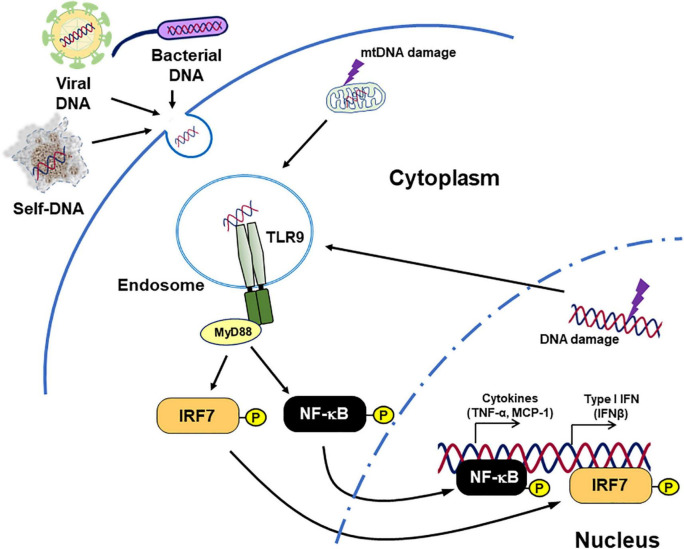
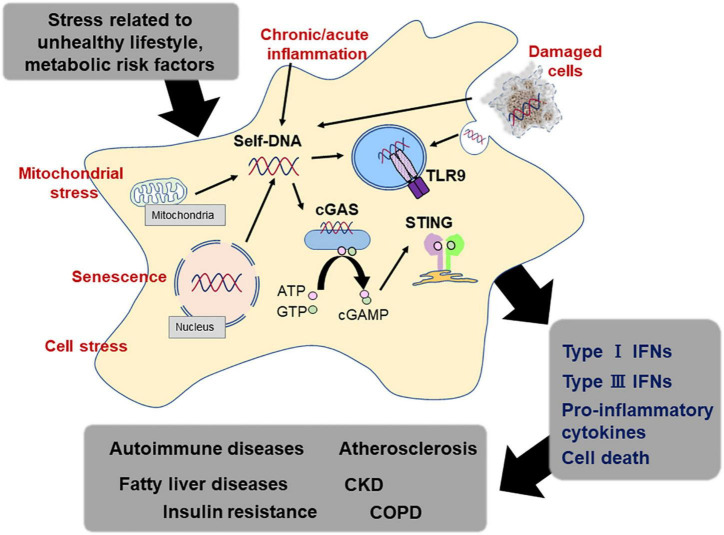
In lifestyle-related diseases, such as cardiovascular, metabolic, respiratory, and kidney diseases, chronic inflammation plays a causal role in their pathogenesis; however, underlying mechanisms of sterile chronic inflammation are not well-understood. Previous studies have confirmed the damage of cells in these organs in the presence of various risk factors such as diabetes, dyslipidemia, and cigarette smoking, releasing various endogenous ligands for pattern recognition receptors. These studies suggested that nucleic acids released from damaged tissues accumulate in these tissues, acting as an endogenous ligand. Undamaged DNA is an integral factor for the sustenance of life, whereas, DNA fragments, especially those from pathogens, are potent activators of the inflammatory response. Recent studies have indicated that inflammatory responses such as the production of type I interferon (IFN) induced by DNA-sensing mechanisms which contributes to self-defense system in innate immunity participates in the progression of inflammatory diseases by the recognition of nucleic acids derived from the host, including mitochondrial DNA (mtDNA). The body possesses several types of DNA sensors. Toll-like receptor 9 (TLR9) recognizes DNA fragments in the endosomes. In addition, the binding of DNA fragments in the cytosol activates cyclic guanosine monophosphate (GMP)-adenosine monophosphate (AMP) synthase (cGAS), resulting in the synthesis of the second messenger cyclic GMP-AMP (cGAMP). The binding of cGAMP to stimulator of interferon genes (STING) activates NF-κB and TBK-1 signaling and consequently the production of many inflammatory cytokines including IFNs. Numerous previous studies have demonstrated the role of DNA sensors in self-defense through the recognition of DNA fragments derived from pathogens. Beyond the canonical role of TLR9 and cGAS-STING, this review describes the role of these DNA-sensing mechanism in the inflammatory responses caused by endogenous DNA fragments, and in the pathogenesis of lifestyle-related diseases.
在心血管疾病、代谢性疾病、呼吸系统疾病和肾脏疾病等与生活方式相关的疾病中,慢性炎症在其发病机制中起着因果作用;然而,无菌性慢性炎症的潜在机制尚未完全明确。先前的研究已经证实,在糖尿病、血脂异常和吸烟等各种风险因素存在的情况下,这些器官中的细胞会受到损伤,从而释放出各种用于模式识别受体的内源性配体。这些研究表明,受损组织释放的核酸会在这些组织中积累,作为一种内源性配体。未受损的DNA是维持生命不可或缺的因素,而DNA片段,尤其是来自病原体的片段,是炎症反应的有效激活剂。最近的研究表明,由DNA传感机制诱导的I型干扰素(IFN)产生等炎症反应有助于先天免疫中的自我防御系统,通过识别包括线粒体DNA(mtDNA)在内的宿主来源的核酸参与炎症性疾病的进展。人体拥有几种类型的DNA传感器。Toll样受体9(TLR9)识别内体中的DNA片段。此外,胞质溶胶中DNA片段的结合会激活环磷酸鸟苷(GMP)-腺苷单磷酸(AMP)合酶(cGAS),从而导致第二信使环磷酸鸟苷-腺苷单磷酸(cGAMP)的合成。cGAMP与干扰素基因刺激物(STING)的结合会激活NF-κB和TBK-1信号通路,进而产生许多炎症细胞因子,包括IFN。此前众多研究已经证明了DNA传感器通过识别病原体来源的DNA片段在自我防御中的作用。除了TLR9和cGAS-STING的经典作用外,本综述还描述了这些DNA传感机制在由内源性DNA片段引起的炎症反应以及与生活方式相关疾病的发病机制中的作用。