Gong Hao, Adajar Joash B, Tessier Léa, Li Shuai, Guzman Leno, Chen Ying, Qi Long
College of Engineering, South China Agricultural University Guangzhou Guangdong Province P. R. China.
Guangdong Laboratory for Lingnan Modern Agriculture Guangzhou Guangdong Province P. R. China.
Ecol Evol. 2022 Sep 16;12(9):e9331. doi: 10.1002/ece3.9331. eCollection 2022 Sep.
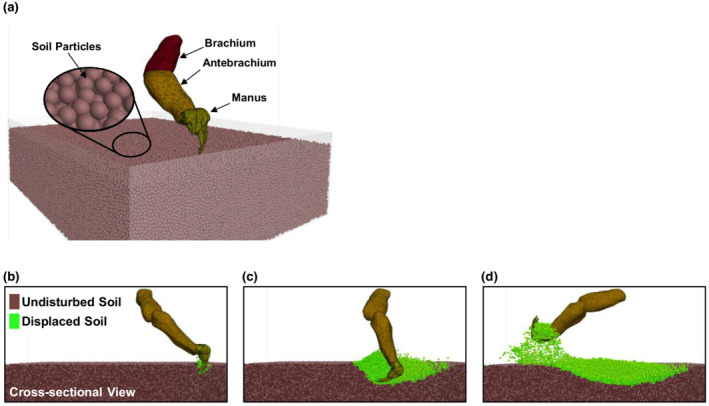
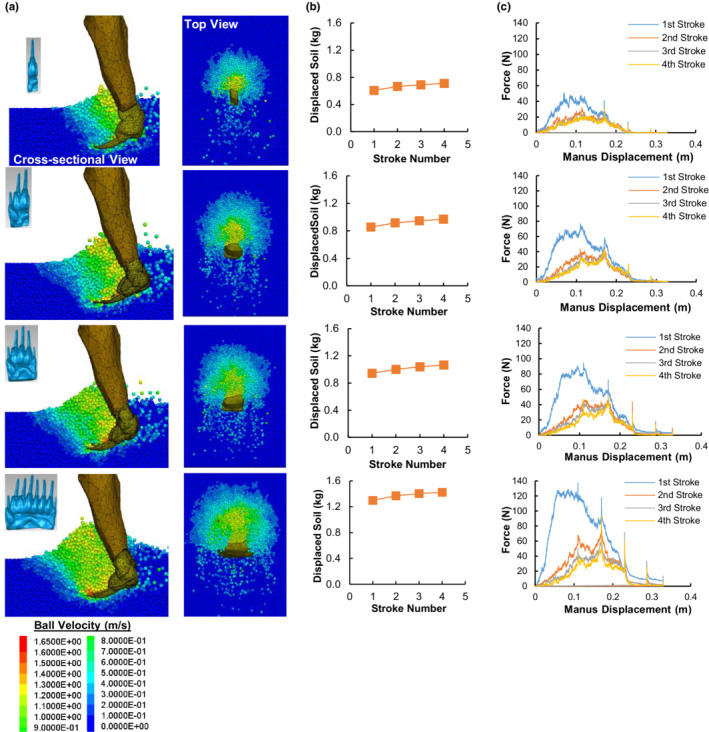
The morphological features of fossorial animals have continuously evolved in response to the demands of survival. However, existing methods for animal burrowing mechanics are not capable of addressing the large deformation of substrate. The discrete element method (DEM) is able to overcome this limitation. In this study, we used DEM to develop a general model to simulate the motion of an animal body part and its interaction with the substrate. The DEM also allowed us to easily change the forms of animal body parts to examine how those different forms affected the biomechanical functions. These capabilities of the DEM were presented through a case study of modeling the burrowing process of North American Badger. In the case study, the dynamics (forces, work, and soil displacements) of burrowing were predicted for different forms of badger claw and manus, using the model. Results showed that when extra digits are added to a manus, the work required for a badger to dig increases considerably, while the mass of soil dug only increases gradually. According to the proposed efficiency index (ratio of the amount of soil dug to the work required), the modern manus with 5 digits has indeed biomechanical advantage for their fossorial lifestyle, and the current claw curvature (25.3 mm in radius) is indeed optimal. The DEM is able to predict biomechanical relationships between functions and forms for any fossorial animals. Results can provide biomechanical evidences for explaining how the selective pressures for functions influence the morphological evolution in fossorial animals.
穴居动物的形态特征为了生存需求不断进化。然而,现有的动物挖掘力学方法无法解决基质的大变形问题。离散元法(DEM)能够克服这一局限性。在本研究中,我们使用离散元法建立了一个通用模型,以模拟动物身体部位的运动及其与基质的相互作用。离散元法还使我们能够轻松改变动物身体部位的形态,以研究这些不同形态如何影响生物力学功能。通过对北美獾挖掘过程建模的案例研究展示了离散元法的这些能力。在案例研究中,使用该模型预测了不同形态的獾爪和前掌挖掘时的动力学(力、功和土壤位移)。结果表明,当给前掌增加额外的趾头时,獾挖掘所需的功大幅增加,而挖掘的土壤质量仅逐渐增加。根据提出的效率指标(挖掘的土壤量与所需功的比值),具有5个趾头的现代前掌对于其穴居生活方式确实具有生物力学优势,并且当前的爪曲率(半径为25.3毫米)确实是最佳的。离散元法能够预测任何穴居动物功能与形态之间的生物力学关系。研究结果可为解释功能的选择压力如何影响穴居动物的形态进化提供生物力学证据。