Mainz Comprehensive Epilepsy and Sleep Medicine Center, Department of Neurology, University Medical Center of the Johannes Gutenberg University Mainz, Langenbeckstr. 1, 55131, Mainz, Germany.
Department of Neurology, Philipps-University Marburg, Marburg, Germany.
CNS Drugs. 2022 Oct;36(10):1113-1119. doi: 10.1007/s40263-022-00954-w. Epub 2022 Sep 30.
Eslicarbazepine acetate (ESL), a novel sodium channel blocker, is approved for mono and adjunctive treatment of partial epileptic seizures with or without secondary generalization. Its efficacy in primary generalized seizures has not yet been evaluated.
To evaluate the efficacy and safety of ESL in primary generalized tonic-clonic seizures (PGTCS) in an observational study.
The data were collected from a prospective population-based register. Effectiveness was measured as relative reduction in standardized seizure frequency (SSF), responder rate (≥ 50% reduction in SSF), and seizure freedom rate at 6 and 12 months after initiation of ESL. Safety and tolerability were evaluated using patients' diaries.
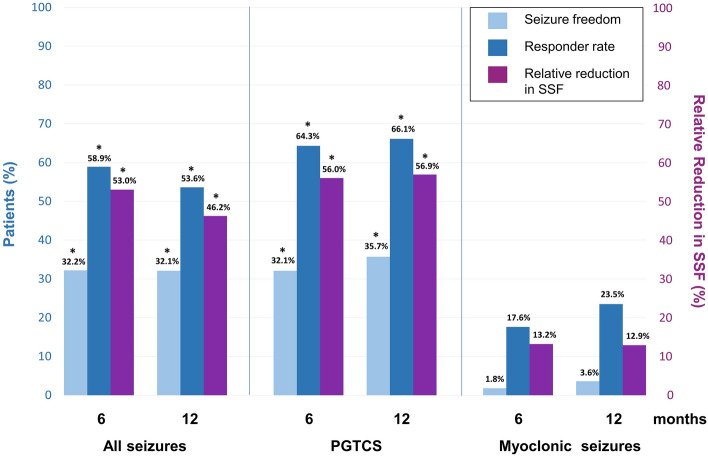
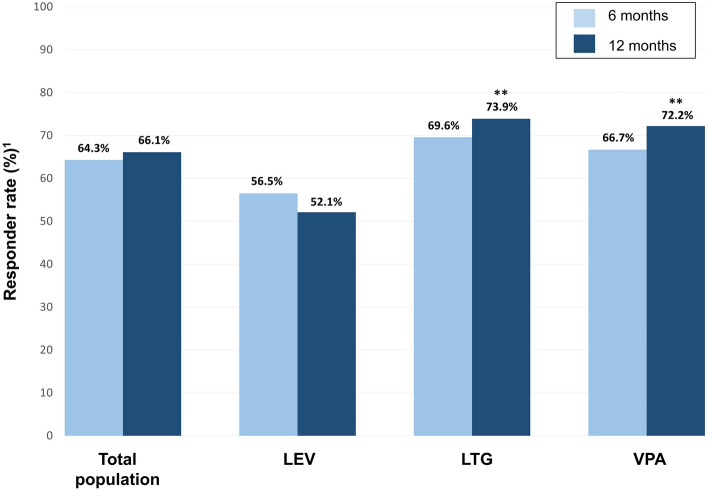
Fifty-six adult patients with PGTCS were treated with ESL as adjunctive therapy. Of these, 30.4% (n = 17) had myoclonic seizures in addition to PGTCS. The retention rate after 12 months was 80.4% (n = 45). After initiating ESL therapy, reduction in SSF for PGTCS on ESL was 56.0% after 6 months and 56.9% after 12 months (p < 0.01), whereas myoclonic seizures did not show any significant improvement in frequency. The responder rate for PGTCS was 64.3% after 6 months and 66.1% after 12 months, and seizure freedom was achieved in 32.1% and 35.7%, respectively. Forty-three patients (73.2%) reported no side effects. Among the reported side effects of ESL therapy, headache (7.1%), dizziness (8.9%), tiredness (7.1%), nausea (5.4%), and hyponatremia (5.4%) were the most prevalent.
Our data suggest that ESL may provide additional benefits in the treatment of patients with PGTCS and motivate randomized controlled trials in this indication.
艾司利卡西平醋酸盐(ESL)是一种新型的钠离子通道阻滞剂,已被批准用于单药和联合治疗部分性癫痫发作,伴有或不伴有继发性全面发作。其在原发性全面性强直-阵挛发作(PGTCS)中的疗效尚未得到评估。
在一项观察性研究中评估 ESL 治疗原发性全面性强直-阵挛发作(PGTCS)的疗效和安全性。
数据来自前瞻性基于人群的登记处。有效性通过标准化发作频率的相对减少(SSF)、应答率(SSF 减少≥50%)以及 ESL 起始后 6 个月和 12 个月时的无发作率来衡量。使用患者日记评估安全性和耐受性。
56 例 PGTCS 成年患者接受 ESL 作为辅助治疗。其中,30.4%(n=17)除 PGTCS 外还有肌阵挛发作。12 个月后的保留率为 80.4%(n=45)。在开始 ESL 治疗后,PGTCS 的 SSF 在 6 个月时降低了 56.0%,12 个月时降低了 56.9%(p<0.01),而肌阵挛发作的频率没有明显改善。PGTCS 的应答率在 6 个月时为 64.3%,在 12 个月时为 66.1%,无发作率分别为 32.1%和 35.7%。43 名患者(73.2%)报告无副作用。ESL 治疗的报告副作用中,头痛(7.1%)、头晕(8.9%)、疲倦(7.1%)、恶心(5.4%)和低钠血症(5.4%)最为常见。
我们的数据表明,ESL 可能为 PGTCS 患者的治疗提供额外的益处,并促使在该适应症中开展随机对照试验。