Mainz Comprehensive Epilepsy and Sleep Medicine Center, Department of Neurology, University Medical Center of the Johannes Gutenberg University Mainz, Langenbeckstrasse 1, 55131, Mainz, Germany.
Department of Neurology, Philipps-University Marburg, Marburg, Germany.
CNS Drugs. 2024 Sep;38(9):733-742. doi: 10.1007/s40263-024-01109-9. Epub 2024 Aug 3.
Cenobamate (CNB) is a new antiseizure medication (ASM) to treat drug-resistant, focal-onset seizures. Data on its use in early therapy lines are not yet available, and clinicians frequently consider CNB to be a later ASM drug choice. We investigated the efficacy and safety of CNB as an early adjunctive treatment in drug-resistant, focal-onset seizures.
The study population were patients with drug-resistant, focal-onset seizures who were initiated with CNB after they did not respond to two or three lifetime ASMs, including all prior and concomitant ASMs. These patients were matched (1:2) by sex, age, and seizure frequency to controls who were initiated with any ASM other than CNB. All participants participated in the Mainz Epilepsy Registry. We evaluated the retention rate after 12 months of CNB and after each new adjunctive ASM in the control group. In addition, seizure freedom and the response rate (reduction of seizure frequency by ≥ 50% from baseline) after 12 months were estimated.
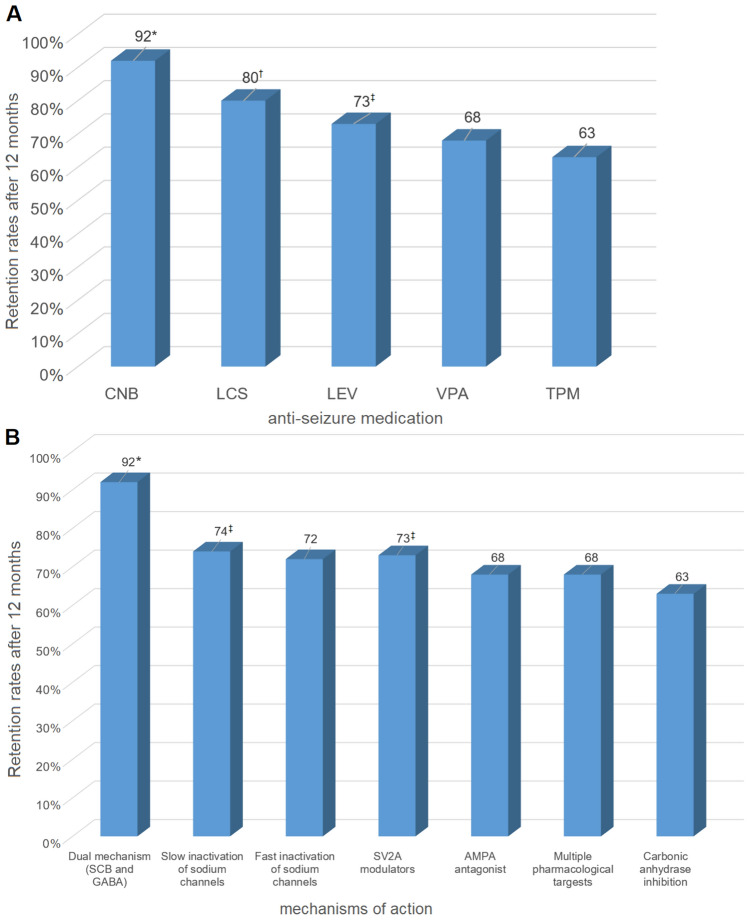
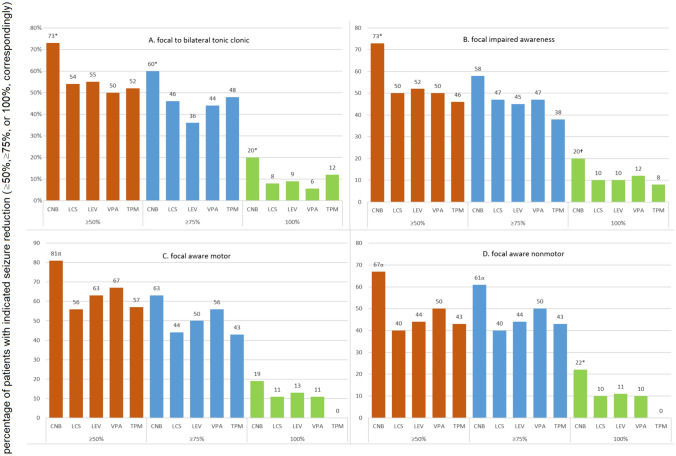
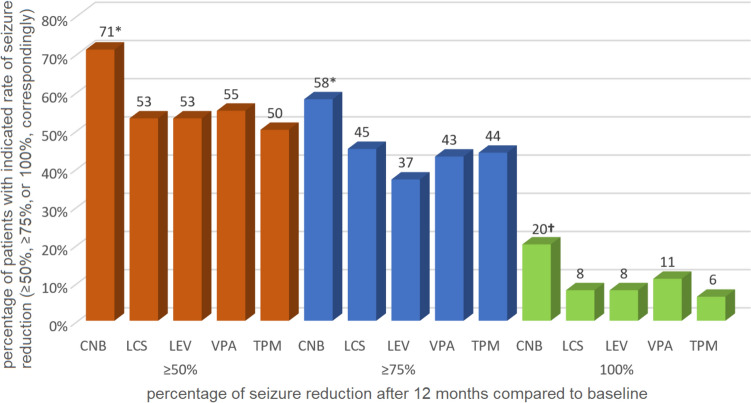
We included 231 patients aged 44.4 ± 15.8 years. Of these, 33.3% (n = 77) were on CNB, 19.0% (n = 44) on valproate (VPA), 17.3% (n = 40) on lacosamide (LCS), 16.4% (n = 38) on levetiracetam (LEV), and 13.9% (n = 32) on topiramate (TPM). The highest retention rate after 12 months since the beginning of the early adjunctive therapy was observed on CNB (92.0%), compared with LCS (80.0%), LEV (73.3%), VPA (68.2%), or TPM (62.5%) (p < 0.05). Seizure freedom and response rate were also the best on CNB (19.5% and 71.4%, respectively) compared with other ASMs (8.3% and 52.5%, respectively; p < 0.05). No significant differences in adverse events between CNB and other ASMs were observed.
Our study provides evidence that CNB is an effective ASM with a good safety profile in the early therapy lines of drug-resistant, focal-onset seizures. This data should support medical decision making in the management of patients with refractory epilepsy.
NCT05267405.
苯巴比妥(CNB)是一种新的抗癫痫药物(ASM),用于治疗耐药性、局灶性发作性癫痫。关于其在早期治疗线中的使用的数据尚未可知,临床医生通常认为 CNB 是后期 ASM 药物的选择。我们研究了 CNB 作为耐药性、局灶性发作性癫痫的早期辅助治疗的疗效和安全性。
研究人群为对两种或三种终身 ASM 反应不佳(包括所有既往和同时使用的 ASM)的耐药性、局灶性发作性癫痫患者,这些患者在开始使用 CNB 治疗。这些患者按照性别、年龄和发作频率与对照组进行匹配(1:2),对照组患者使用除 CNB 以外的任何 ASM 进行初始治疗。所有参与者均参与了美因茨癫痫登记处的研究。我们评估了 CNB 治疗 12 个月后的保留率以及对照组中每一种新辅助 ASM 治疗后的保留率。此外,我们还估计了 12 个月后的无癫痫发作率和反应率(与基线相比,癫痫发作频率降低≥50%)。
我们纳入了 231 名年龄为 44.4±15.8 岁的患者。其中,33.3%(n=77)患者使用 CNB,19.0%(n=44)患者使用丙戊酸钠(VPA),17.3%(n=40)患者使用拉科酰胺(LCS),16.4%(n=38)患者使用左乙拉西坦(LEV),13.9%(n=32)患者使用托吡酯(TPM)。从早期辅助治疗开始,12 个月后保留率最高的是 CNB(92.0%),其次是 LCS(80.0%)、LEV(73.3%)、VPA(68.2%)或 TPM(62.5%)(p<0.05)。与其他 ASM 相比,CNB 的无癫痫发作率(19.5%)和反应率(71.4%)也最高(分别为 8.3%和 52.5%;p<0.05)。未观察到 CNB 与其他 ASM 之间在不良反应方面有显著差异。
本研究提供了证据表明,CNB 是一种有效的 ASM,在耐药性、局灶性发作性癫痫的早期治疗线中具有良好的安全性。这些数据应该支持在管理难治性癫痫患者时的医疗决策。
NCT05267405。