Institute for Health Research, Kaiser Permanente Colorado (MF Daley, LM Reifler, and JM Glanz), Aurora, Colo; Department of Pediatrics, University of Colorado School of Medicine (MF Daley and SJ Hambidge), Aurora, Colo.
Institute for Health Research, Kaiser Permanente Colorado (MF Daley, LM Reifler, and JM Glanz), Aurora, Colo.
Acad Pediatr. 2023 Jan-Feb;23(1):37-46. doi: 10.1016/j.acap.2022.08.006. Epub 2022 Sep 28.
To assess the association between cumulative aluminum exposure from vaccines before age 24 months and persistent asthma at age 24 to 59 months.
A retrospective cohort study was conducted in the Vaccine Safety Datalink (VSD). Vaccination histories were used to calculate cumulative vaccine-associated aluminum in milligrams (mg). The persistent asthma definition required one inpatient or 2 outpatient asthma encounters, and ≥2 long-term asthma control medication dispenses. Cox proportional hazard models were used to evaluate the association between aluminum exposure and asthma incidence, stratified by eczema presence/absence. Adjusted hazard ratios (aHR) and 95% confidence intervals (CI) per 1 mg increase in aluminum exposure were calculated, adjusted for birth month/year, sex, race/ethnicity, VSD site, prematurity, medical complexity, food allergy, severe bronchiolitis, and health care utilization.
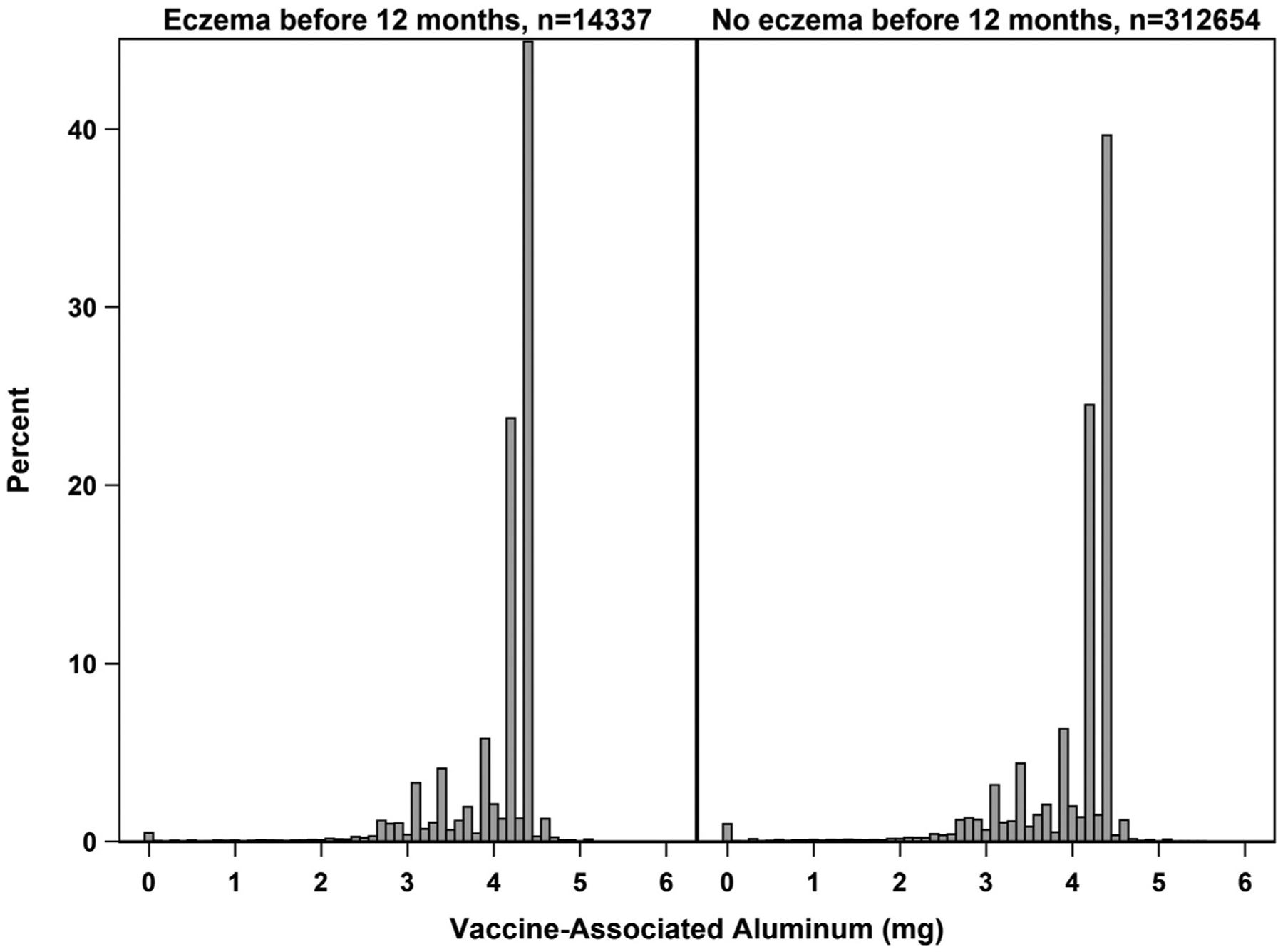
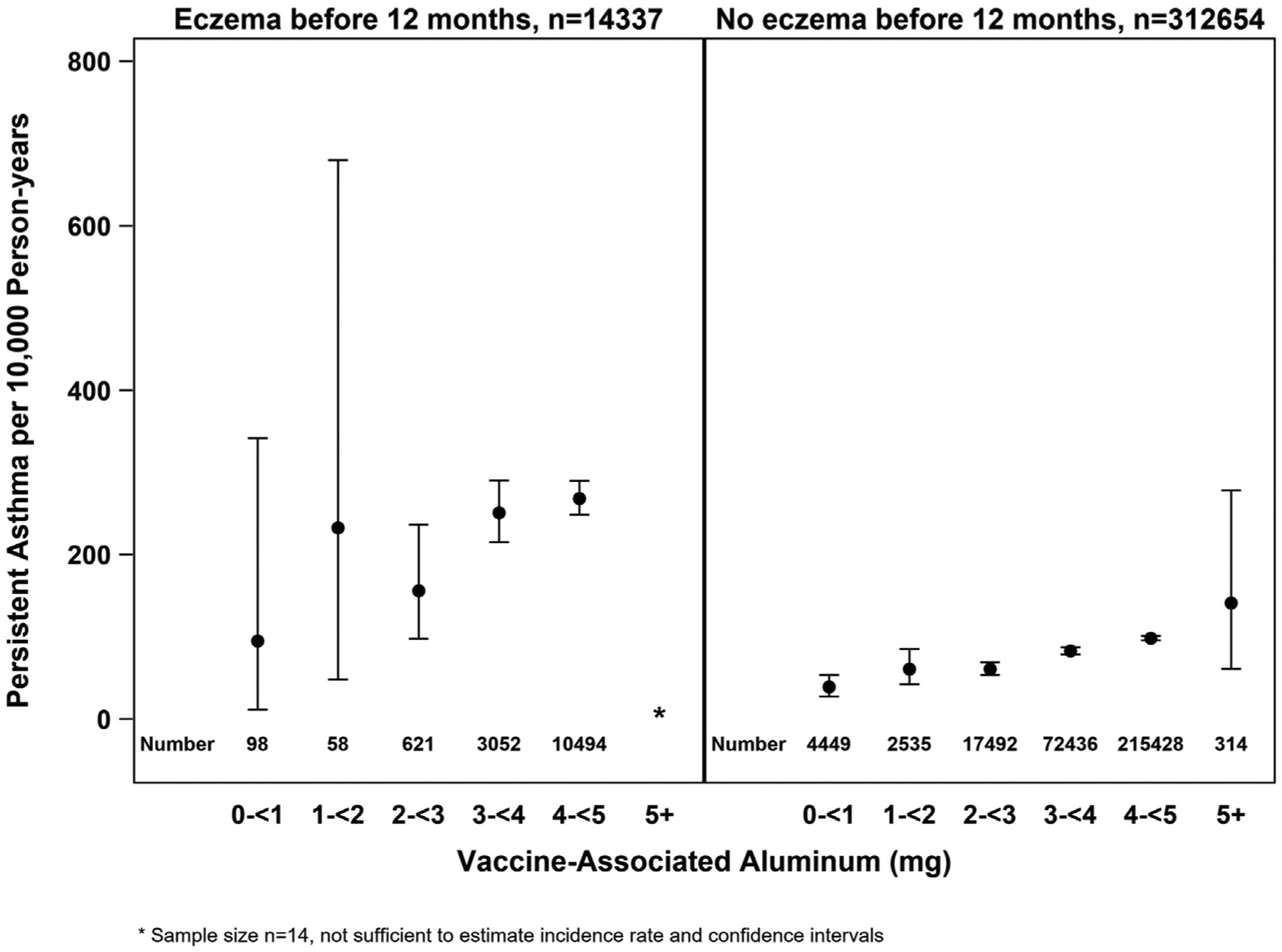
The cohort comprised 326,991 children, among whom 14,337 (4.4%) had eczema. For children with and without eczema, the mean (standard deviation [SD]) vaccine-associated aluminum exposure was 4.07 mg (SD 0.60) and 3.98 mg (SD 0.72), respectively. Among children with and without eczema, 6.0% and 2.1%, respectively, developed persistent asthma. Among children with eczema, vaccine-associated aluminum was positively associated with persistent asthma (aHR 1.26 per 1 mg increase in aluminum, 95% CI 1.07, 1.49); a positive association was also detected among children without eczema (aHR 1.19, 95% CI 1.14, 1.25).
In a large observational study, a positive association was found between vaccine-related aluminum exposure and persistent asthma. While recognizing the small effect sizes identified and the potential for residual confounding, additional investigation of this hypothesis appears warranted.
评估 24 个月前疫苗中累积铝暴露与 24 至 59 个月时持续性哮喘之间的关联。
在疫苗安全数据链(VSD)中进行了回顾性队列研究。利用疫苗接种史计算了毫克(mg)疫苗相关铝的累积量。持续性哮喘的定义需要一次住院或 2 次门诊哮喘就诊,以及≥2 次长期哮喘控制药物配给。采用 Cox 比例风险模型评估了铝暴露与哮喘发病率之间的关系,按湿疹存在/不存在分层。按出生月份/年、性别、种族/民族、VSD 地点、早产、医疗复杂性、食物过敏、严重细支气管炎和医疗保健利用情况进行调整后,计算了每增加 1mg 铝暴露的调整后风险比(aHR)和 95%置信区间(CI)。
该队列包括 326991 名儿童,其中 14337 名(4.4%)有湿疹。对于有和没有湿疹的儿童,疫苗相关铝暴露的平均(标准差[SD])分别为 4.07mg(SD 0.60)和 3.98mg(SD 0.72)。有和没有湿疹的儿童中,持续性哮喘的发病率分别为 6.0%和 2.1%。对于有湿疹的儿童,疫苗相关铝与持续性哮喘呈正相关(每增加 1mg 铝,aHR 为 1.26,95%CI 为 1.07,1.49);在没有湿疹的儿童中也发现了正相关(aHR 为 1.19,95%CI 为 1.14,1.25)。
在一项大型观察性研究中,发现疫苗相关铝暴露与持续性哮喘之间存在正相关。尽管认识到确定的小效应量和潜在的残余混杂因素,但似乎有必要进一步调查这一假设。