Department of Surgery, Maastricht University Medical Centre, P.O. Box 5800, 6202 AZ, Maastricht, the Netherlands.
Division Medical Oncology, Maastricht University Medical Centre, GROW, Maastricht University, Maastricht, the Netherlands.
Eur Radiol. 2023 Mar;33(3):2209-2217. doi: 10.1007/s00330-022-09115-5. Epub 2022 Sep 30.
For patients with ductal carcinoma in situ (DCIS), data about the impact of breast MRI at primary diagnosis on the incidence and characteristics of contralateral breast cancers are scarce.
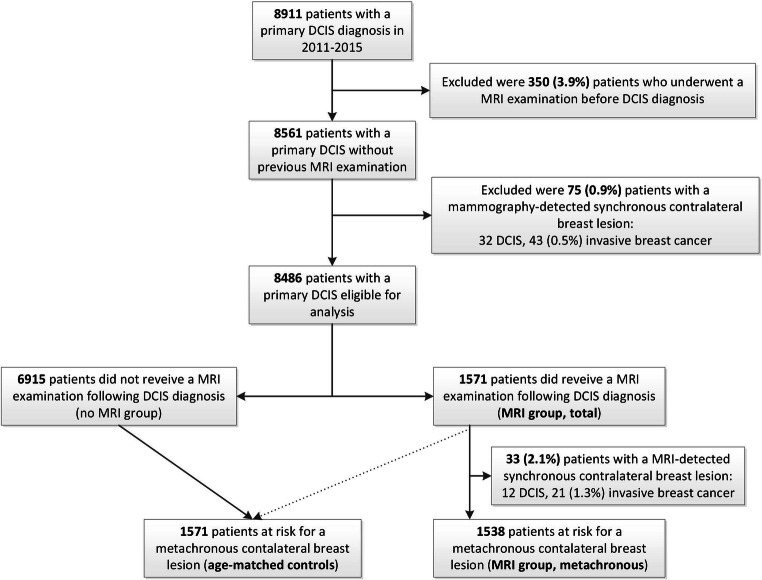
We selected all 8486 women diagnosed with primary DCIS in the Netherlands in 2011-2015 from the Netherlands Cancer Registry. The synchronous and metachronous detection of contralateral DCIS (cDCIS) and contralateral invasive breast cancer (cIBC) was assessed for patients who received an MRI upon diagnosis (MRI group) and for an age-matched control group without MRI.
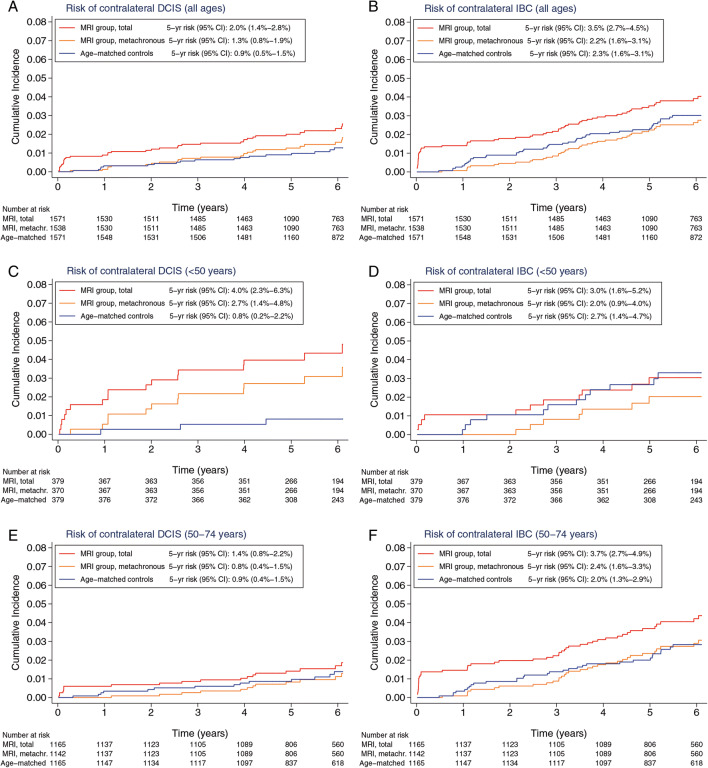
Nineteen percent of patients received an MRI, of which 0.8% was diagnosed with synchronous cDCIS and 1.3% with synchronous cIBC not found by mammography. The 5-year cumulative incidence of synchronous plus metachronous cDCIS was higher for the MRI versus age-matched control group (2.0% versus 0.9%, p = 0.02) and similar for cIBC (3.5% versus 2.3%, p = 0.17). The increased incidence of cDCIS was observed in patients aged < 50 years (sHR = 4.22, 95% CI: 1.19-14.99), but not in patients aged 50-74 years (sHR = 0.89, 95% CI: 0.41-1.93).
MRI at primary DCIS diagnosis detected additional synchronous cDCIS and cIBC, and was associated with a higher rate of metachronous cDCIS without decreasing the rate of metachronous cIBC. This finding was most evident in younger patients.
• Magnetic resonance imaging at primary diagnosis of ductal carcinoma in situ detected an additional synchronous breast lesion in 2.1% of patients. • In patients aged younger than 50 years, the use of pre-operative MRI was associated with a fourfold increase in the incidence of a second contralateral DCIS without decreasing the incidence of metachronous invasive breast cancers up to 5 years after diagnosis. • In patients aged over 50 years, the use of pre-operative MRI did not result in a difference in the incidence of a second contralateral DCIS or metachronous invasive breast cancer.
对于患有导管原位癌(DCIS)的患者,有关在初次诊断时进行乳腺 MRI 对同侧乳腺癌发生率和特征的影响的数据很少。
我们从荷兰癌症登记处选择了 2011 年至 2015 年期间在荷兰被诊断为原发性 DCIS 的 8486 名女性。评估了接受诊断时 MRI(MRI 组)和无 MRI 的年龄匹配对照组中同侧 DCIS(cDCIS)和同侧浸润性乳腺癌(cIBC)的同步和异时检出情况。
19%的患者接受了 MRI,其中 0.8%被诊断为同步 cDCIS,1.3%为通过乳房 X 线摄影术未发现的同步 cIBC。与年龄匹配的对照组相比,MRI 组的 5 年累积同步加异时 cDCIS 发生率更高(2.0%比 0.9%,p = 0.02),cIBC 的发生率相似(3.5%比 2.3%,p = 0.17)。在年龄<50 岁的患者中观察到 cDCIS 的发生率增加(sHR = 4.22,95%CI:1.19-14.99),但在 50-74 岁的患者中则没有(sHR = 0.89,95%CI:0.41-1.93)。
在 DCIS 初次诊断时进行 MRI 检测到了额外的同步 cDCIS 和 cIBC,并且与更高的异时 cDCIS 发生率相关,而不会降低异时 cIBC 的发生率。这一发现在年轻患者中更为明显。
在导管原位癌的初次诊断中进行 MRI 检测出了 2.1%的患者有额外的同侧乳腺病变。
在年龄<50 岁的患者中,术前 MRI 的使用与第二次同侧 DCIS 的发生率增加四倍相关,而不会降低诊断后 5 年内同侧浸润性乳腺癌的发生率。
在年龄>50 岁的患者中,术前 MRI 的使用并未导致第二次同侧 DCIS 或同侧浸润性乳腺癌的发生率差异。