Mielke Juliane, Leppla Lynn, Valenta Sabine, Zullig Leah L, Zúñiga Franziska, Staudacher Sandra, Teynor Alexandra, De Geest Sabina
Institute of Nursing Science (INS), Department Public Health (DPH), Faculty of Medicine, University of Basel, Bernoullistrasse 28, CH-4056, Basel, Switzerland.
Department of Medicine I, Faculty of Medicine, Medical Center University of Freiburg, Freiburg im Breisgau, Germany.
Implement Sci Commun. 2022 Oct 1;3(1):102. doi: 10.1186/s43058-022-00354-7.
Designing intervention and implementation strategies with careful consideration of context is essential for successful implementation science projects. Although the importance of context has been emphasized and methodology for its analysis is emerging, researchers have little guidance on how to plan, perform, and report contextual analysis. Therefore, our aim was to describe the Basel Approach for coNtextual ANAlysis (BANANA) and to demonstrate its application on an ongoing multi-site, multiphase implementation science project to develop/adapt, implement, and evaluate an integrated care model in allogeneic SteM cell transplantatIon facILitated by eHealth (the SMILe project).
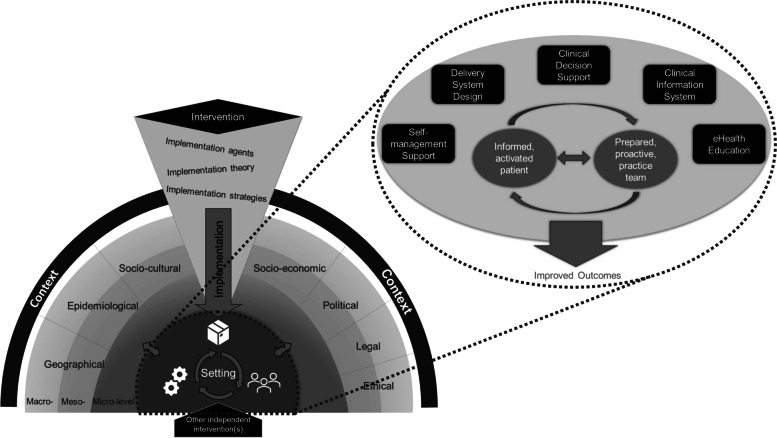
BANANA builds on guidance for assessing context by Stange and Glasgow (Contextual factors: the importance of considering and reporting on context in research on the patient-centered medical home, 2013). Based on a literature review, BANANA was developed in ten discussion sessions with implementation science experts and a medical anthropologist to guide the SMILe project's contextual analysis. BANANA's theoretical basis is the Context and Implementation of Complex Interventions (CICI) framework. Working from an ecological perspective, CICI acknowledges contextual dynamics and distinguishes between context and setting (the implementation's physical location).
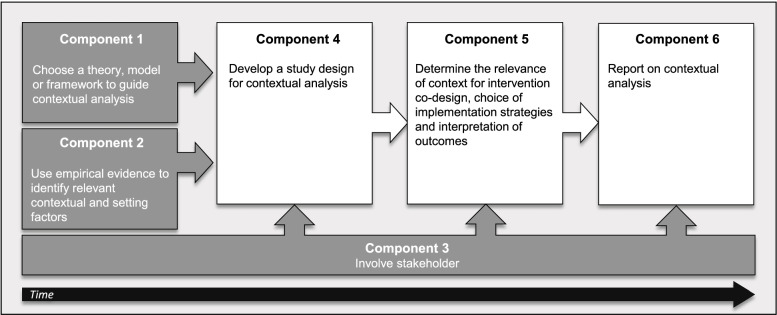
BANANA entails six components: (1) choose a theory, model, or framework (TMF) to guide the contextual analysis; (2) use empirical evidence derived from primary and/or secondary data to identify relevant contextual factors; (3) involve stakeholders throughout contextual analysis; (4) choose a study design to assess context; (5) determine contextual factors' relevance to implementation strategies/outcomes and intervention co-design; and (6) report findings of contextual analysis following appropriate reporting guidelines. Partly run simultaneously, the first three components form a basis both for the identification of relevant contextual factors and for the next components of the BANANA approach.
Understanding of context is indispensable for a successful implementation science project. BANANA provides much-needed methodological guidance for contextual analysis. In subsequent phases, it helps researchers apply the results to intervention development/adaption and choices of contextually tailored implementation strategies. For future implementation science projects, BANANA's principles will guide researchers first to gather relevant information on their target context, then to inform all subsequent phases of their implementation science project to strengthen every part of their work and fulfill their implementation goals.
在实施科学项目中,充分考虑背景因素来设计干预和实施策略对于项目的成功至关重要。尽管背景因素的重要性已得到强调,且其分析方法也在不断涌现,但研究人员在如何规划、开展和报告背景分析方面几乎没有指导。因此,我们的目的是描述巴塞尔背景分析方法(BANANA),并展示其在一个正在进行的多地点、多阶段实施科学项目中的应用,该项目旨在开发/调整、实施和评估由电子健康促进的异基因干细胞移植综合护理模式(SMILe项目)。
BANANA基于Stange和Glasgow评估背景的指南(背景因素:在以患者为中心的医疗之家研究中考虑和报告背景的重要性,2013年)。通过文献综述,在与实施科学专家和医学人类学家的十次讨论会上开发了BANANA,以指导SMILe项目的背景分析。BANANA的理论基础是复杂干预的背景与实施(CICI)框架。从生态角度出发,CICI承认背景动态,并区分背景和场所(实施的实际地点)。
BANANA包含六个组成部分:(1)选择一种理论、模型或框架(TMF)来指导背景分析;(2)利用从原始和/或二手数据中获得的经验证据来识别相关背景因素;(3)在整个背景分析过程中让利益相关者参与;(4)选择一种研究设计来评估背景;(5)确定背景因素与实施策略/结果以及干预共同设计的相关性;(6)按照适当的报告指南报告背景分析结果。前三个组成部分部分同时进行,它们既是识别相关背景因素 的基础,也是BANANA方法后续组成部分的基础。
对背景的理解对于成功的实施科学项目不可或缺。BANANA为背景分析提供了急需的方法指导。在后续阶段,它有助于研究人员将结果应用于干预开发/调整以及背景定制实施策略的选择。对于未来的实施科学项目,BANANA的原则将指导研究人员首先收集有关其目标背景的相关信息,然后为其实施科学项目的所有后续阶段提供信息,以加强工作的各个部分并实现其实施目标。