Chakrabarti Subho, Singh Navdeep
Department of Psychiatry, Postgraduate Institute of Medical Education and Research, Chandigarh 160012, UT, India.
World J Psychiatry. 2022 Sep 19;12(9):1204-1232. doi: 10.5498/wjp.v12.i9.1204.
Lifetime psychotic symptoms are present in over half of the patients with bipolar disorder (BD) and can have an adverse effect on its course, outcome, and treatment. However, despite a considerable amount of research, the impact of psychotic symptoms on BD remains unclear, and there are very few systematic reviews on the subject.
To examine the extent of psychotic symptoms in BD and their impact on several aspects of the illness.
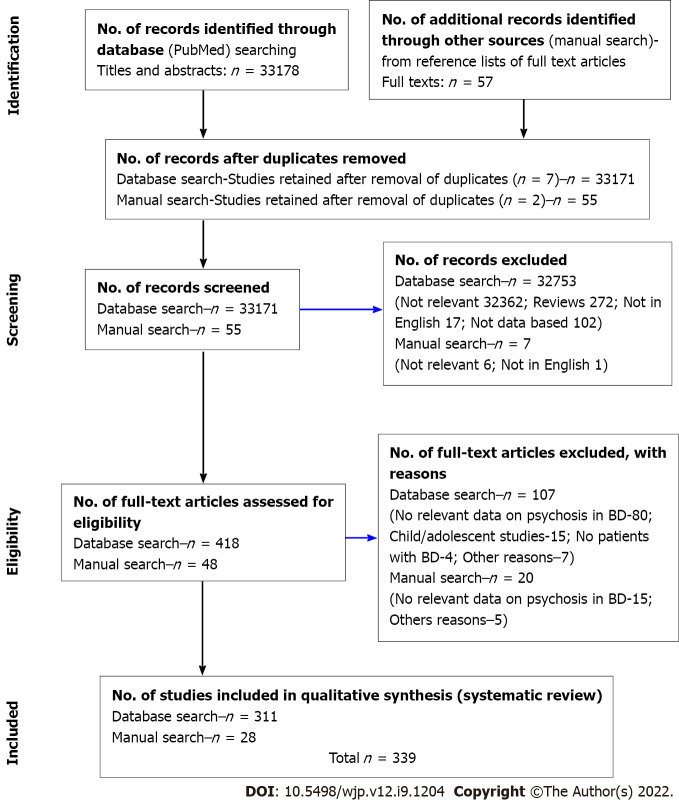
The Preferred Reporting Items for Systematic Reviews and Meta-analyses guidelines were followed. An electronic literature search of six English-language databases and a manual search was undertaken to identify published articles on psychotic symptoms in BD from January 1940 to December 2021. Combinations of the relevant Medical Subject Headings terms were used to search for these studies. Articles were selected after a screening phase, followed by a review of the full texts of the articles. Assessment of the methodological quality of the studies and the risk of bias was conducted using standard tools.
This systematic review included 339 studies of patients with BD. Lifetime psychosis was found in more than a half to two-thirds of the patients, while current psychosis was found in a little less than half of them. Delusions were more common than hallucinations in all phases of BD. About a third of the patients reported first-rank symptoms or mood-incongruent psychotic symptoms, particularly during manic episodes. Psychotic symptoms were more frequent in bipolar type I compared to bipolar type II disorder and in mania or mixed episodes compared to bipolar depression. Although psychotic symptoms were not more severe in BD, the severity of the illness in psychotic BD was consistently greater. Psychosis was usually associated with poor insight and a higher frequency of agitation, anxiety, and hostility but not with psychiatric comorbidity. Psychosis was consistently linked with increased rates and the duration of hospitalizations, switching among patients with depression, and poorer outcomes with mood-incongruent symptoms. In contrast, psychosis was less likely to be accompanied by a rapid-cycling course, longer illness duration, and heightened suicidal risk. There was no significant impact of psychosis on the other parameters of course and outcome.
Though psychotic symptoms are very common in BD, they are not always associated with an adverse impact on BD and its course and outcome.
超过半数的双相情感障碍(BD)患者一生中会出现精神病性症状,这些症状会对其病程、结局及治疗产生不利影响。然而,尽管已有大量研究,但精神病性症状对双相情感障碍的影响仍不明确,关于该主题的系统评价也非常少。
探讨双相情感障碍中精神病性症状的程度及其对该疾病几个方面的影响。
遵循系统评价和Meta分析的首选报告项目指南。对六个英文数据库进行电子文献检索,并进行手工检索,以确定1940年1月至2021年12月期间发表的关于双相情感障碍中精神病性症状的文章。使用相关医学主题词的组合来检索这些研究。在筛选阶段后选择文章,随后对文章全文进行审查。使用标准工具对研究的方法学质量和偏倚风险进行评估。
该系统评价纳入了339项双相情感障碍患者的研究。超过半数至三分之二的患者一生中曾出现过精神病性症状,而目前有精神病性症状的患者略少于半数。在双相情感障碍的各个阶段,妄想比幻觉更常见。约三分之一的患者报告有一级症状或心境不一致的精神病性症状,尤其是在躁狂发作期间。与双相II型障碍相比,双相I型中精神病性症状更频繁;与双相抑郁相比,躁狂或混合发作中更频繁。虽然双相情感障碍患者的精神病性症状并不更严重,但有精神病性症状的双相情感障碍患者病情严重程度始终更高。精神病性症状通常与自知力差以及激越、焦虑和敌意的发生率较高有关,但与精神科合并症无关。精神病性症状始终与住院率和住院时间增加、抑郁患者病情转换以及心境不一致症状的较差结局有关。相比之下,精神病性症状不太可能伴有快速循环病程、更长的病程和更高的自杀风险。精神病性症状对病程和结局的其他参数没有显著影响。
虽然精神病性症状在双相情感障碍中非常常见,但它们并不总是与对双相情感障碍及其病程和结局的不利影响相关。