McGeady Ciarán, Vučković Aleksandra, Singh Tharu Niraj, Zheng Yong-Ping, Alam Monzurul
Centre for Rehabilitation Engineering, University of Glasgow, Glasgow, United Kingdom.
Department of Biomedical Engineering, The Hong Kong Polytechnic University, Kowloon, Hong Kong SAR, China.
Front Rehabil Sci. 2022 Jun 23;3:896766. doi: 10.3389/fresc.2022.896766. eCollection 2022.
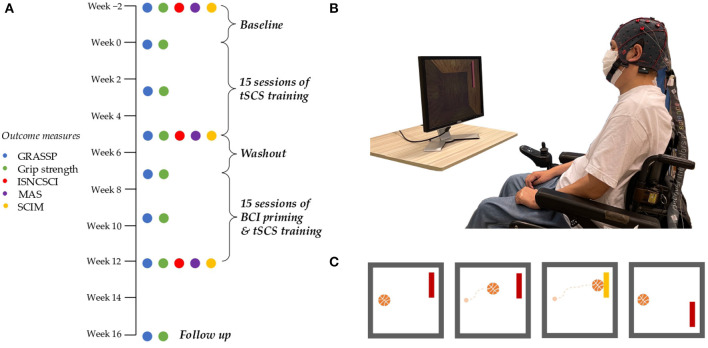
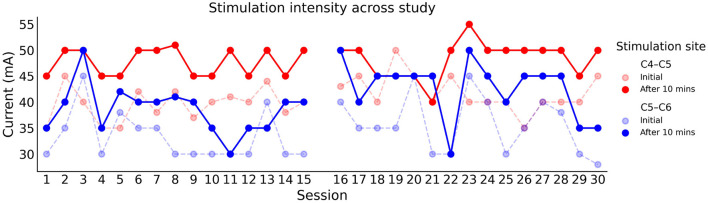
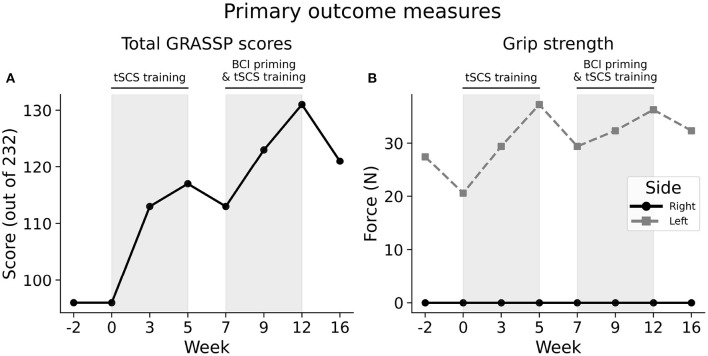
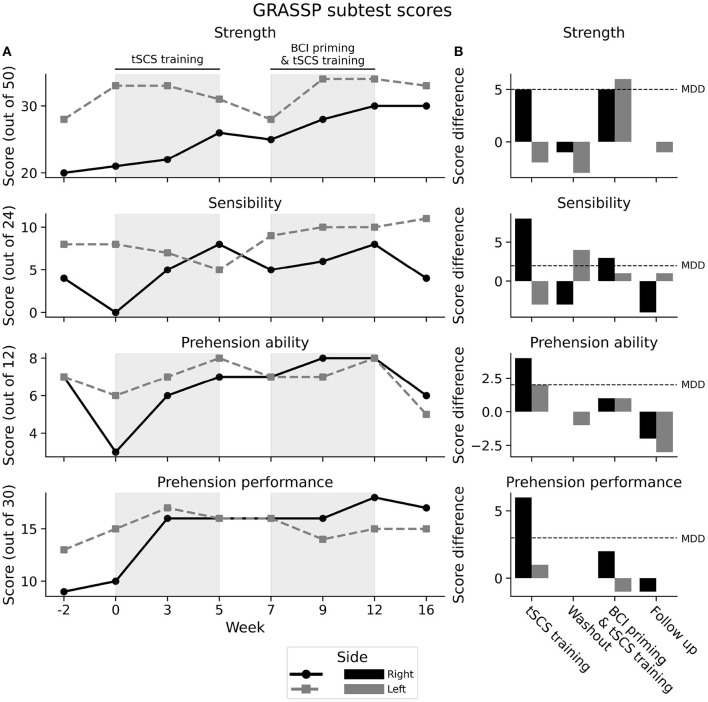
Loss of arm and hand function is one of the most devastating consequences of cervical spinal cord injury (SCI). Although some residual functional neurons often pass the site of injury, recovery after SCI is extremely limited. Recent efforts have aimed to augment traditional rehabilitation by combining exercise-based training with techniques such as transcutaneous spinal cord stimulation (tSCS), and movement priming. Such methods have been linked with elevated corticospinal excitability, and enhanced neuroplastic effects following activity-based therapy. In the present study, we investigated the potential for facilitating tSCS-based exercise-training with brain-computer interface (BCI) motor priming. An individual with chronic AIS A cervical SCI with both sensory and motor complete tetraplegia participated in a two-phase cross-over intervention whereby they engaged in 15 sessions of intensive tSCS-mediated hand training for 1 h, 3 times/week, followed by a two week washout period, and a further 15 sessions of tSCS training with bimanual BCI motor priming preceding each session. We found using the Graded Redefined Assessment for Strength, Sensibility, and Prehension that the participant's arm and hand function improved considerably across each phase of the study: from 96/232 points at baseline, to 117/232 after tSCS training alone, and to 131/232 points after BCI priming with tSCS training, reflecting improved strength, sensation, and gross and fine motor skills. Improved motor scores and heightened perception to sharp sensations improved the neurological level of injury from C4 to C5 following training and improvements were generally maintained four weeks after the final training session. Although functional improvements were similar regardless of the presence of BCI priming, there was a moderate improvement of bilateral strength only when priming preceded tSCS training, perhaps suggesting a benefit of motor priming for tSCS training.
手臂和手部功能丧失是颈脊髓损伤(SCI)最具破坏性的后果之一。尽管一些残留的功能神经元通常会通过损伤部位,但脊髓损伤后的恢复极其有限。最近的努力旨在通过将基于运动的训练与经皮脊髓刺激(tSCS)和运动启动等技术相结合来增强传统康复效果。这些方法与皮质脊髓兴奋性升高以及基于活动的治疗后增强的神经可塑性效应有关。在本研究中,我们调查了利用脑机接口(BCI)运动启动促进基于tSCS的运动训练的潜力。一名患有慢性AIS A级颈脊髓损伤且感觉和运动完全性四肢瘫痪的个体参与了一项两阶段交叉干预,在此过程中,他们进行了15次强化tSCS介导的手部训练,每次1小时,每周3次,随后是两周的洗脱期,然后在每次训练前进行另外15次tSCS训练并伴有双手BCI运动启动。我们使用力量、感觉和抓握能力分级重新评估发现,参与者的手臂和手部功能在研究的每个阶段都有显著改善:从基线时的96/232分,到仅进行tSCS训练后的117/232分,再到BCI启动结合tSCS训练后的131/232分,反映出力量、感觉以及粗略和精细运动技能的改善。运动评分的提高和对尖锐感觉的感知增强使损伤的神经平面从C4提高到了C5,并且在最后一次训练 session 后的四周内,改善情况总体得以维持。尽管无论是否存在BCI启动,功能改善情况相似,但只有在启动先于tSCS训练时,双侧力量才有适度改善,这可能表明运动启动对tSCS训练有益。