Centre for Rehabilitation Engineering, University of Glasgow, Glasgow G12 8QQ, UK.
Department of Biomedical Engineering, The Hong Kong Polytechnic University, Hung Hom, Kowloon, Hong Kong.
Sensors (Basel). 2021 Oct 2;21(19):6593. doi: 10.3390/s21196593.
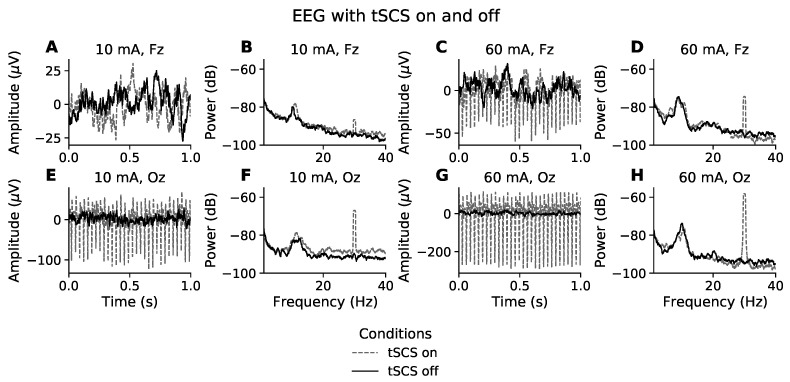
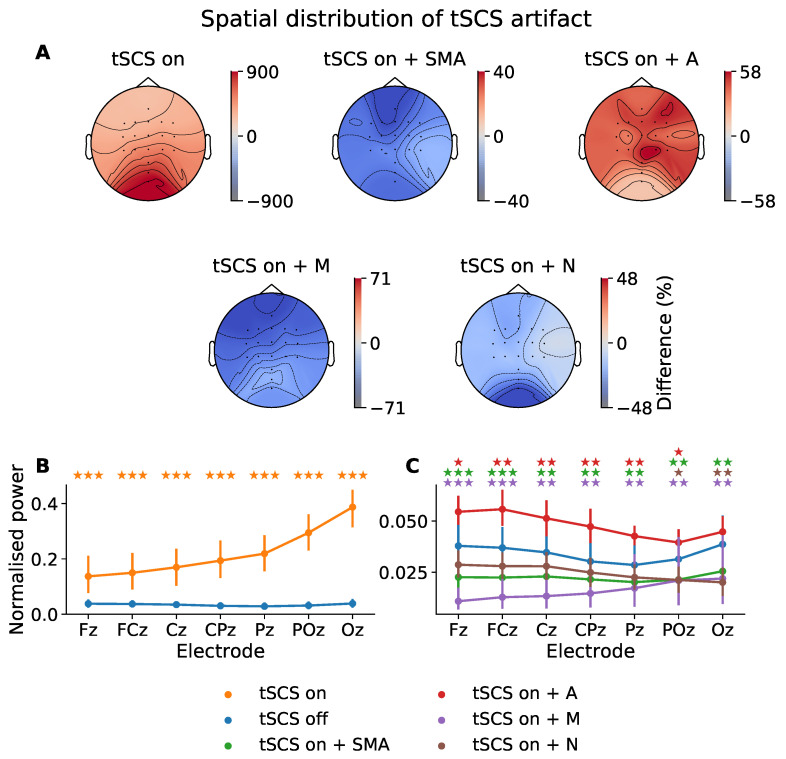
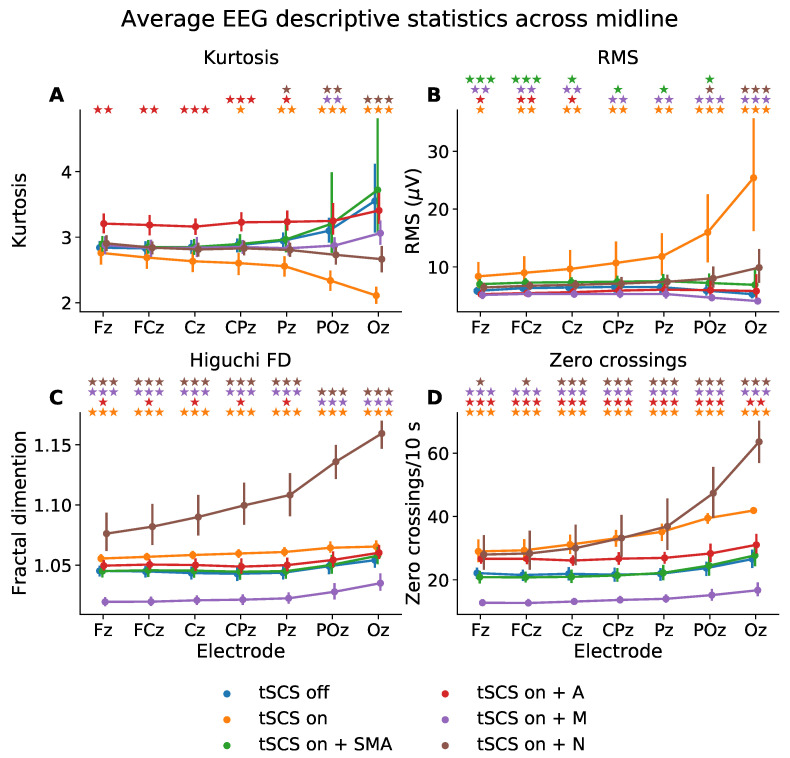
Transcutaneous electrical spinal cord stimulation (tSCS) is a non-invasive neuromodulatory technique that has in recent years been linked to improved volitional limb control in spinal-cord injured individuals. Although the technique is growing in popularity there is still uncertainty regarding the neural mechanisms underpinning sensory and motor recovery. Brain monitoring techniques such as electroencephalography (EEG) may provide further insights to the changes in coritcospinal excitability that have already been demonstrated using other techniques. It is unknown, however, whether intelligible EEG can be extracted while tSCS is being applied, owing to substantial high-amplitude artifacts associated with stimulation-based therapies. Here, for the first time, we characterise the artifacts that manifest in EEG when recorded simultaneously with tSCS. We recorded multi-channel EEG from 21 healthy volunteers as they took part in a resting state and movement task across two sessions: One with tSCS delivered to the cervical region of the neck, and one without tSCS. An offline analysis in the time and frequency domain showed that tSCS manifested as narrow, high-amplitude peaks with a spectral density contained at the stimulation frequency. We quantified the altered signals with descriptive statistics-kurtosis, root-mean-square, complexity, and zero crossings-and applied artifact-suppression techniques-superposition of moving averages, adaptive, median, and notch filtering-to explore whether the effects of tSCS could be suppressed. We found that the superposition of moving averages filter was the most successful technique at returning contaminated EEG to levels statistically similar to that of normal EEG. In the frequency domain, however, notch filtering was more effective at reducing the spectral power contribution of stimulation from frontal and central electrodes. An adaptive filter was more appropriate for channels closer to the stimulation site. Lastly, we found that tSCS posed no detriment the binary classification of upper-limb movements from sensorimotor rhythms, and that adaptive filtering resulted in poorer classification performance. Overall, we showed that, depending on the analysis, EEG monitoring during transcutaneous electrical spinal cord stimulation is feasible. This study supports future investigations using EEG to study the activity of the sensorimotor cortex during tSCS, and potentially paves the way to brain-computer interfaces operating in the presence of spinal stimulation.
经皮脊髓电刺激(tSCS)是一种非侵入性的神经调节技术,近年来与脊髓损伤患者的随意肢体控制改善有关。尽管该技术越来越受欢迎,但对于支持感觉和运动恢复的神经机制仍存在不确定性。脑监测技术,如脑电图(EEG),可能会提供有关皮质脊髓兴奋性变化的进一步见解,这些变化已经通过其他技术得到了证明。然而,由于与基于刺激的疗法相关的大量高振幅伪影,尚不清楚在应用 tSCS 的同时是否可以提取可理解的 EEG。在这里,我们首次描述了当同时记录 tSCS 时 EEG 中出现的伪影。我们记录了 21 名健康志愿者在两次会议期间进行静息状态和运动任务时的多通道 EEG:一次在颈部区域接受 tSCS,一次不接受 tSCS。在时间和频域中的离线分析表明,tSCS 表现为狭窄的高振幅峰值,其频谱密度包含在刺激频率处。我们使用描述性统计量(峰度、均方根、复杂度和过零)量化了改变的信号,并应用了抑制伪影的技术(移动平均叠加、自适应、中值和陷波滤波),以探讨是否可以抑制 tSCS 的影响。我们发现,移动平均叠加滤波器是最成功的技术,可以使受污染的 EEG 恢复到与正常 EEG 统计上相似的水平。然而,在频域中,陷波滤波在降低来自额部和中央电极的刺激的频谱功率贡献方面更为有效。自适应滤波器更适合靠近刺激部位的通道。最后,我们发现 tSCS 不会损害上肢运动从感觉运动节律的二进制分类,并且自适应滤波会导致分类性能下降。总的来说,我们表明,根据分析的不同,在经皮脊髓电刺激期间进行 EEG 监测是可行的。这项研究支持使用 EEG 来研究 tSCS 期间感觉运动皮层活动的未来研究,并有可能为在脊髓刺激存在的情况下运行的脑机接口铺平道路。