Department of Radiation Oncology and Shandong Provincial Key Laboratory of Radiation Oncology, Shandong Cancer Hospital and Institute, Shandong First Medical University and Shandong Academy of Medical Sciences, Jinan, China.
Research Unit of Radiation Oncology, Chinese Academy of Medical Sciences, Jinan, China.
Front Immunol. 2022 Sep 15;13:998516. doi: 10.3389/fimmu.2022.998516. eCollection 2022.
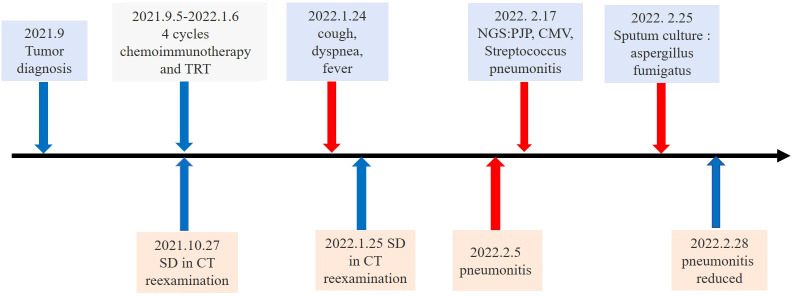
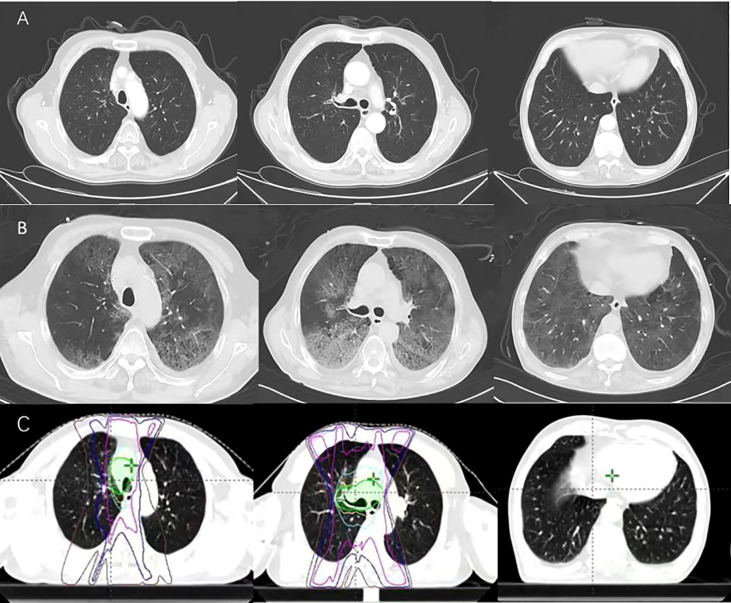
Immune-checkpoint inhibitors (ICI) targeting programmed cell death 1 (PD-1) and its ligand 1 (PD-L1) have quickly changed the treatment landscape in advanced non-small cell lung cancer. However, any patient treated with an immune checkpoint inhibitor is at risk for immune-related adverse events (irAEs). Checkpoint inhibitor pneumonitis (CIP) is a rare but potentially severe pulmonary toxicity of immunotherapy. Since the imaging features and symptoms are not specific, the diagnosis of CIP is challenging. In addition, CIP may mimic other lung diseases. Due to these characteristics, proper patient management may be delayed. So, a comprehensive understanding of imaging features is essential for a prompt detection and correct management of these drug-induced lung diseases. We presented a patient with lung squamous cell cancer who has clinical symptoms preceding imaging evidence of pneumonitis after immunotherapy and radiotherapy. We also discussed the safety of immunotherapy, the complexity and management of immune pneumonitis.
免疫检查点抑制剂(ICI)针对程序性细胞死亡 1(PD-1)及其配体 1(PD-L1),迅速改变了晚期非小细胞肺癌的治疗格局。然而,任何接受免疫检查点抑制剂治疗的患者都有发生免疫相关不良事件(irAEs)的风险。检查点抑制剂性肺炎(CIP)是一种罕见但潜在严重的免疫治疗肺毒性。由于其影像学特征和症状不具有特异性,CIP 的诊断具有挑战性。此外,CIP 可能模仿其他肺部疾病。由于这些特征,可能会延迟对患者进行适当的管理。因此,全面了解影像学特征对于及时发现和正确管理这些药物引起的肺部疾病至关重要。我们报告了一例肺鳞癌患者,该患者在免疫治疗和放疗后出现肺炎的影像学证据之前有临床症状。我们还讨论了免疫治疗的安全性、免疫性肺炎的复杂性和管理。