School of Management, Shenyang Jianzhu University, Shenyang 110168, China.
J Environ Public Health. 2022 Sep 19;2022:9721446. doi: 10.1155/2022/9721446. eCollection 2022.
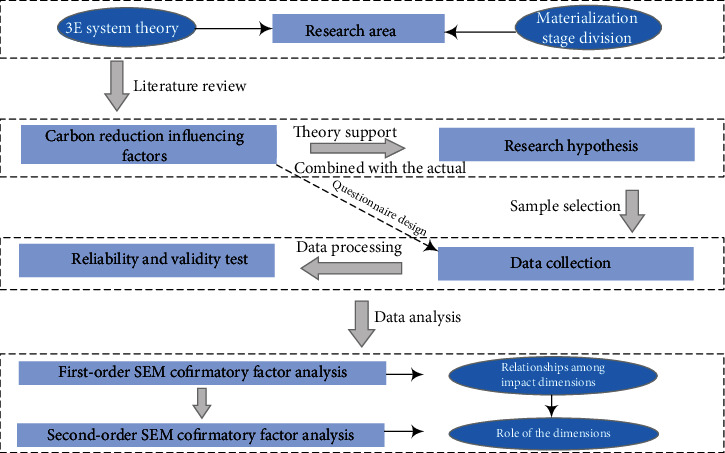
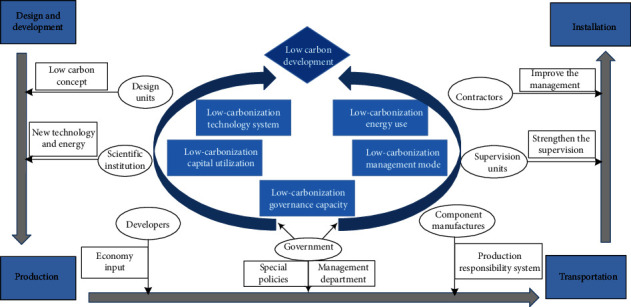
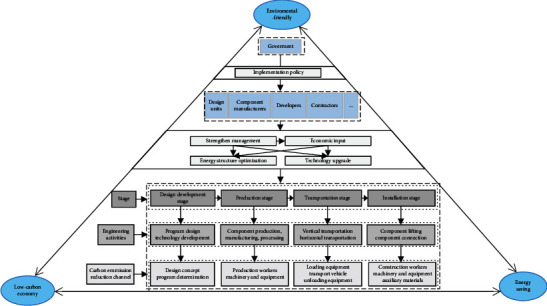
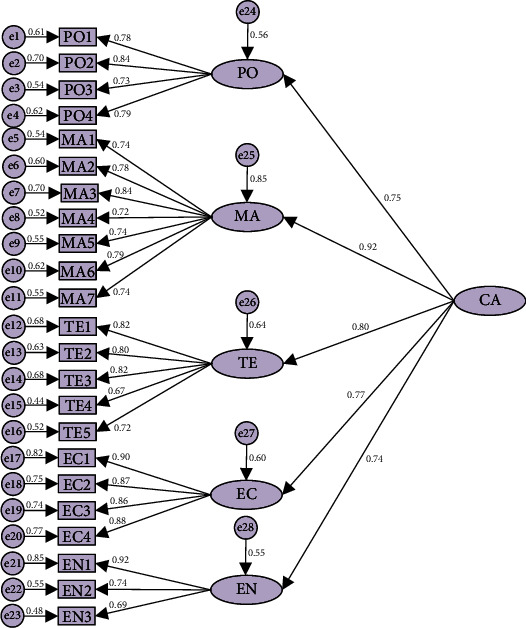
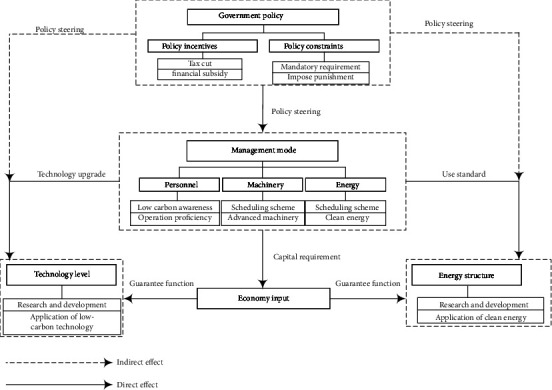
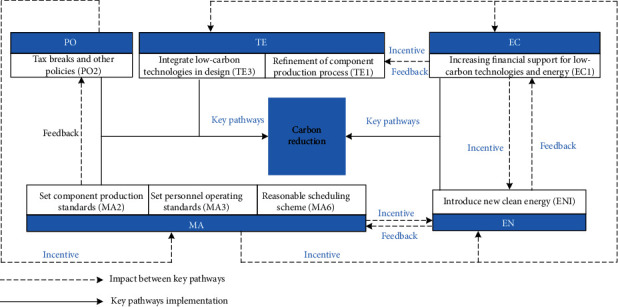
In recent years, in the process of promoting prefabricated buildings, problems such as waste of resources and energy have been present, which have seriously hindered the realization of carbon emission reduction benefits of prefabricated buildings. Especially during the materialization stage of prefabricated buildings which involves the most engineering activities and the most extensive sources of carbon emissions, it is urgent to further meet the low-carbon development of the construction industry. This study takes the 4 substages of design and development, component production, transportation, and installation during the materialization stage as the point of penetration and identifies the carbon reduction impact pathways based on the 3E (Environment-Economy-Energy) system theory in 5 dimensions: government policy, management mode, technology level, economy input, and energy structure. The data are collected through the questionnaire survey, and structural equation modeling (SEM) is utilized to examine the hypothesis and impact dimensions of the study. The results confirm that the management mode has the strongest effects on carbon emission reduction, followed by government policy, economy input, and technology level, and the energy structure has the weakest effects. This study presents the key carbon reduction pathways during the materialization stage of prefabricated buildings and provides recommendations for different participants to optimize policy guidance, strengthen management supervision, accelerate technology research and development, increase economy input, and optimize energy structure, with a view to achieving low-carbon governance capacity, management mode, technology system, capital, and energy utilization, and also enriches the theory in the field of prefabricated buildings carbon emission reduction, which can better achieve low-carbon development of prefabricated buildings.
近年来,在推广装配式建筑的过程中,存在资源能源浪费等问题,严重阻碍了装配式建筑减排效益的实现。尤其是在装配式建筑物质化阶段,涉及工程活动最多、碳排放来源最广泛,迫切需要进一步满足建筑行业低碳发展的要求。本研究以设计与开发、构件生产、运输、安装 4 个物质化阶段为切入点,基于“3E(环境-经济-能源)”系统理论,从政府政策、管理模式、技术水平、经济投入和能源结构 5 个维度识别了碳减排影响路径。通过问卷调查收集数据,并利用结构方程模型(SEM)检验研究的假设和影响维度。结果表明,管理模式对碳减排的影响最大,其次是政府政策、经济投入和技术水平,能源结构的影响最小。本研究提出了装配式建筑物质化阶段的关键碳减排路径,为不同参与者提供了优化政策引导、加强管理监督、加快技术研发、增加经济投入和优化能源结构的建议,以期实现低碳治理能力、管理模式、技术体系、资金和能源利用的提升,丰富了装配式建筑碳减排领域的理论,更好地实现装配式建筑的低碳发展。