Faculty of Psychology, University of Basel, Basel, BS, Switzerland.
REHAB Basel, Basel, BS, Switzerland.
PLoS One. 2022 Oct 5;17(10):e0274833. doi: 10.1371/journal.pone.0274833. eCollection 2022.
There is a broad range of known effects of animal contact on human mental and physical health. Neurological correlates of human interaction with animals have been sparsely investigated. We investigated changes in frontal brain activity in the presence of and during contact with a dog.
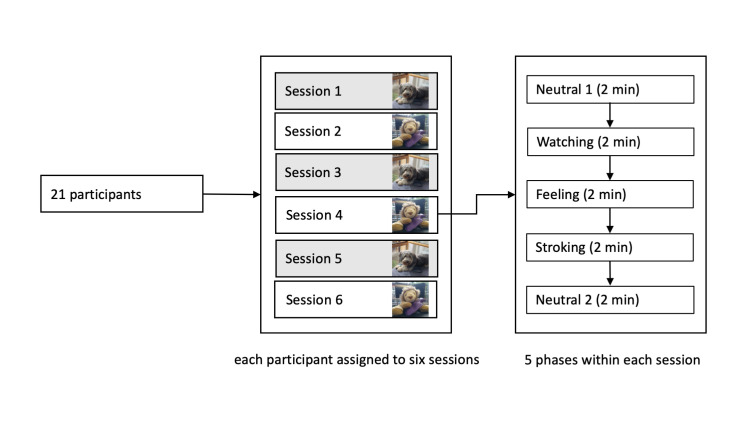
Twenty-one healthy individuals each participated in six sessions. In three sessions, participants had contact with a dog, and in three control sessions they interacted with a plush animal. Each session had five two-minute phases with increasing intensity of contact to the dog or plush animal from the first to the fourth phase. We measured oxygenated, deoxygenated, and total hemoglobin and oxygen saturation of the blood in the frontal lobe/frontopolar area with functional near-infrared spectroscopy (SenSmart Model X-100) to assess brain activity.
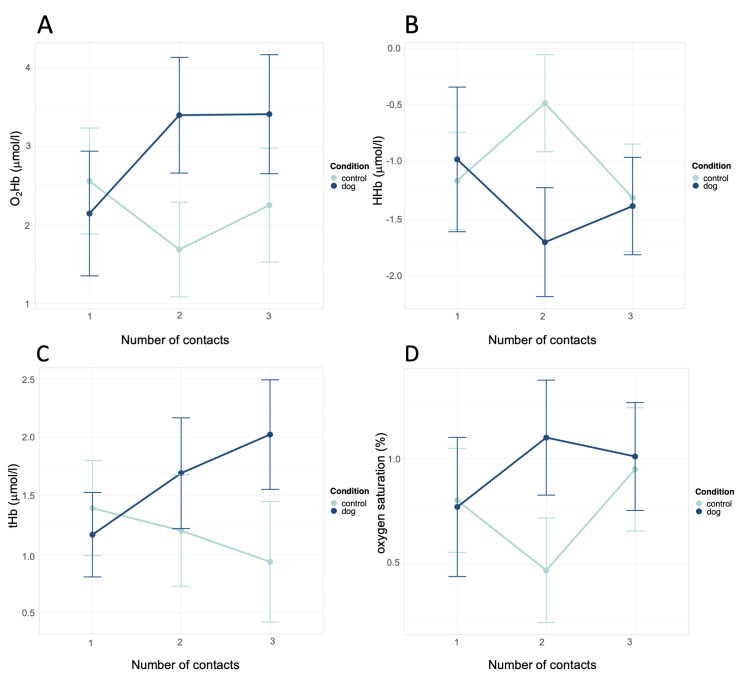
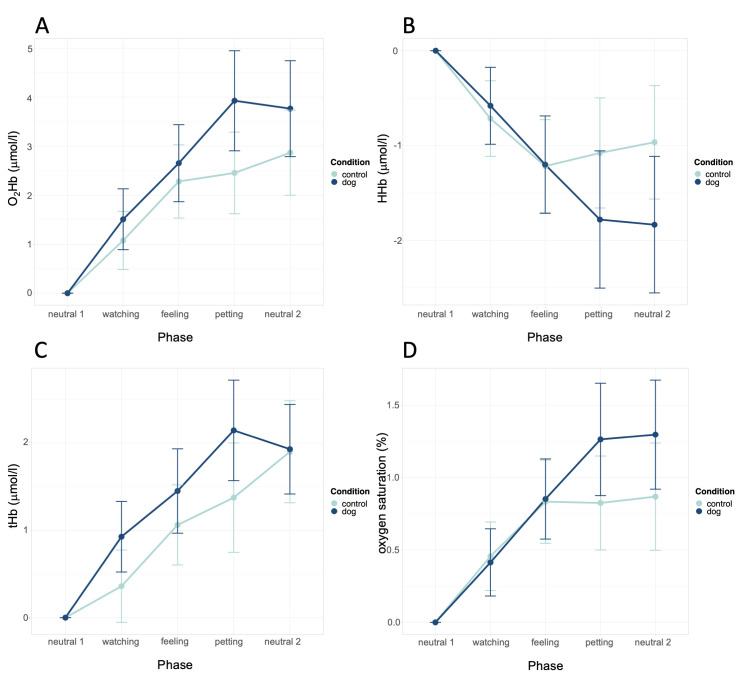
In both conditions, the concentration of oxygenated hemoglobin increased significantly from the first to the fourth phase by 2.78 μmol/l (CI = 2.03-3.53, p < .001). Oxygenated hemoglobin concentration was 0.80 μmol/l higher in the dog condition compared to in the control condition (CI = 0.27-1.33, p = .004). Deoxygenated-hemoglobin concentration, total hemoglobin concentration, and oxygen saturation showed similar patterns.
Prefrontal brain activation in healthy subjects increased with the rise in interaction closeness with a dog or a plush animal. Moreover, interaction with a dog stimulated more brain activity compared to the control condition, suggesting that interactions with a dog can activate stronger attentional processes and elicit more emotional arousal than interacting with a nonliving stimulus.
动物接触对人类身心健康有广泛的已知影响。人类与动物互动的神经相关性研究甚少。我们研究了在存在和接触狗时额叶大脑活动的变化。
21 名健康个体每人参与了六次会议。在三次会议中,参与者与狗接触,在三次对照会议中,他们与毛绒动物互动。每个会议有五个两分钟的阶段,从第一阶段到第四阶段,与狗或毛绒动物的接触强度逐渐增加。我们使用功能近红外光谱仪(SenSmart Model X-100)测量额叶/额极区域的含氧、脱氧和总血红蛋白以及血液氧饱和度,以评估大脑活动。
在两种情况下,从第一阶段到第四阶段,含氧血红蛋白的浓度分别增加了 2.78 μmol/l(CI = 2.03-3.53,p <.001)。与对照条件相比,狗条件下的含氧血红蛋白浓度高 0.80 μmol/l(CI = 0.27-1.33,p =.004)。脱氧血红蛋白浓度、总血红蛋白浓度和氧饱和度呈现出相似的模式。
健康受试者的前额叶大脑激活随着与狗或毛绒动物互动的紧密程度的增加而增加。此外,与狗的互动比对照条件刺激更多的大脑活动,这表明与狗的互动可以激活更强的注意力过程,并引起比与非生命刺激更多的情感唤醒。