Saiphoklang Narongkorn, Patanayindee Pimchanok, Ruchiwit Pitchayapa
Division of Pulmonary and Critical Care Medicine, Department of Internal Medicine, Faculty of Medicine, Thammasat University, Bangkok, Thailand.
Crit Care Res Pract. 2022 Sep 26;2022:9972846. doi: 10.1155/2022/9972846. eCollection 2022.
Lung fibrosis is a sequela of COVID-19 among patients with severe pneumonia. Idiopathic pulmonary fibrosis and lung fibrosis due to COVID-19 may share many similar features. There are limited data on effects of antifibrotic treatment of infection-related lung fibrosis. This study aimed to evaluate the effect of nintedanib on patients' post-COVID-19 lung fibrosis.
A retrospective, matched case-control study was performed on hospitalized patients with COVID-19 pneumonia. Patients who received nintedanib treatment for COVID-19 pulmonary fibrosis (nintedanib group) were compared to patients with standard treatment (control group). The primary outcome was oxygen improvement. The secondary outcomes were chest X-ray improvement, SpO/FiO ratio improvement, mortality rates at 60 days, and adverse events.
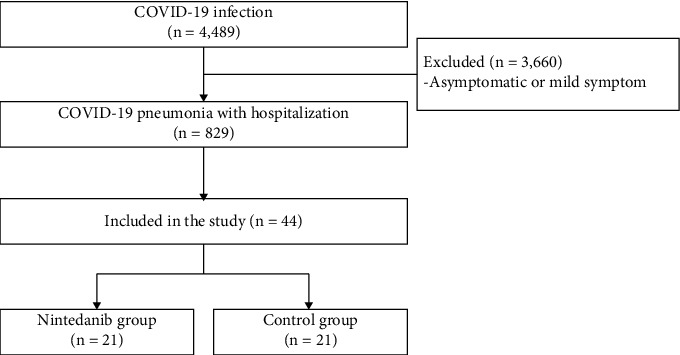
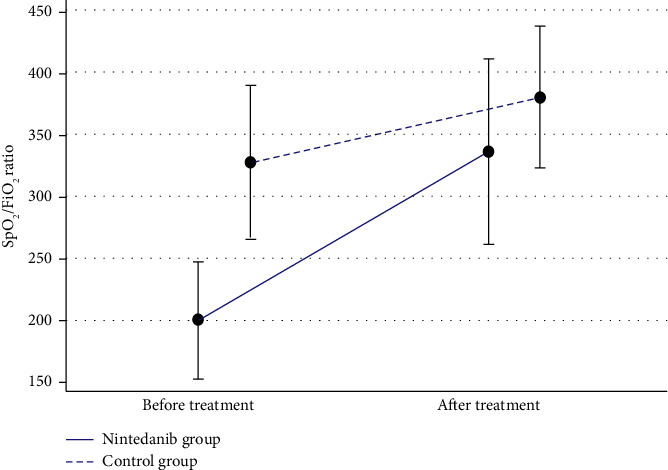
A total of 42 patients with COVID-19 pneumonia were included (21 in each group). Mean age was 64.43 ± 14.59 years, and 54.8% were men. At baseline, SpO/FiO ratio before treatment was 200.57 ± 105.77 in the nintedanib group and 326.90 ± 137.10 in the control group ( = 0.002). Oxygen improvement and chest X-ray improvement were found in 71.4% and 71.4% in the nintedanib group and in 66.7% and 66.7% in the control group ( = 0.739). The nintedanib group had more improvement in SpO/FiO ratio than in the control group (144.38 ± 118.05 vs 55.67 ± 75.09, = 0.006). The 60-day mortality rates of the nintedanib and the control groups were 38.1% vs 23.8%, = 0.317. Hepatitis and loss of appetite were common adverse events (9.5% and 9.5%), while the incidence of diarrhea was 4.8%.
Nintedanib as add-on treatment in post-COVID-19 lung fibrosis did not improve oxygenation, chest X-ray findings, or the 60-day mortality. However, this antifibrotic drug improved SpO/FiO ratio in our patients. Further randomized controlled trials are needed to determine the efficacy of nintedanib for treatment of patients with post-COVID-19 lung fibrosis. . This study was registered in TCTR20220426001.
肺纤维化是重症肺炎型新型冠状病毒肺炎(COVID-19)患者的后遗症。特发性肺纤维化和COVID-19所致肺纤维化可能有许多相似特征。关于抗纤维化治疗对感染相关性肺纤维化的影响的数据有限。本研究旨在评估尼达尼布对COVID-19后肺纤维化患者的疗效。
对COVID-19肺炎住院患者进行一项回顾性匹配病例对照研究。将接受尼达尼布治疗COVID-19肺纤维化的患者(尼达尼布组)与接受标准治疗的患者(对照组)进行比较。主要结局是氧合改善。次要结局是胸部X线改善、动脉血氧分压/吸入氧浓度(SpO₂/FiO₂)比值改善、60天死亡率和不良事件。
共纳入42例COVID-19肺炎患者(每组21例)。平均年龄为64.43±14.59岁,54.8%为男性。基线时,尼达尼布组治疗前的SpO₂/FiO₂比值为200.57±105.77,对照组为326.90±137.10(P = 0.002)。尼达尼布组氧合改善和胸部X线改善的比例分别为71.4%和71.4%,对照组分别为66.7%和66.7%(P = 0.739)。尼达尼布组的SpO₂/FiO₂比值改善程度高于对照组(144.38±118.05 vs 55.67±75.09,P = 0.006)。尼达尼布组和对照组的60天死亡率分别为38.1%和23.8%,P = 0.317。肝炎和食欲减退是常见不良事件(9.5%和9.5%),腹泻发生率为4.8%。
尼达尼布作为COVID-19后肺纤维化的附加治疗,并未改善氧合、胸部X线表现或60天死亡率。然而,这种抗纤维化药物改善了我们患者的SpO₂/FiO₂比值。需要进一步的随机对照试验来确定尼达尼布治疗COVID-19后肺纤维化患者的疗效。本研究已在泰国临床试验注册中心(TCTR)注册,注册号为TCTR20220426001。