Pidgeon Justine H, Bhardwaj Mahesh K, Titterington Patrick, Latulippe Karen, Roh Shiyoung, Ramsey David J
New England College of Optometry, Boston, MA, USA.
Department of Surgery, Division of Ophthalmology, Lahey Hospital & Medical Center, Peabody, MA, USA.
Ther Adv Ophthalmol. 2022 Sep 29;14:25158414221123526. doi: 10.1177/25158414221123526. eCollection 2022 Jan-Dec.
The emergence of coronavirus disease 2019 (COVID-19) forced many eye care providers to implement telehealth services while in-person visits were reserved for essential and/or emergency eye care.
This study documents how an optometry group successfully implemented telehealth to care for patients during the outbreak of the COVID-19 pandemic in the United States.
Retrospective, comparative case series.
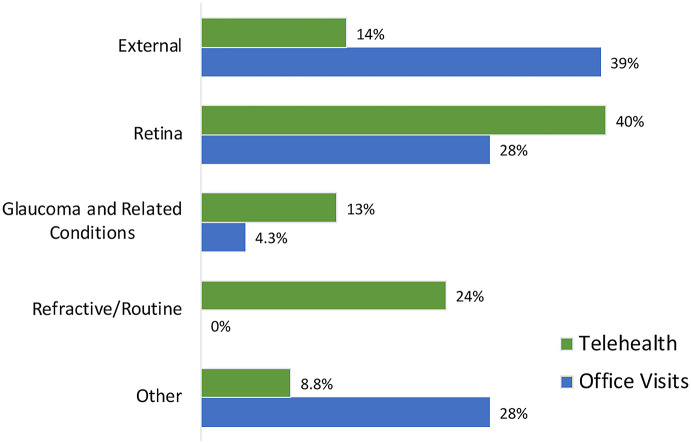
Records were reviewed for patients seen in an academic optometry clinic from 23 March through 7 April 2020, the period of the Massachusetts stay-at-home advisory issued in response to COVID-19. Patients who completed telehealth visits were compared with those who received in-person care. Services delivered by telehealth included a check of symptoms, medication refills, health education, and assurance of future follow up. The study took into account the reason for each visit, as well as the rate of scheduled and completed follow-up appointments. Patient satisfaction with in-person care was evaluated by Press Ganey patient experience surveys.
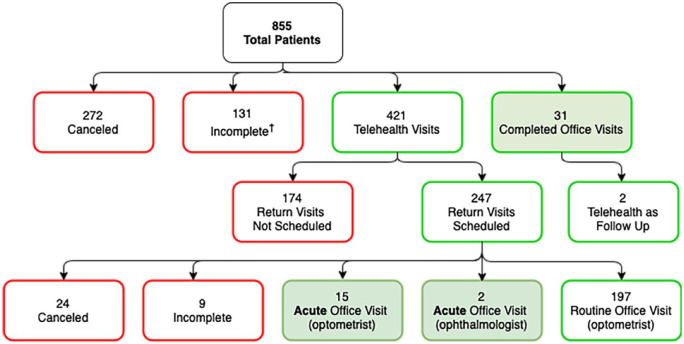
Out of 855 patients scheduled, 421 patients completed telehealth encounters (49%), and 46 patients completed in-clinic visits (5.4%). A further 272 patients canceled appointments (32%), 123 patients were unable to be contacted (14%), and 8 patients declined care offered by telehealth (0.94%). Most patients who were cared for by telehealth returned to see optometrists (88%). By contrast, most patients who required in-person visits during this period were subsequently seen by ophthalmologists (58%, < 0.001). Patient satisfaction remained high for in-person visits that took place during the COVID-19-related emergency, with improvements noted in patient satisfaction regarding 'information about delays' (47 % versus 100%, = 0.007) and 'concern for questions or worries' (76% versus 100%, = 0.037) compared with the same period 1 year prior.
Optometrists rapidly embraced telehealth to deliver eye care to their patients during the COVID-19 public health emergency. Most eye issues were able to be addressed through telehealth; urgent eye problems were triaged and referred to the optometry clinic, when appropriate.
2019年冠状病毒病(COVID-19)的出现迫使许多眼科护理提供者实施远程医疗服务,而面对面就诊则保留用于必要和/或紧急眼科护理。
本研究记录了一个验光小组在美国COVID-19大流行爆发期间如何成功实施远程医疗来为患者提供护理。
回顾性、比较性病例系列研究。
对2020年3月23日至4月7日在一家学术验光诊所就诊的患者记录进行审查,这是马萨诸塞州因应对COVID-19发布居家建议的时期。将完成远程医疗就诊的患者与接受面对面护理的患者进行比较。通过远程医疗提供的服务包括症状检查、药物续方、健康教育以及对未来随访的保证。该研究考虑了每次就诊的原因以及预约和完成随访预约的比例。通过Press Ganey患者体验调查评估患者对面对面护理的满意度。
在855名预约患者中,421名患者完成了远程医疗会诊(49%),46名患者完成了门诊就诊(5.4%)。另有272名患者取消了预约(32%),123名患者无法取得联系(14%),8名患者拒绝了远程医疗提供的护理(0.94%)。大多数接受远程医疗护理的患者后来又回来找验光师(88%)。相比之下,在此期间需要面对面就诊的大多数患者随后由眼科医生诊治(58%,P<0.001)。在与COVID-19相关的紧急情况期间进行的面对面就诊中,患者满意度仍然很高,与1年前同期相比,患者对“延误信息”(47%对100%,P=0.007)和“对问题或担忧的关注”(76%对100%,P=0.037)的满意度有所提高。
在COVID-19公共卫生紧急情况期间,验光师迅速采用远程医疗为患者提供眼科护理。大多数眼部问题能够通过远程医疗解决;紧急眼部问题经过分类,并在适当时转诊至验光诊所。