Jung Yee Rin, Chu Byoung Sun
School of Optometry and Vision Science, Daegu Catholic University, Gyeongsan-si, Republic of Korea.
Clin Optom (Auckl). 2024 Dec 14;16:309-316. doi: 10.2147/OPTO.S491431. eCollection 2024.
The use of mobile phone applications (apps) in the health sector, including in eye care, is increasing. This study aimed to compare interpupillary distance (IPD) measurements using common clinical techniques (pupillometer, PD ruler, and autorefractor), which are contact procedures, with measurements from a non-contact mobile phone application.
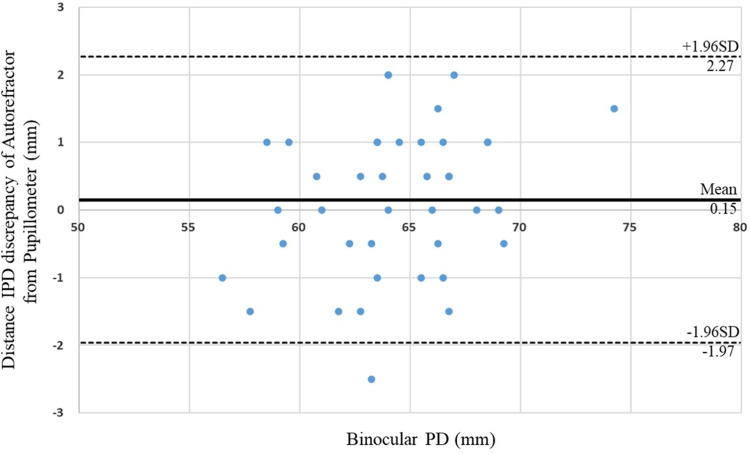
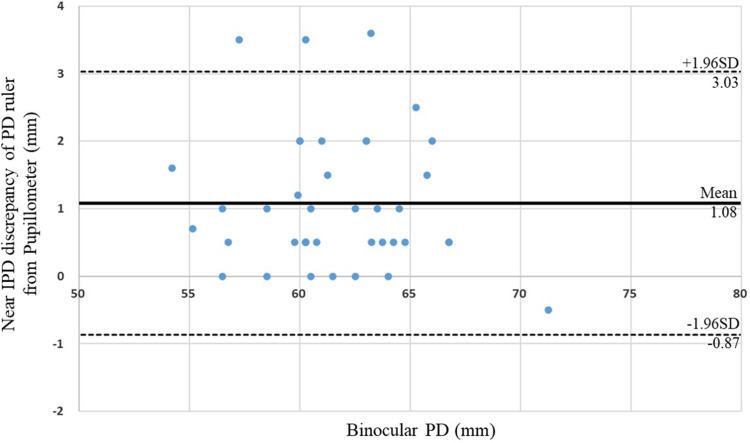
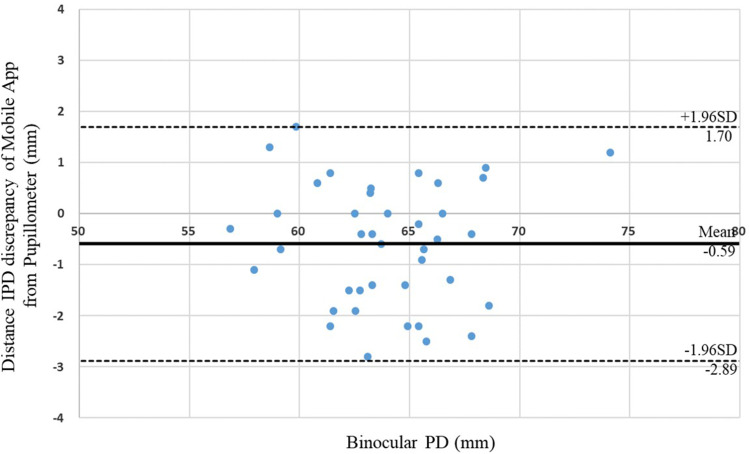
Forty participants were recruited (mean age 25.65±3.72 years, 21 male and 19 female). Binocular distance and near IPD measurements from four instruments were compared: pupillometer (TOPCON PD-5, Japan), PD ruler, auto-refractor (KR-8100P, TOPCON, Japan), and Mobile Application (Eye Measure, 1.22). Two consecutive measurements were performed. The pupillometer measurement was used as the gold standard measurement for the Bland-Altman analysis, and two analyses were conducted: repeated measures ANOVA and Bland- Altman plots to analyze mean differences (MD) and 95% confidence intervals (CI) calculated as MD±1.96* standard deviation (SD).
The measurement method affected IPD distance (F(3, 117)=15.74, p<0.01). The mobile apps resulted in significantly smaller distance IPD measurements than other methods. The PD ruler method yielded significantly larger distance IPD measurements than the pupillometer. For binocular near IPD, there was a significant difference among the methods (F(2, 78)=15.06, p<0.01). Pairwise comparison revealed that IPD ruler measurement was greater than with the other two methods (pupillometer and mobile application), while no difference was found between the pupillometer and mobile application. For consistency of measurement, correlation of two consecutive measurements was carried out, and it was found to be strongly correlated for all methods (r=0.9; p.<01).
Measurement by different tools showed difference of IPD measurement although induced prism due to discrepancy were within the allowed tolerance of less than 0.33 prism diopter (ISO 16034:2002) for all methods. Therefore, mobile App can be efficiently used for screening purposes for many people where limited services are available. However, caution should be exercised when mobile apps are used, such as in complex and for eyes which are misaligned.
手机应用程序(应用)在包括眼科护理在内的医疗领域的使用正在增加。本研究旨在比较使用常见临床技术(瞳孔计、瞳距尺和自动验光仪)进行的瞳孔间距(IPD)测量(这些都是接触式操作)与使用非接触式手机应用程序进行的测量。
招募了40名参与者(平均年龄25.65±3.72岁,男性21名,女性19名)。比较了四种仪器的双眼距离和近IPD测量结果:瞳孔计(日本拓普康PD - 5)、瞳距尺、自动验光仪(日本拓普康KR - 8100P)和手机应用程序(Eye Measure,1.22版)。进行了连续两次测量。瞳孔计测量结果用作Bland - Altman分析的金标准测量,进行了两项分析:重复测量方差分析和Bland - Altman图,以分析平均差异(MD)和95%置信区间(CI),计算方法为MD±1.96×标准差(SD)。
测量方法影响IPD距离(F(3, 117)=15.74,p<0.01)。手机应用程序得出的IPD测量距离明显小于其他方法。瞳距尺方法得出的IPD测量距离明显大于瞳孔计。对于双眼近IPD,各方法之间存在显著差异(F(2, 78)=15.06,p<0.01)。两两比较显示,瞳距尺测量结果大于其他两种方法(瞳孔计和手机应用程序),而瞳孔计和手机应用程序之间未发现差异。为了测量的一致性,对连续两次测量进行了相关性分析,发现所有方法的相关性都很强(r = 0.9;p<0.01)。
尽管由于差异导致的诱导棱镜在所有方法中都在允许的公差范围内(小于0.33棱镜度,ISO 16034:2002),但不同工具的测量显示出IPD测量的差异。因此,在服务有限的情况下,手机应用程序可有效地用于许多人的筛查目的。然而,在使用手机应用程序时应谨慎,例如在复杂情况和眼睛存在斜视时。