Singh Jagjeet, Sanghavi Paulomi, Mallik Roop
Department of Biological Sciences, Tata Institute of Fundamental Research, Mumbai, India.
Department of Biosciences and Bioengineering, Indian Institute of Technology Bombay, Mumbai, India.
Front Cell Dev Biol. 2022 Sep 19;10:893375. doi: 10.3389/fcell.2022.893375. eCollection 2022.
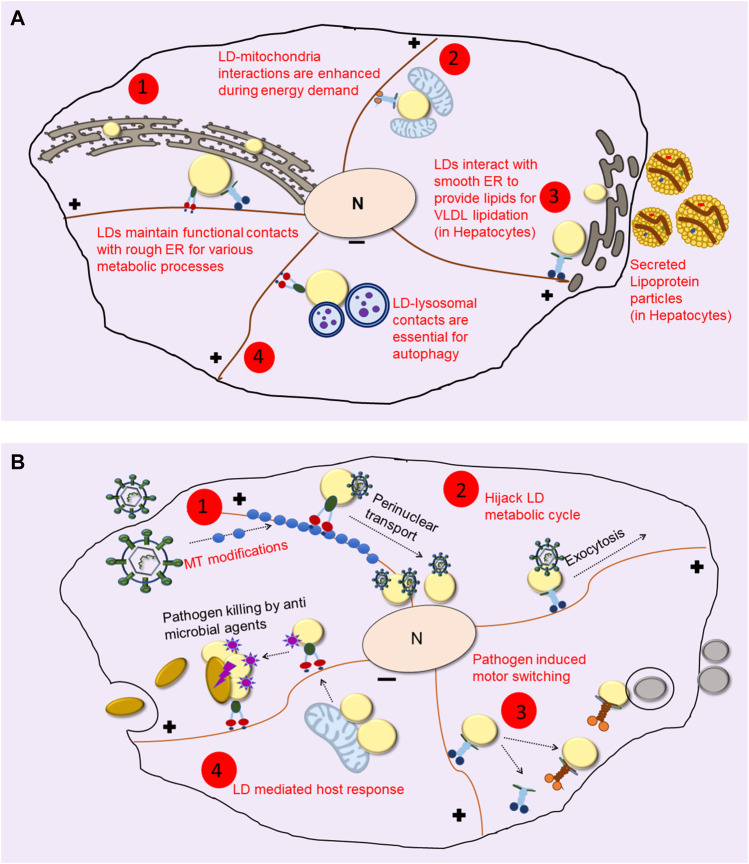
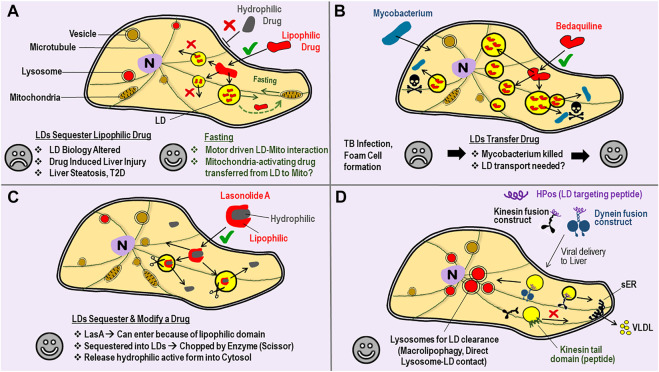
Lipid Droplets (LDs) are evolutionarily conserved cellular organelles that store neutral lipids such as triacylglycerol and cholesterol-esters. Neutral lipids are enclosed within the limiting membrane of the LD, which is a monolayer of phospholipids and is therefore fundamentally different from the bilayer membrane enclosing most other organelles. LDs have long been viewed as a storehouse of lipids needed on demand for generating energy and membranes inside cells. Outside this classical view, we are now realizing that LDs have significant roles in protein sequestration, supply of signalling lipids, viral replication, lipoprotein production and many other functions of important physiological consequence. To execute such functions, LDs must often exchange lipids and proteins with other organelles (e.g., the ER, lysosomes, mitochondria) physical contacts. But before such exchanges can occur, how does a micron-sized LD with limited ability to diffuse around find its cognate organelle? There is growing evidence that motor protein driven motion of LDs along microtubules may facilitate such LD-organelle interactions. We will summarize some aspects of LD motion leading to LD-organelle contacts, how these change with metabolic state and pathogen infections, and also ask how these pathways could perhaps be targeted selectively in the context of disease and drug delivery. Such a possibility arises because the binding of motor proteins to the monolayer membrane on LDs could be different from motor binding to the membrane on other cellular organelles.
脂滴(LDs)是进化上保守的细胞器,储存三酰甘油和胆固醇酯等中性脂质。中性脂质被包裹在脂滴的限制膜内,该限制膜是单层磷脂,因此与包裹大多数其他细胞器的双层膜有根本区别。长期以来,脂滴一直被视为细胞内按需产生能量和膜所需脂质的储存库。除了这种传统观点外,我们现在意识到脂滴在蛋白质隔离、信号脂质供应、病毒复制、脂蛋白产生以及许多其他具有重要生理意义的功能中发挥着重要作用。为了执行这些功能,脂滴通常必须与其他细胞器(如内质网、溶酶体、线粒体)进行脂质和蛋白质的交换及物理接触。但在这种交换发生之前,一个扩散能力有限的微米级脂滴如何找到其同源细胞器呢?越来越多的证据表明,驱动蛋白沿微管驱动脂滴运动可能促进脂滴与细胞器的相互作用。我们将总结导致脂滴与细胞器接触的脂滴运动的一些方面,这些方面如何随代谢状态和病原体感染而变化,还会探讨在疾病和药物递送背景下这些途径如何可能被选择性靶向。出现这种可能性是因为驱动蛋白与脂滴上的单层膜结合可能与驱动蛋白与其他细胞器膜的结合不同。