Department of Biomedical Engineering, King's College London, 1 Lambeth Palace Rd, London, SE1 7EU, UK.
Division of Cardiovascular Medicine, Radcliffe Department of Medicine, University of Oxford, Oxford, UK.
Int J Cardiovasc Imaging. 2022 Dec;38(12):2695-2705. doi: 10.1007/s10554-022-02724-7. Epub 2022 Oct 6.
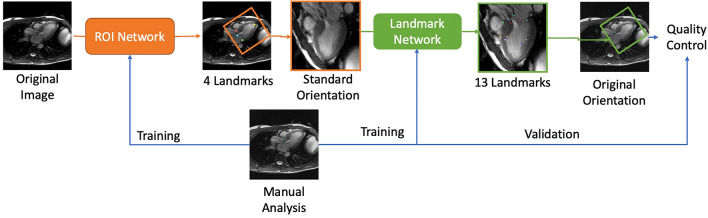
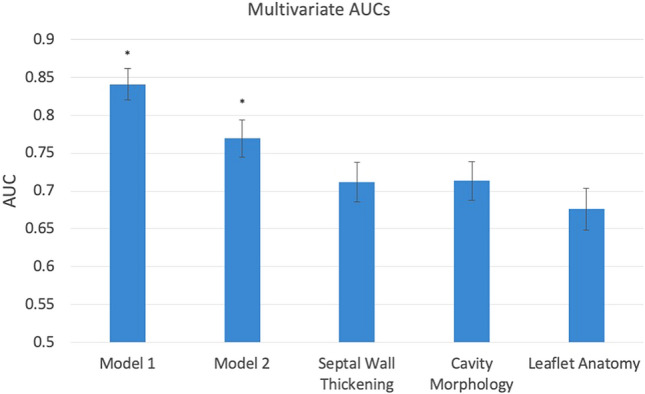
Left ventricular outflow tract obstruction (LVOTO) is common in hypertrophic cardiomyopathy (HCM), but relationships between anatomical metrics and obstruction are poorly understood. We aimed to develop machine learning methods to evaluate LVOTO in HCM patients and quantify relationships between anatomical metrics and obstruction. This retrospective analysis of 1905 participants of the HCM Registry quantified 11 anatomical metrics derived from 14 landmarks automatically detected on the three-chamber long axis cine CMR images. Linear and logistic regression was used to quantify strengths of relationships with the presence of LVOTO (defined by resting Doppler pressure drop of > 30 mmHg), using the area under the receiver operating characteristic (AUC). Intraclass correlation coefficients between the network predictions and three independent observers showed similar agreement to that between observers. The distance from anterior mitral valve leaflet tip to basal septum (AML-BS) was most highly correlated with Doppler pressure drop (R = 0.19, p < 10). Multivariate stepwise regression found the best predictive model included AML-BS, AML length to aortic valve diameter ratio, AML length to LV width ratio, and midventricular septal thickness metrics (AUC 0.84). Excluding AML-BS, metrics grouped according to septal hypertrophy, LV geometry, and AML anatomy each had similar associations with LVOTO (AUC 0.71, 0.71, 0.68 respectively, p = ns), significantly less than their combination (AUC 0.77, p < 0.05 for each). Anatomical metrics derived from a standard three-chamber CMR cine acquisition can be used to highlight risk of LVOTO, and suggest further investigation if necessary. A combination of geometric factors is required to provide the best risk prediction.
左心室流出道梗阻(LVOTO)在肥厚型心肌病(HCM)中很常见,但解剖学指标与梗阻之间的关系尚不清楚。我们旨在开发机器学习方法来评估 HCM 患者的 LVOTO 并量化解剖学指标与梗阻之间的关系。这项对 HCM 登记处 1905 名参与者的回顾性分析,使用来自自动检测的 14 个标记的三个心腔长轴电影 CMR 图像,量化了 11 个解剖学指标。线性和逻辑回归用于量化存在 LVOTO(定义为休息时多普勒压力降> 30mmHg)与解剖学指标之间的关系强度,使用接收者操作特征曲线下的面积(AUC)。网络预测与三个独立观察者之间的组内相关系数表明,与观察者之间的一致性相似。前二尖瓣叶尖端到基底部间隔(AML-BS)与多普勒压力降的相关性最高(R = 0.19,p < 10)。多变量逐步回归发现,最佳预测模型包括 AML-BS、AML 长度与主动脉瓣直径比、AML 长度与 LV 宽度比以及中隔厚度指标(AUC 0.84)。排除 AML-BS 后,根据间隔肥厚、LV 几何形状和 AML 解剖分组的指标与 LVOTO 具有相似的相关性(AUC 分别为 0.71、0.71 和 0.68,p = ns),显著低于其组合(AUC 0.77,p < 0.05)。来自标准三腔 CMR 电影采集的解剖学指标可用于突出 LVOTO 的风险,如果有必要,还可以进一步调查。需要组合几何因素以提供最佳风险预测。