Department of Biology, University of Konstanz, 78457, Konstanz, Germany.
Argentine Dryland Research Institute of the National Scientific and Technical Research Council (IADIZA-CONICET), 5500, Mendoza, Argentina.
Nat Commun. 2022 Oct 6;13(1):5893. doi: 10.1038/s41467-022-33319-4.
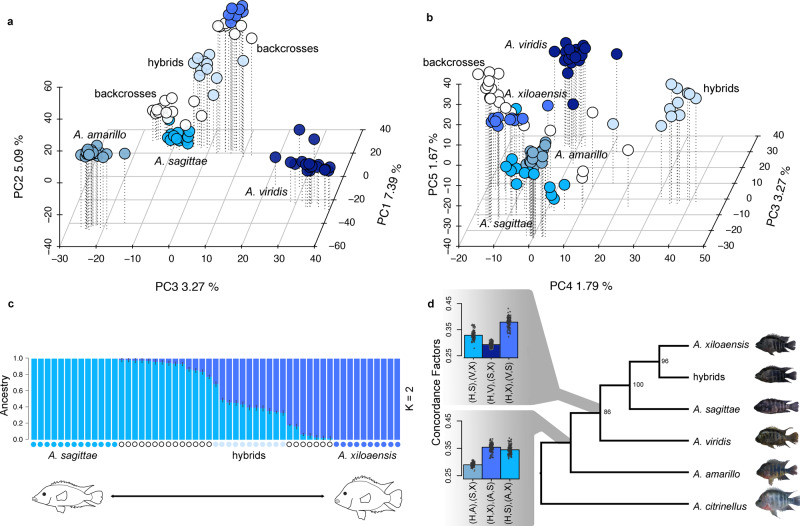
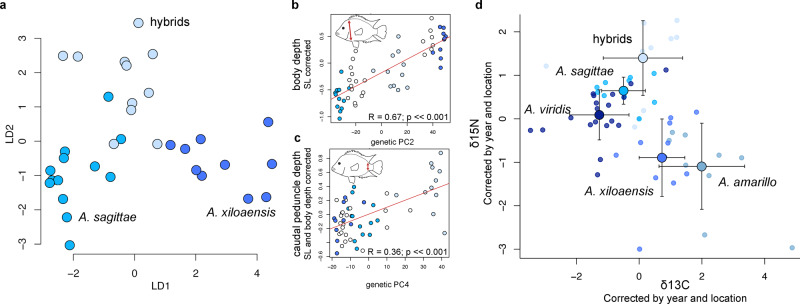
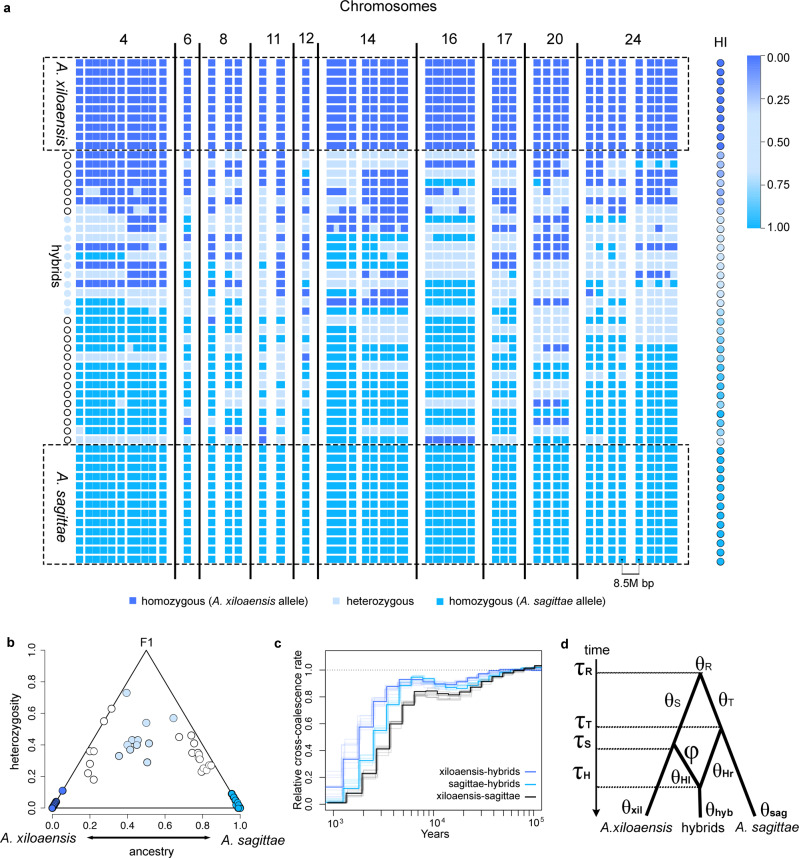
Homoploid hybrid speciation (i.e., hybrid speciation without a change in ploidy) has traditionally been considered to be rare in animals. Only few accepted empirical examples of homoploid hybrid speciation in nature exist, and in only one previous case (insects) was it convincingly shown that this process occurred in complete sympatry. Here, we report an instance of sympatric homoploid hybrid speciation in Midas cichlid fishes in Crater Lake Xiloá, Nicaragua. The hybrid lineage, albeit at an early stage of speciation, has genomically and phenotypically diverged from both of its two parental species. Together with a distinct stable isotope signature this suggests that this hybrid lineages occupies a different trophic niche compared to the other sympatric Midas cichlid species in Crater Lake Xiloá.
同倍体杂种形成(即,没有倍性变化的杂种形成)在动物中传统上被认为是罕见的。在自然界中只有少数被接受的同倍体杂种形成的实证例子,而且以前只有一个例子(昆虫)令人信服地表明这个过程是在完全同域发生的。在这里,我们报告了尼加拉瓜希洛阿火山口湖中的 Midas 慈鲷鱼类的同域同倍体杂种形成实例。尽管这个杂种谱系处于物种形成的早期阶段,但它在基因组和表型上已经与它的两个亲本物种分化开来。再加上独特的稳定同位素特征,这表明与希洛阿火山口湖中其他同域的 Midas 慈鲷物种相比,这个杂种谱系占据了不同的营养位。