Ren Li, Tu Xiaolong, Luo Mengxue, Liu Qizhi, Cui Jialin, Gao Xin, Zhang Hong, Tai Yakui, Zeng Yiyan, Li Mengdan, Wu Chang, Li Wuhui, Wang Jing, Wu Dongdong, Liu Shaojun
State Key Laboratory of Developmental Biology of Freshwater Fish, Engineering Research Center of Polyploid Fish Reproduction and Breeding of the State Education Ministry, College of Life Sciences, Hunan Normal University, Changsha 410081, China.
State Key Laboratory of Genetic Resources and Evolution, Kunming Institute of Zoology, Chinese Academy of Sciences, Kunming 650201, China.
Gigascience. 2025 Jan 6;14. doi: 10.1093/gigascience/giae117.
Genomic data have unveiled a fascinating aspect of the evolutionary past, showing that the mingling of different species through hybridization has left its mark on the histories of numerous life forms. However, the relationship between hybridization events and the origins of cyprinid fishes remains unclear.
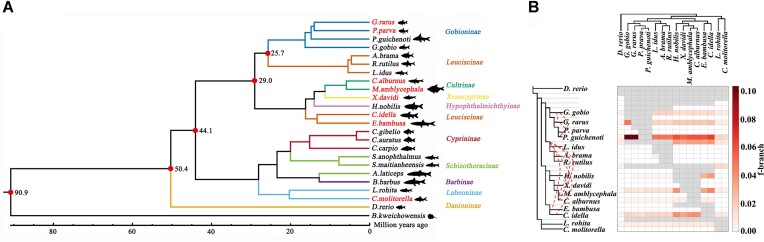
In this study, we generated de novo assembled genomes of 8 cyprinid fishes and conducted phylogenetic analyses on 24 species. Widespread allele sharing across species boundaries was observed within 7 subfamilies of cyprinid fishes. Based on a systematic analysis of multiple tissues, we found that the testis exhibited a conserved pattern of divergence between the herbivorous Megalobrama amblycephala and the carnivorous Culter alburnus, suggesting a potential link to incomplete reproductive isolation. Significant differences in the expression of 4 genes (dpp2, ctrl, psb7, and ppce) in the liver and intestine, accompanied by variations in enzyme activities, indicated swift divergence in digestive enzyme secretion. Moreover, we identified introgressed genes linked to organ development in sympatric fishes with analogous feeding habits within the Cultrinae and Leuciscinae subfamilies.
Our findings highlight the significant role played by incomplete reproductive isolation and frequent gene flow events, particularly those associated with the development of digestive organs, in driving speciation among cyprinid fishes in diverse freshwater ecosystems.
基因组数据揭示了进化历史中一个引人入胜的方面,表明不同物种通过杂交的混合在众多生命形式的历史上留下了印记。然而,杂交事件与鲤科鱼类起源之间的关系仍不清楚。
在本研究中,我们生成了8种鲤科鱼类的从头组装基因组,并对24个物种进行了系统发育分析。在鲤科鱼类的7个亚科中观察到跨物种边界的广泛等位基因共享。基于对多个组织的系统分析,我们发现草食性的团头鲂和肉食性的翘嘴鲌的睾丸表现出保守的分化模式,这表明可能与不完全生殖隔离有关。肝脏和肠道中4个基因(dpp2、ctrl、psb7和ppce)表达的显著差异,伴随着酶活性的变化,表明消化酶分泌迅速分化。此外,我们在鲤亚科和雅罗鱼亚科中具有相似食性的同域鱼类中鉴定出与器官发育相关的渗入基因。
我们的研究结果强调了不完全生殖隔离和频繁的基因流动事件,特别是那些与消化器官发育相关的事件,在驱动不同淡水生态系统中鲤科鱼类物种形成中所起的重要作用。